Hanoi (VNS/VNA) - The e-commerce market has experienced rapid growth, leading to a surge in demand for highly skilled talents.
The country’s e-commerce market surpassed 25 billion USD last year, growing by 22% year-on-year, and now accounts for approximately 9% of total retail sales in goods and consumer services.
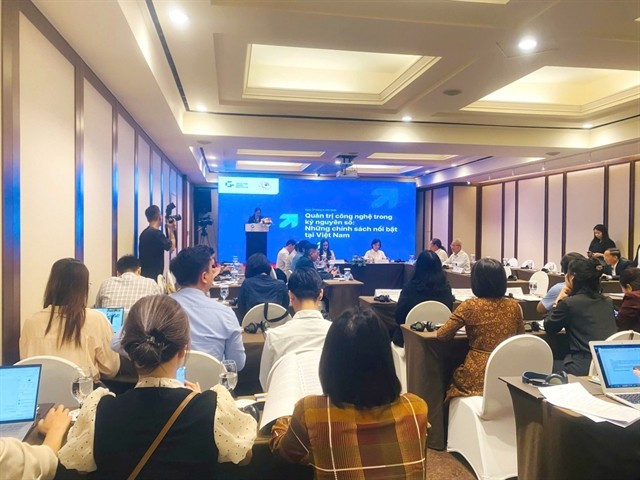
Meanwhile, the human resources for e-commerce were currently both lacking and weak, said Nguyen Huu Tuan, Director of the Centre for E-commerce and Digital Technology Development (eComDX) under the Vietnam E-commerce and Digital Economy Agency at the Ministry of Industry and Trade, at the workshop on technology management in the digital age held in Hanoi on May 27.
To solve this situation, Tuan believed that the 'on-demand' training model between the State and enterprises was a potential solution. This is a flexible model that meets market demand, providing both theoretical knowledge and focusing on practice, effectively connecting labour supply and demand.
However, for this model to operate effectively and sustainably, there needed to be clear and transparent co-ordination between the State and enterprises, he said.
Training programmes, even those 'on-demand', also needed to ensure the provision of basic knowledge and core skills, helping students adapt to the ever-changing e-commerce environment in the long term, he added.
In addition, he said that e-commerce training programmes were increasingly diverse and had positive changes thanks to the application of new technology.
Some universities have begun to integrate subjects related to new technologies into their curricula, such as AI applications in e-commerce, blockchain and cryptocurrencies, AI in finance, big data management and analysis.
The Vietnam E-commerce and Digital Economy Agency has also implemented many digital technology training programmes for businesses and local departments to raise awareness and increase capacity to apply technology to e-commerce activities.
From a domestic policy perspective, Dr Nguyen Minh Thao from the Central Institute for Economic Management (CIEM), affirmed that Vietnam has made significant progress in developing the digital economy but still faces numerous challenges, such as a shortage of digital talent, limited innovation capacity, and inconsistencies in policies to encourage R&D investment.
"To move fast and sustainably, the institutions must stay ahead of technology. We need to expand the policy experimentation space, promote sandbox models and develop soft policies to support businesses, while ensuring the safety of digital systems and managing systemic risks," Thao emphasised.
Resolution 57-NQ/TW represented a political turning point as it was the first time that digital transformation, innovation, and science and technology had been identified as three strategic breakthroughs in the country's development, she added.
The objectives have been set that by 2030, Vietnam aims to be among the top three ASEAN countries in AI research capacity and by 2045, the digital economy is expected to contribute at least 50% of GDP./.
See more
Capital sources expanded for sustainable growth
According to the State Bank of Vietnam (SBV), by the end of November 2025, outstanding green credit was estimated at around 750 trillion VND (28.55 billion USD), with an average growth rate exceeding that of overall credit in the economy.
Traceability emerges as protective shield for Vietnam’s exports
Traceability data are evolving into a critical layer of protection, helping exporters reduce tariff risks, shorten inspection times and strengthen proof of origin, thereby avoiding exclusion from formal distribution networks.
Retail market expands sharply, sustainability challenges persist
According to a report on recently released by the Ministry of Industry and Trade’s Agency for Domestic Market Surveillance and Development, the size of the market reached more than 7 quadrillion VND (about 266 billion USD) in 2025, up around 10% compared with 2024.
Vietnam eyes Israel as promising rice market under free trade deal
The Vietnam - Israel Free Trade Agreement (VIFTA), which took effect in late 2024, is poised to provide a fresh boost to agricultural exports, with rice at the forefront.
Resolution 79: State economy to lead growth
Resolution 79 is described as a “clear action declaration” by the Politburo, saying the state economy is not only responsible for maintaining macroeconomic stability, but must also become the force leading a new growth model that is green and sustainable.
Leveraging export advantages within RCEP region
In 2025, seafood exports to China alone exceeded 2.2 billion USD, up about 33% compared to 2024. Shipments to Japan fetched nearly 1.7 billion USD, a year-on-year increase of 14.6%, while those to the Republic of Korea and Australia grew by 9.6% and 3.2%, respectively.
Da Nang continues targeted investment promotion approaches
According to Chairman of the Da Nang People’s Committee Pham Duc An, the city prioritises building sustainable economic ecosystems and focuses on key breakthrough sectors with strong spillover effects, including high technology and digital transformation, logistics, urban infrastructure, finance, processing and manufacturing industries, high-tech agriculture, and the pharmaceutical and medicinal herb industry.
📝OP-ED: Resolution 79 – Launchpad for national aspirations
Resolution 79 is not only about SOEs. At a deeper level, it is about how Vietnam reorganises its development drivers in a world that is changing at breakneck speed.
UOB raises Vietnam’s 2026 GDP growth forecast to 7.5%
In 2025, Vietnam’s GDP grew by 8%, beating UOB’s forecast of 7.7% but still falling short of the Government’s target of 8.3–8.5%, which would have needed an extraordinary boost in the final quarter.
Reference exchange rate up 4 VND on January 10
With the current trading band of +/- 5%, the ceiling rate applicable for commercial banks during the day is 26,388 VND/USD, and the floor rate 23,874 VND/USD.
Infrastructure key to unlocking tourism’s role in double-digit growth target
With transport links running smoothly, urban infrastructure upgraded and digital platforms built out in a more systematic way, tourism would move beyond a purely consumption-driven sector to become a deeper, more durable engine of growth.
Hyundai sales in Vietnam rise almost 23% in December
In 2025, sales reached 53,229 vehicles across the market, a result considered a testament to the efforts by TC Group, Hyundai Thanh Cong, and the entire Hyundai dealership network nationwide amidst a volatile market.
Da Nang approves plan key infrastructure developers at FTZ
The Da Nang FTZ is expected to contribute 17.9% to the city’s gross regional domestic product and create 127,000 jobs by 2040, with total investment needs estimated at 40 trillion VND (1.6 billion USD).
HCM City accelerates shift toward ecological urban agriculture
The city’s agricultural sector is undergoing a strong transformation, restructuring toward higher value-added and sustainable development. In recent years, the sector has maintained steady growth, with agricultural, forestry and fisheries output rising by an estimated 2.5% annually.
Vietnam records biggest trade surplus with Netherlands among European partners
Vietnam’s exports to the Netherlands totalled 13.5 billion USD last year, up 3.7% compared to 2024, while imports stood at 825 million USD, rising 5.2%.
Footwear-leather industry seeks new drivers to sustain growth
Vietnam currently ranks third globally in footwear production, with around 1.4 billion pairs manufactured annually, behind China and India, and second in exports with approximately 1.3 billion pairs a year.
Sunpro - Ben Tre wind power plant becomes operational in Vinh Long
The plant features seven turbines and has a total investment of about 1.6 trillion VND (60.9 million USD), expected to generate 89.5 GWh per year, enough to supply electricity for about 27,000 households.
Dong Nai to launch major projects ahead of 14th National Party Congress
The launch of work on these projects represents an important political event for the province as they demonstrate the strong commitment of the entire political system to developing a comprehensive and modern infrastructure network, enhancing inter-regional connectivity, and addressing social welfare needs.
PM orders sharp cut in State-funded projects, caps 2026–2030 total at 3,000
For 2026, the Government has allocated nearly 995.35 trillion VND in state budget investment, with about 85.6% already assigned as of January 7.
Lam Dong ready for nationwide economic census 2026
The entire process needs to reassure respondents that statistical activities operate independently, information is protected under the Statistics Law, and all data collection is completely separate from tax management.