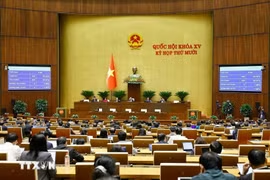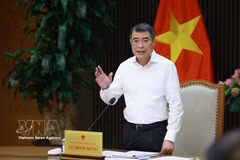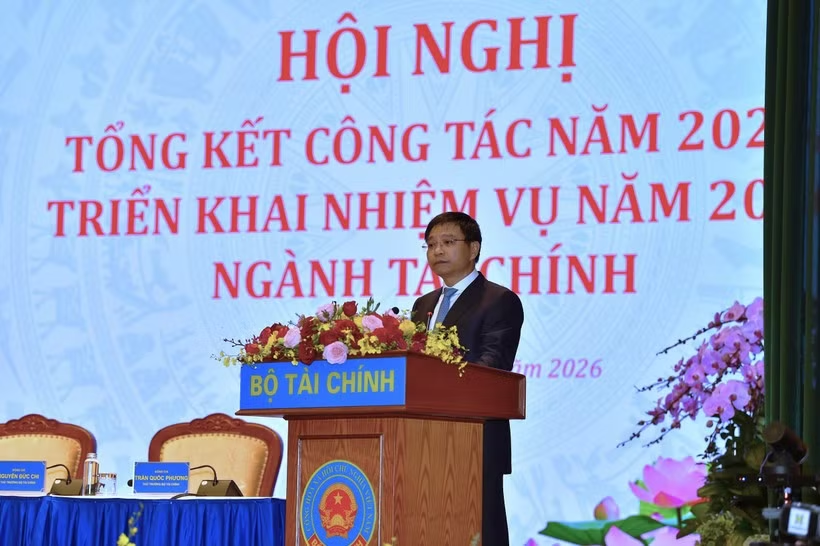
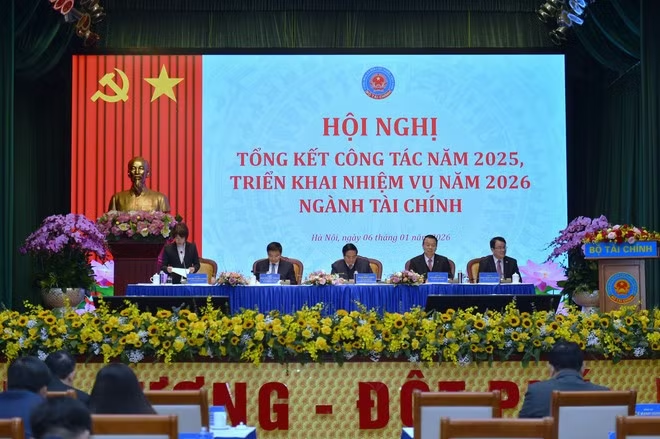
Hanoi (VNA) – Addressing a nationwide online conference reviewing the State budget and financial performance in 2025 and setting priorities for this year on January 6, Minister of Finance Nguyen van Thang declared the sector’s determination to press ahead with institutional reform, signalling readiness for double-digit growth next year.
Summing up 2025, the Ministry of Finance reported that State budget revenues exceeded projections by nearly 35%, while GDP growth reached about 8%.
A year of strong gains
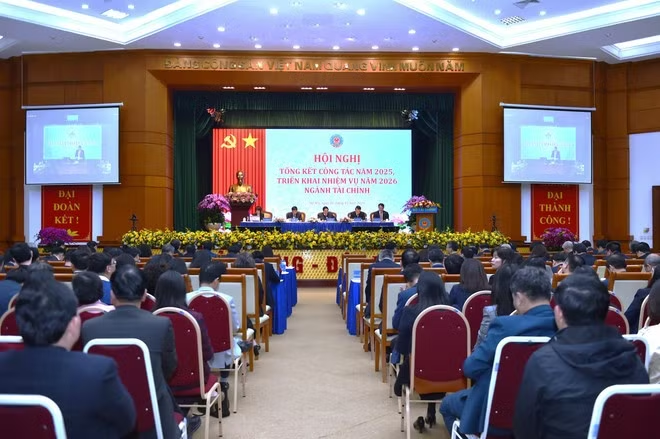
Opening the conference, linked to 33 locations across the country, the minister reflected on a year marked by challenges “beyond forecasts”, including volatility in global financial markets and the severe toll of natural disasters and climate change.
Despite the global headwinds, GDP per capita surpassed the 5,000 USD threshold, 1.4 times higher than in 2020. Vietnam has entered the ranks of upper-middle-income countries, underscoring a robust recovery following the pandemic and geopolitical turbulence.
Operating within an expansionary fiscal framework last year, the ministry accepted reduced revenues in the short term to nurture future growth. It proactively proposed packages of tax, fee, and land-rent exemptions, reductions, and deferrals worth nearly 251 trillion VND (approximately 9.64 billion USD). The measures served as a timely lifeline for businesses and households navigating difficult conditions.
At the same time, administrative streamlining and tighter control of recurrent expenditure enabled greater resources to be channelled towards development investment. As a result, development spending accounted for 32 – 33% of total State budget expenditure, facilitating the timely completion of major infrastructure projects, notably 3,345 kilometres of expressway.
According to the ministry’s report, total State budget revenue as of December 31, 2025, reached an estimated 2.65 quadrillion VND, nearly 35% above projections and up 30.3% year on year, despite the extensive tax relief measures.
Institutional restructuring also saw a 37% reduction in administrative units from the central to the local levels. While acknowledging the significant pressures involved, Thang maintained that the smooth functioning of the newly reorganised system demonstrated both sound policy judgement and strong political resolve.
Setting the course for 2026
Much of the conference focused on challenges and priorities for 2026, the first year of implementing the Resolution of the 14th National Party Congress.
The minister candidly acknowledged outstanding difficulties, including the considerable task of steering fiscal policy to mobilise total social investment equivalent to around 40% of GDP. Achieving economic growth of 10% or higher in 2026, as set by the National Assembly and Government, will require what he described as “breakthroughs in thinking and institutions”.
The ministry intends to accelerate decentralisation, guided by the principle that “localities decide, localities implement, and localities take responsibility”. The aim is to remove bottlenecks, unlock financial resources for development, and attract high-quality capital flows into emerging sectors such as semiconductors, artificial intelligence, and international financial centres.
A bright spot anticipated in 2026 is the continued upgrading of Vietnam’s stock market. Following its elevation by FTSE Russell in 2025 to secondary emerging market status, the priority now is to maintain stability and transparency while expanding modern financial products. With market capitalisation nearing 78% of GDP, the stock market is increasingly establishing itself as one of the economy’s principal channels for capital mobilisation.
For 2026, the ministry has set a State budget revenue target of more than 2.52 quadrillion VND, representing a 28.6% increase compared with the 2025 estimate. The budget deficit is to be contained at 4.2% of GDP, safeguarding national financial security as the country pursues its ambitious growth agenda./.