German executive recommends Vietnam shift to innovation-driven growth

To maintain its edge, Vietnam must accelerate regulatory and governance reforms, increase investment in research and development, strengthen its capacity to manage risks, and ensure more efficient cross-border financial connectivity, said German banking executive Jens Ruebbert.

Jens Ruebbert, Asia-Pacific Regional Head of Landesbank Baden-Württemberg (LBBW) and Chairman of the EU–ASEAN Business Council (Photo published VNA)

Berlin (VNA) – Vietnam must move beyond manufacturing-led growth and make innovation a key economic driver to sustain its competitiveness and secure long-term growth, German banking executive Jens Ruebbert has said.

Ruebbert, Asia-Pacific Regional Head of Landesbank Baden-Wuerttemberg (LBBW) and Chairman of the EU–ASEAN Business Council, said Vietnam has maintained impressive growth for years, steadily strengthening its position in global supply chains and emerging as a leading Southeast Asian destination for European companies seeking to expand.

The International Monetary Fund forecasts Vietnam's economy will surpass 600 billion USD by 2030, reflecting increasingly solid growth fundamentals, he noted.

Vietnam's transformation over the past two decades has been remarkable, shifting from an agriculture-based economy towards industrialisation and deep global trade integration. Its participation in numerous free trade agreements, including the EU–Vietnam Free Trade Agreement (EVFTA), has helped expand market access and boost competitiveness.

Exports have nearly tripled over the past decade to 473 billion USD, with higher-value products such as computers, electronics and machinery gaining prominence over traditional products such as textiles and phones. This shift signals stronger manufacturing capabilities and deeper participation in higher value-added segments of global supply chains, Ruebbert said.

Foreign investment remains a major growth engine. Registered investment reached 50.4 billion USD in the first nine months of 2026 while disbursed foreign direct investment (FDI) totalled 21 billion USD. This is an important resource for accelerating industrial transformation and laying the groundwork for future growth, he noted.

Vietnam's appeal is also reflected in European business sentiment. He cited the EU–ASEAN Business Council's annual survey as finding that 64% of surveyed companies identify Vietnam as a preferred destination for business expansion in Southeast Asia. However, they also hope that the EU will further increase its presence and level of engagement with the region, beyond the existing framework for trade cooperation.

Ruebbert, who spent four years living and working in Vietnam, said the country could benefit further from global supply chain diversification as companies seek alternative production bases to reduce dependence on a single market and enhance adaptability to changes. Semiconductors and the digital economy also offer significant opportunities to generate new growth momentum.

However, he warned that reliance on foreign capital and technology, relatively low R&D spending and gaps in innovation capacity could constrain Vietnam's ambitions. US trade and tariff policies also pose challenges to its economy while competition from China and other ASEAN economies is intensifying.

To maintain its edge, Vietnam must accelerate regulatory and governance reforms, increase investment in research and development, strengthen its capacity to manage risks, and ensure more efficient cross-border financial connectivity, he said.

The country should also deepen economic ties with Germany, particularly in trade and investment. While bilateral trade continues to expand, German exports to Vietnam still have considerable room to grow. Vietnam currently ranks 21st among Germany's export markets.

Ruebbert stressed that Vietnam has the potential to go beyond being an alternative manufacturing hub in the region. Its next growth phase must focus on industrial capacity upgrading, domestic market development and a more solid foundation for innovation./.

VNA

See more

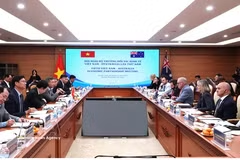
At the fifth Vietnam-Australia Economic Partnership Meeting (Photo: mof.gov.vn)

Vietnam, Australia convene fifth Economic Partnership Meeting

Australia sees Vietnam as one of Southeast Asia’s most promising economic partners. Australia is ready to send technical experts to help Vietnam meet strict biosecurity standards, opening the way for more quality Vietnamese farm produce into Australia.

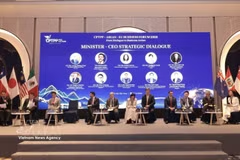
Speakers at the 2026 CPTPP–ASEAN–EU Business Forum in Hanoi on November 26 (Photo: VNA)

Vietnam advances business connectivity among CPTPP, ASEAN and EU

As 2026 CPTPP Chair, Vietnam is promoting closer links between the CPTPP, ASEAN and the EU. While the CPTPP offers high-standard trade commitments, ASEAN brings dynamic growth and manufacturing capacity, and the EU owns market potential, capital, technology and innovation.

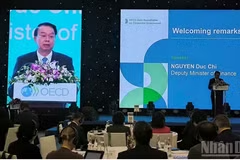
Deputy Minister of Finance Nguyen Duc Chi speaks at the event. (Photo: nhandan.vn)

OECD report outlines priorities for Vietnam’s capital market development

The OECD identifies five policy priorities to deepen the country's capital market: strengthening market confidence, facilitating companies' access to equity financing, expanding long-term funding through corporate bonds, developing the investor base, and enhancing international integration.

Deputy Minister of Industry and Trade Luong Hoang Thai (Photo: VNA)

Vietnam to continue trade talks with US over proposed additional tariffs

Thai stressed that the findings are preliminary and that the US investigation process still includes opportunities for consultation, clarification and public feedback before a final decision is made. Relevant countries, US businesses and other stakeholders can submit their views during this process.

Participants pose for a group photo at the Vietnam–Kyushu Tourism Forum 2026. (Photo: VNA)

Vietnam–Kyushu Tourism Forum looks to widen markets

The forum aimed to link Vietnamese and Japanese regulators, tourism promoters, local authorities and companies, and push market data exchange, product development and tourism cooperation between Vietnam and Kyushu.

Spokeswoman of the Ministry of Foreign Affairs Pham Thu Hang (Photo: VNA)

Vietnam urges US to objectively assess its trade-related efforts, achievements

In recent times, Vietnam has made various commitments during negotiations on a reciprocal, fair and balanced trade agreement with the US. It has also proactively implemented important reforms to address the US's concerns, including issues related to investigations under Section 301 of the US Trade Act of 1974.

Genuine and counterfeit products on display at the programme (Photo: VNA)

Vietnam launches counterfeit goods demo, promotes domestic products

Raising consumer awareness and equipping people with the skills to identify genuine and counterfeit goods are important to building a healthy business environment. Consumers not only need protection but also help create a transparent market by choosing products with clear origins and guaranteed quality, an official has said.

Illustrative image (Source: VNA)

Fuel prices fall from 3 pm on November 26

Under the latest adjustment, E5 RON92 petrol is priced at 18,391 VND (0.71 USD) per litre, down 185 VND from the previous ceiling price and 665 VND below E10 RON95-III.

The North-South high-speed railway project is expected to shorten travel times between provinces and cities. (Photo: VNA)

Key consultancy contract for North-South high-speed railway project signed

The Thang Long Project Management Unit held a signing ceremony on November 25 for Contract Package TV-02, covering consultancy services for surveys and the preparation of a feasibility study report, including the Front-End Engineering Design (FEED) and bidding documents, for the North-South high-speed railway project.

The policy allowing businesses to deduct up to 200% of research and development (R&D) expenses helps ease financial pressure and free up additional resources for technology investment. (Illustrative photo: VNA)

Tax incentives encourage businesses to master technology

Tax incentives are particularly important for technology businesses, as R&D involves not only researching new technologies but also continuously improving products, enhancing features, optimising processes and increasing productivity. Such activities require sustained investment, while commercial returns often take considerable time to materialise.

A rooftop solar power system installed at a factory in the Duc Tho Industrial Cluster, Duc Tho commune, Ha Tinh province. (Photo: VNA)

Government approves programme to drive North Central region's development

Deputy Prime Minister Pham Gia Tuc signed a decision on November 23 approving a programme to implement the North Central region's master plan for 2021-2030, with a vision to 2050, aiming to turn the region into a dynamic and sustainable growth hub, with science, technology and innovation serving as key economic drivers.

Quang Tri allocates over 50 billion VND for trade promotion in 2026-2030, supporting OCOP entities in market expansion and brand development (Photo: VNA)

E-commerce expands market access for OCOP products

Rather than relying on traditional outlets, cooperatives, businesses and household producers are increasingly using short videos, livestreams and e-commerce platforms to introduce their products, origins and production processes and distinctive values. These tools help bring producers closer to consumers and expand their reach beyond local markets.