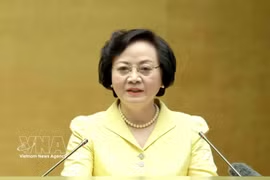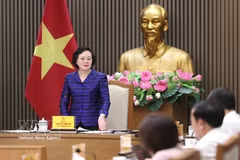
Hanoi (VNA) – Deputy Prime Minister Pham Thi Thanh Tra, on behalf of the Government, signed Resolution No. 336/NQ-CP on October 23, issuing the Government’s action plan to implement Conclusion No. 105-KL/TW, dated October 15, 2026 of the 14th Party Central Committee, on attracting and effectively utilising talent in key sectors and fields to support the country’s fast and sustainable development.
Developing an open national framework for talent identification
Under the plan, the Ministry of Home Affairs will lead efforts and coordinate with relevant ministries and agencies to draft a National Assembly resolution on special mechanisms and policies for talent affairs.
An open and flexible national talent criteria framework will be developed, comprising general standards and specific criteria tailored to different groups, sectors, fields and types of assignments. Existing regulations on attracting, employing and rewarding talented individuals across the political system will be reviewed and revised to ensure consistency with newly approved special policies.
Policies on salaries, housing, land and power decentralisation in talent affairs will be further improved, with priority given to mountainous, border, maritine, and insular areas.
A unified national talent database, talent indicator system and talent information portal will be established. Mechanisms for assessing, collecting, verifying, updating, connecting, sharing and exploiting data will be developed, ensuring consistency, information security and personal data protection.
The plan also calls for improved mechanisms for managing risks and assessing and protecting individuals who undertake innovation tasks for the common good. Transparent mechanisms will be established to recognise and honour national talent based on tangible contributions. Administrative procedures for international talent and their family members will also be streamlined through coordinated processes with clearly defined responsibilities and processing deadlines.
Identifying priority sectors and strategic tasks
The Ministry of Science and Technology will coordinate with the Ministry of Home Affairs and relevant agencies to identify and update the list of priority sectors, strategic tasks, programmes, projects, key works, major national challenges and breakthrough initiatives requiring talented personnel.
Digital platforms and technological tools will be developed to identify talent, connect candidates with opportunities, forecast demand and coordinate talent deployment, while avoiding duplicated investment and ensuring data security.
Investment will focus on leading research teams, national key laboratories, strategic technology centres, specialised innovation hubs and high-performance computing centres. Sandbox mechanisms will be applied to specific arrangements for assigning tasks, employing and rewarding talent, financing, intellectual property and access to research infrastructure.
Launching a “talent develops talent” programme
The Ministry of Education and Training will lead the development of a programme under which leading experts mentor and guide young talent. Early identification, selection, training and development schemes will be introduced for different groups and priority fields, with particular attention to talented school and university students.
The programme will support scientists, engineers, managers, young entrepreneurs and highly skilled workers in attaining international standards. Training will be closely linked to research, innovation and reality, with long-term support for career development.

Outstanding scientists and young talent will be selected for training and research at leading foreign universities, research institutes and technology corporations. Overseas training outcomes will be linked to domestic development needs, research outputs and the application of knowledge and technology.
Selected universities, research institutes, key laboratories and innovation centres will be upgraded to regional and international standards. Centres of excellence and talent development and networking hubs will also be established.
Establishing special financial mechanisms
The Ministry of Finance will lead efforts to develop special financial policies for attracting and utilising talent. Annual state budget allocations for talent development are expected to reach around 0.1% of GDP within the overall funding for science, technology, innovation and digital transformation. Localities with financial autonomy may decide on higher spending levels.
Financial policies will encourage businesses across economic sectors to identify, nominate, recruit, use and develop talent, as well as co-finance training, research and innovation in strategic sectors and emerging and high technologies.
Ministries, agencies and localities will incorporate talent development into their strategies and socio-economic development plans. Results in attracting, nurturing and effectively deploying talent will serve as a basis for assessing the accountability of organisations and their leaders.
The plan also calls for expanding international cooperation networks and initiatives to engage overseas Vietnamese and international experts in training, consultancy, research, technology transfer and the implementation of strategic tasks and projects in Vietnam./