Jakarta (VNA) – Indonesia is developing adsorbed natural gas (ANG) technology to reduce its reliance on imported liquefied petroleum gas (LPG) and save approximately 1.5 billion USD annually in LPG subsidy costs.
The technology is viewed as a key solution to addressing Indonesia’s energy challenges and budgetary burdens amid persistently high domestic LPG demand.
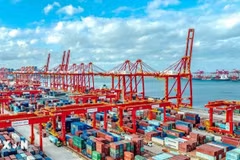
Indonesia currently relies heavily on LPG imports. According to the Ministry of Energy and Mineral Resources (ESDM), imports meet about 80% of domestic LPG demand, while domestic production covers only around 20%.
This dependency places significant strain on the national budget when international energy prices fluctuate. Reports from the Ministry of Finance indicate that volatility in oil prices, exchange rates and LPG demand directly affects government spending on energy subsidies and price compensation.
According to the Institute for Energy Economics and Financial Analysis (IEEFA), Indonesia spent 87 trillion IDR (5.4 billion USD) on LPG subsidies in 2025.
Against this backdrop, developing technology to effectively store and utilise domestic gas reserves is considered a crucial step towards reducing LPG imports, thereby easing the burden on the State budget and enhancing energy security.
The initiative aligns with the Indonesian Government’s strategy to boost the use of domestic natural gas. The ESDM is simultaneously promoting the integration of gas infrastructure to secure supplies and gradually reduce dependence on imported LPG.
Furthermore, the Indonesian Government has implemented policies to support the gas market. As part of an economic stimulus package for the second half of 2026, the country has applied a 0% import duty on LPG used as feedstock in the petrochemical industry, aiming to lower production costs and enhance the sector’s competitiveness./.