Indonesia promotes use of biofuels

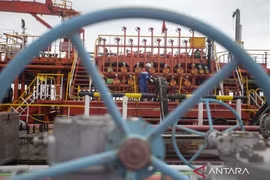
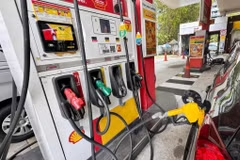
Eniya Listiani Dewi, director general of new, renewable energy and energy conservative at the Indonesian Energy and Mineral Resources Ministry (ESDM), said that the B50 blend, consisting of 50% crude palm oil (CPO) and 50% fossil diesel, is still in the road testing phase, which has been underway since December 9, 2025.

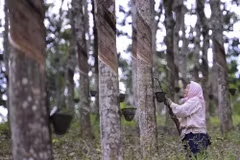
Jakarta (VNA) – The Indonesian Government is preparing to roll out the use of B50 biofuel from July 1, with expectations that the policy will help save around 157.28 trillion IDR (equivalent to 9.18 billion USD) this year.

As reported by the national news ageny Antara, Eniya Listiani Dewi, director general of new, renewable energy and energy conservative at the Indonesian Energy and Mineral Resources Ministry (ESDM), said that the B50 blend, consisting of 50% crude palm oil (CPO) and 50% fossil diesel, is still in the road testing phase, which has been underway since December 9, 2025.

The road testing on nine types of vehicles is targeted for completion in May. Following the road testing, ESDM Ministry will inspect the condition of the engines. Road testing and engine inspections for the automotive sector are targeted for completion in June.

According to Eniya, preliminary results of the B50 testing indicate that the quality of the fuel meets the required specifications.

In addition to the automotive sector, B50 is being tested in agricultural machinery, heavy mining equipment, maritime transportation, railways and power generation.

The Indonesian Government data show biodiesel utilisation reached 14.2 million kL in 2025, or 105.2% of the target of 13.5 million kL.

The planned shift to B50 is part of President Prabowo Subianto’s strategy to strengthen resilience against global supply disruptions. The government estimates the policy could reduce fossil fuel consumption by about 4 million kL annually./.
VNA

See more

Singapore blocks six websites impersonating news publications

Singapore blocks six websites impersonating news publications

A joint statement issued on April 23 by the Ministry of Home Affairs (MHA) and the Infocomm Media Development Authority (IMDA) said the websites masquerade as Singapore websites by spoofing or using terms associated with the country in their domain name.

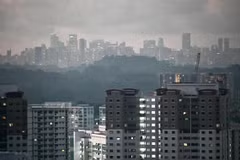
Singapore's inflation accelerates as the conflict in the Middle East drives up petrol prices. (Photo: straitstimes.com)

Singapore inflation accelerates as petrol prices hike

According to a joint statement released on April 23 by the Monetary Authority of Singapore and the Ministry of Trade and Industry Singapore, overall inflation rose to 1.8% year-on-year, up from 1.2% in February.

The ASEAN Summit is scheduled to take place on May 7–8, 2026 in Cebu, the Philippines. (Photo: mb.com.ph)

Philippines: Preparations for ASEAN Summit on track

The ASEAN Summit will take place on May 7–8 in Cebu, while ASEAN summits with partners and related meetings will be held in Manila later this year. Previously, about 650 ministerial- and senior official-level meetings scheduled to be hosted by the Philippines will be held online.

Malaysia targets 32% renewable energy capacity

Malaysia targets 32% renewable energy capacity

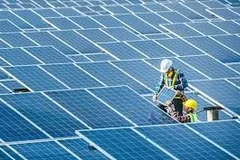
Deputy Prime Minister Datuk Seri Fadillah Yusof, who is also the Minister of Energy Transition and Water Transformation of Malaysia, said the country had achieved 31% installed RE capacity as of December 2025.

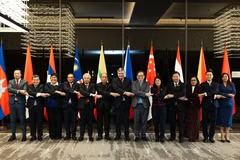
Deputy foreign ministers and senior officials of the 11 ASEAN member states and Russia pose for a group photo. (Photo: Ministry of Foreign Affairs)

ASEAN, Russia prepare for 35th anniversary summit

Deputy Minister Dang Hoang Giang reaffirmed that ASEAN views Russia as one of its key partners contributing to regional peace, stability and development. He proposed enhancing high-level strategic exchanges, strengthening cooperation in priority areas such as cybersecurity, including the effective implementation of the Hanoi Convention, and expanding collaboration within ASEAN-led mechanisms.

Thailand ready to share experience with Vietnam in green urban development: officials

Thailand ready to share experience with Vietnam in green urban development: officials

Thailand is ready to share its experience and successful models in green urban development with Vietnam, as the two countries share many similar characteristics, including rapid urbanisation, traffic congestion, flooding, canal networks and growing demand for greener public spaces, Thai officials have said in recent interviews with the Vietnam News Agency.

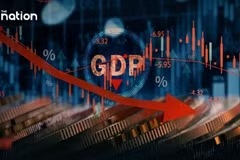
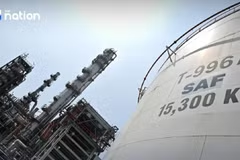
KKP cuts GDP forecast, warns Thailand faces recession risk. (Photo: The Nation)

Thailand’s economy may face recession risk

In its latest report, KKP Research noted that Thailand’s vulnerability goes beyond its reliance on imported crude oil and liquefied natural gas (LNG). Disruptions to shipping routes in the Middle East could also worsen shortages of fertilisers, affecting agricultural output, as well as petrochemical feedstocks, which would impact the plastics and textile industries.

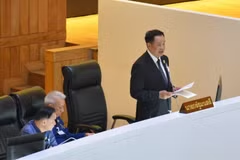
Thai Prime Minister Anutin Charnvirakul speaks before Thai Parliament in Bangkok. (Photo: Xinhua/VNA)

Thailand plans tighter, targeted fiscal 2027 budget

Thailand's fiscal 2027 budget is projected at around 3.78 trillion THB (nearly 118 billion USD), a 2% increase from the previous year, with a focus on targeted spending and cutting unnecessary expenses, according to Prime Minister Anutin Charnvirakul.

Fitch downgrades Philippines’ outlook to ‘negative’. (Illustrative photo: Reuters)

Fitch downgrades Philippines’ outlook to ‘negative’

The Outlook revision reflects rising risks to the Philippines' strong medium-term growth prospects from recent disruptions to public investment, exacerbated in the near-term by elevated exposure to the ongoing global energy shock.

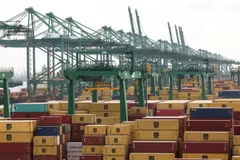
The Singapore Maritime Technology & Research Roadmap is aimed at advancing the sector’s efficiency and sustainability. (Photo: businesstimes.com.sg)

Singapore unveils new roadmap to boost innovation in maritime sector

The Singapore Maritime Technology & Research Roadmap is aimed at advancing the sector’s efficiency and sustainability. It highlights priorities – including digital technologies, decarbonisation and operational integration – to boost resilience, productivity and innovation in Singapore’s maritime ecosystem. It also addresses structural issues such as manpower, land and sea space limitations.