Issues of law-governed socialist State building discussed in detail

Different issues in the building and perfection of a law-governed socialist State were discussed at a meeting held on October 19 under the chair of National Assembly (NA) Chairman Vuong Dinh Hue.
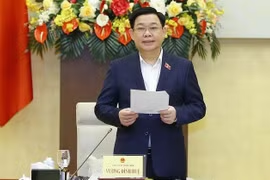
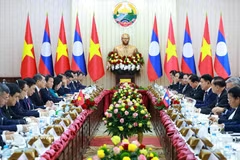
Issues of law-governed socialist State building discussed in detail ảnh 1National Assembly (NA) Chairman Vuong Dinh Hue at the meeting (Source: VNA)

Hanoi (VNA) – Differentissues in the building and perfection of a law-governed socialist State werediscussed at a meeting held on October 19 under the chair of National Assembly(NA) Chairman Vuong Dinh Hue.

The meeting is the second held by the steering committee for ascheme to build a “strategy for building and perfecting the law-governedsocialist State of Vietnam until 2030, with a vision to 2045 headed by NA Chairman Hue.

Participants looked into andapproved a draft report on Issue No. 10 on completing mechanisms for taskassignment, coordination, and control among State agencies in the execution ofjudicial power, and among agencies and organisations in judicial activities tomeet requirements of the building and perfection of a law-governed socialistState.
Issues of law-governed socialist State building discussed in detail ảnh 2At the event (Source: VNA)

They gave opinions on a draftreport on Issue No. 12 on completing the mechanism for protecting the Constitution.Two sub-committees reported on the progress of compiling reports for Issue No. 9 on the strategyfor making and perfecting the legal system and for organising law enforcement to 2030, and Issue No. 11 on reforming and improving the quality and effectiveness ofthe NA’s activities.

Chairman Hue spoke highly ofthe opinions given at the meeting, noting that the model of a law-governedsocialist State in Vietnam features both the universality of a law-governedState in the world and the specific socialist-oriented features of the country.

Given this, the strategymaking process must adhere to relevant viewpoints of the Party and State, theresolution of the 13th National Party Congress, as well as thesocio-economic development strategy for 2021 - 2030. It must also take intoaccount the post-2030 period, he added./.
VNA
See more

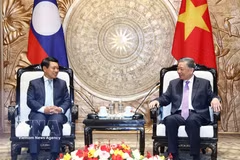
General Secretary of the Communist Party of Vietnam Central Committee and President To Lam (R) receives Lao Prime Minister Saleumxay Kommasith in Hanoi on November 27. (Photo: VNA)

Top Vietnamese leader receives Lao Prime Minister

General Secretary of the Communist Party of Vietnam Central Committee and President To Lam congratulated Saleumxay Kommasith on being elected Prime Minister by the 10th National Assembly of Laos, stressing that his first official visit to Vietnam in the new capacity carries important political significance, as it will help consolidate political trust, translate high-level commitments and into concrete actions, and provide fresh impetus for the bilateral relationship to develop in an increasingly profound, substantive and effective manner.

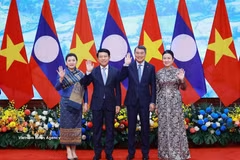
Prime Minister Le Minh Hung (second from right) and his spouse pose for a photo with Lao Prime Minister Saleumxay Kommasith and his spouse in Hanoi on November 27. (Photo: VNA)

Vietnam, Laos bolster comprehensive cooperation, strengthen strategic cohesion

Welcoming PM Saleumxay and his wife on his first official visit to Vietnam in his capacity as Prime Minister, PM Hung stressed that the trip is of important significance in further deepening the great friendship, special solidarity, comprehensive cooperation and strategic cohesion between Vietnam and Laos.

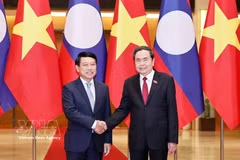
National Assembly President Tran Thanh Man (R) welcomes Lao Prime Minister Saleumxay Kommasith on November 27 evening. (Photo: VNA)

NA President meets with Lao Prime Minister

NA President Man highlighted PM Saleumxay’s first official visit to Vietnam in his new capacity as Prime Minister, saying it is a vivid demonstration of the special relationship between Vietnam and Laos. The visit, he said, will provide fresh momentum for strengthening the two countries’ great friendship, special solidarity, comprehensive cooperation and strategic cohesion between their two Parties, States and peoples.

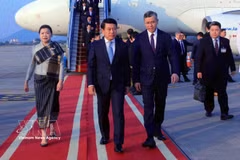
Deputy Minister of Foreign Affairs Ngo Le Van (right) welcomes Cambodian Prime Minister Hun Manet at Noi Bai International Airport, Hanoi on November 27 evening (Photo: VNA)

Cambodian PM arrives in Hanoi for CLMV, ACMECS Summits

Cambodian Prime Minister Hun Manet arrived in Hanoi on November 27 evening to attend the 12th Cambodia-Laos-Myanmar-Vietnam (CLMV) Summit and the 11th Ayeyawady-Chao Phraya-Mekong Economic Cooperation Strategy (ACMECS) Summit.

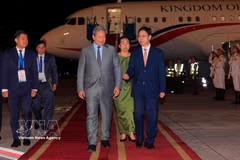
Vietnamese Minister of Finance Ngo Van Tuan (R) welcomes Lao Prime Minister Saleumxay Kommasith and his spouse Alouny Kommasith. (Photo: VNA)

Lao PM and spouse arrive in Hanoi for official visit, international summits

Lao Prime Minister Saleumxay Kommasith arrived in Hanoi on the afternoon of November 27, beginning his official visit to Vietnam, where he will also attend the 12th Cambodia-Laos-Myanmar-Vietnam (CLMV) Summit and the 11th Ayeyawady-Chao Phraya-Mekong Economic Cooperation Strategy (ACMECS) Summit.

☕ Afternoon briefing on November 27

☕ Afternoon briefing on November 27

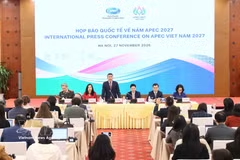
A ceremony marking the 30th anniversary of Vietnam's securities industry, an international press conference on APEC Vietnam 2027, and the fifth Vietnam-Australia Economic Partnership Meeting are among news highlights on November 27.

☀️ Morning digest on November 27

☀️ Morning digest on November 27

General Secretary and President To Lam's reception for Saint Petersburg Governor Aleksander Beglov, Vietnam urging the US to objectively assess its trade-related efforts and achievements, and the launch of the Vietnam–Thailand–Singapore submarine cable project are among news highlights on November 26 evening.

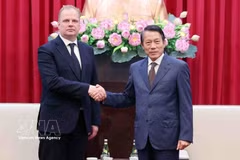
Minister of Public Security General Luong Tam Quang (right) and Deputy Secretary of the Russian Security Council Alexander Venediktov at the meeting in Hanoi on November 26. (Photo: VNA)

Vietnam, Russia promote sci-tech cooperation in security

Minister of Public Security General Luong Tam Quang proposed increasing exchanges of delegations and high-quality personnel training, alongside closer links among research and training institutions, technology businesses and experts to develop specific programmes and projects.