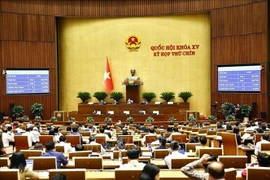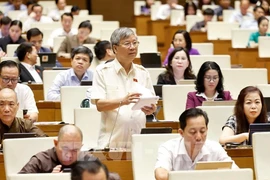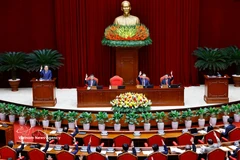
Hanoi (VNA) - National Assembly (NA) deputies continued their ninth session on May 17 with group discussions on some bills, including the draft Law on supplementation and amendments to some articles of the Law on Vietnamese Nationality, the draft revised Law on the State Budget.
The agenda also comprised a series of laws covering public procurement, public-private partnerships, customs, import-export taxes, investment, public investment, and the management and use of public assets.
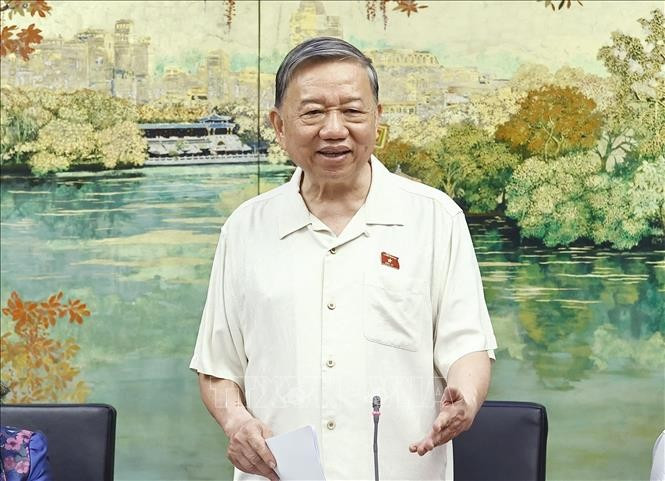
Addressing the discussions in his group, Party General Secretary To Lam emphasised that institutional bottlenecks remain a major constraint on national development. At the same time, legal and institutional reform is increasingly recognised as a foundational driving force for progress, he said, pointing out that this reform has been in initial stage.
He noted that recent National Assembly sessions, both regular and extraordinary, have focused heavily on legislative work.
The Party chief underlined the need to create laws that mobilise the public’s contribution, open pathways, encourage innovation, and offer long-term vision for development – an area that has been relatively neglected.
He stressed that Resolution No. 66-NQ/TW of the Politburo, on reforming legal development and implementation to meet the country's needs in a new era, aims to build a legal system that is coherent, practical, transparent, and conducive to business, innovation, and reform. It also seeks to resolve overlapping and contradictory regulations.
According to the leader, a complete shift is crucial in legislative thinking, from managing to serving, from passive to proactive, and from control to enabling development. Lawmaking, he said, must stay ahead of real-world developments, with clear foresight, practical relevance, and adaptability to rapid change.
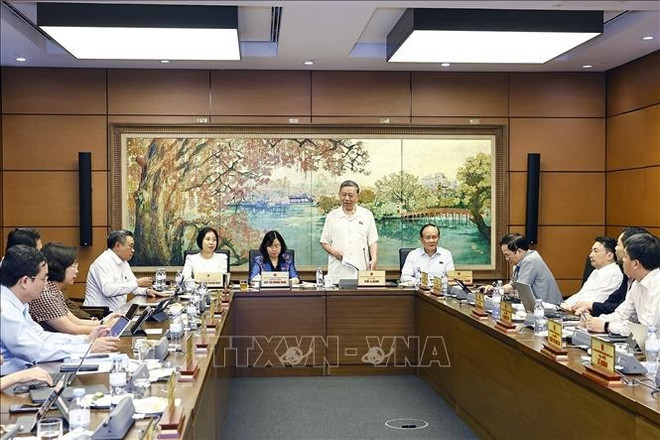
Moreover, the enforcement of laws must be strict, fair, and substantive, tied to transparency and openness to ensure the greatest possible convenience for individuals, businesses, and society as a whole, he underlined.
Laws are not designed to serve the interests of any particular group – they are for the people, for everyone, the General Secretary stated. He underscored the need for clear decentralisation and delegation of powers, coupled with accountability, to eliminate “ask-give” mechanisms and eradicate vested interests, privileges, and group interests.
Noting that a national conference is set to be held on May 18 to disseminate and implement two key resolutions, namely Resolution No. 66-NQ/TW on legal reform and Resolution. 68-NQ/TW on private sector development. The event will also address four other major resolutions adopted earlier, covering science, technology, innovation, digital transformation, and international integration.
Competent authorities are working urgently on resolutions regarding education, training, and health care, he said.
On the proposed amendments to the Law on Vietnamese Nationality, General Secretary Lam said that the law should reflect national pride, unity, and the importance of each individual's role.
Nationality and passports are sacred, he stated, emphasising that the law must mobilise people's strengths and honour those who have contributed to the country, including foreign nationals, while warning that legal loopholes must be closed to prevent abuse, such as document fraud or other related crimes.
Many lawmakers agreed that the draft revised Law on supplementation and amendments to some articles of the Law on Vietnamese Nationality is a crucial legal basis for allowing overseas Vietnamese to acquire or regain Vietnamese nationality and to enjoy full citizenship rights. However, they pointed out that the draft still lacks mechanisms for handling special naturalisation cases.
The Government's decision to amend the law to "relax" policies on re-acquiring Vietnamese nationality and simplify administrative procedures is intended to better support foreign nationals and overseas Vietnamese returning to invest, do business, and contribute to scientific development, innovation, and digital transformation./.