National scientific-technological development and innovation strategy approved

Deputy Prime Minister Vu Duc Dam has signed a decision to issue a strategy for scientific-technological development and innovation until 2030.
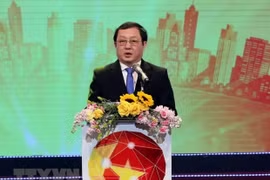
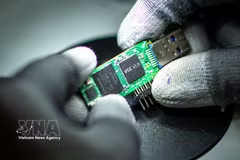
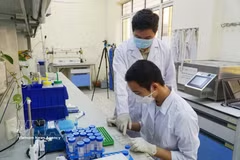
National scientific-technological development and innovation strategy approved ảnh 1Science, technology and innovation will play important roles in developing key industries in Vietnam. - Illustrative image (Photo: VNA) 

Hanoi (VNA) – Deputy Prime Minister Vu Duc Dam has signed a decision to issue a strategy for scientific-technological development and innovation until 2030.

Accordingly, science, technology and innovation will play important roles in developing key industries in Vietnam, with a focus on the processing and manufacturing industries, contributing to restructuring the national economy toward modernity by 2030.

Science, technology and innovation are hoped to significantly contribute to building and developing Vietnam’s cultural, social and human values, providing scientific grounds for developing national development guidelines and policies, and contribute to the human development index (HDI).

To achieve these goals, attention will be paid to boosting scientific-technological and innovative activities nationwide, and setting up innovative ecosystems in industrial, agricultural and service sectors in connection with domestic and global value chains and industry clusters, in which large enterprises and State management agencies are responsible for creating favourable conditions and policies.

A system of national innovative centres will be linked with hi-tech zones, residential areas, financial centres, venture capital funds, universities and research institutes.

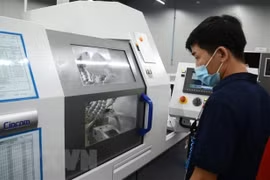
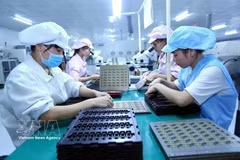
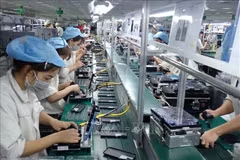
National scientific-technological development and innovation strategy approved ảnh 2Another key mission in the strategy is to develop scientific human resources with a high level of innovation and creative capacity. - Illustrative image (Photo: VNA) 

Additionally, open innovation platforms and networks will be developed to attract domestic and foreign investment resources towards creating new technologies and products, and setting up new enterprises.

Another key mission in the strategy is to develop scientific human resources with a high level of innovation and creative capacity.

The Government will also put an emphasis on building highly qualified scientific human resources, including leading scientists that can match the level of their counterparts in developed nations.

Other policies and mechanisms should be introduced to provide financial support and facilitate immigration as well as working permit procedures for overseas Vietnamese or foreigners who wish to participate in domestic scientific activities.

A network to connect talented overseas Vietnamese scientists should be also formed./.
VNA

See more

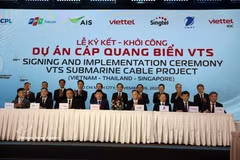
The signing and implementation ceremony for the Vietnam–Thailand–Singapore submarine cable project on November 26, 2026 (Photo: VNA)

Vietnam–Thailand–Singapore submarine cable project launched

Designed with eight fibre pairs, the system will employ next-generation wavelength-division multiplexing (WDM) technology and an open-cable architecture. It is expected to deliver a round-trip data latency of just 12 milliseconds, about 50% lower than the current average.

Deputy Prime Minister Ho Quoc Dung, together with Government leaders, representatives of the Ministry of Science and Technology and CMC Technology Group, performs the official launch ceremony of the Clex legal AI platform. (Photo courtesy of the company)

Vietnamese-made legal AI platform Clex launched

Clex was researched and developed by CMC based on a large language model specialising in Vietnamese law, which was trained and fine-tuned on a knowledge base comprising more than two million legal documents.

The VGC v1.0 security chip, designed and developed by Vietnam (Photo: VNA)

Vietnam builds initial semiconductor foundation

Experts said the first step is not another broad strategy but a hard-headed audit of what Vietnam can actually do and a clear-eyed map of its advantages, technology gaps and opportunities in the global value chain.

The inauguration ceremony of the ASEAN-China Health Exchange and Cooperation Centre in Chongqing. (Photo: VNA)

Vietnam proposes stronger ASEAN-China cooperation in AI

For Vietnam, AI-driven transformation is both a strategic opportunity and an inevitable requirement for development. Science, technology and innovation are becoming key drivers of growth, productivity and competitiveness, said Deputy Minister of Foreign Affairs Nguyen Manh Cuong.

Assembling electronic components on the production line of Bao Sen Co., Ltd in Bac Ninh City. (Photo: VNA)

Vietnam builds technological capacity in digital era

As science, technology and digital transformation become increasingly integrated into production, governance and daily life, they can help create new drivers of growth and advance the development goals set out in the resolution.

The beauty of Dong Van Karst Plateau (Photo: VNA)

Vietnam tourism’s competitive future runs on digitalisation

The Vietnam National Authority of Tourism (VNAT) reported that Vietnam drew about 19.5 million foreign arrivals in the first 10 months of 2026, up 13.8% from a year earlier. That growth, along with changing consumer behavior, is forcing travel companies to rethink sales, service quality and how they mine customer data.

Visitors at the exhibtion held within the framework of the 16th Business of IP Asia Forum. (Photo: VNA)

Vietnam promotes innovation links at Hong Kong Entrepreneur Day 2026

Van expressed her hope that the NIC would serve as a bridge to encourage businesses and major corporations from the GBA to invest in Vietnam and transfer innovative technologies, particularly in artificial intelligence (AI), green transition and financial technology (FinTech).

Karnataka Chief Minister D.K. Shivakumar speaks positively about cooperation prospects and expresses hope that more Vietnamese businesses will invest in the Indian state. (Photo: VNA)

Vietnam, India's Karnataka boost science, technology cooperation

The ambassador highlighted the complementary strengths of Vietnam and the Indian state, home to the country's Silicon Valley, and significant potential for cooperation in artificial intelligence (AI), semiconductors, digital technology, and research and development.

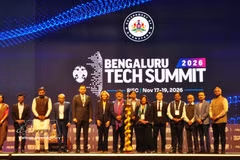
Delegates pose for a group photo at the Bengaluru Tech Summit 2026 in Karnataka, India (Photo: VNA)

Vietnam attends annual int’l tech summit in India

Vietnam's growing focus on science and technology, digital transformation and innovation as new drivers of development made India a natural partner in achieving its development and digital transformation goals. Cooperation potential between the two countries remains substantial, spanning both hardware and software.

Vietnamese Deputy Minister of Science and Technology Tran Trung Tinh speaks at the event. (Photo: Published by VNA)

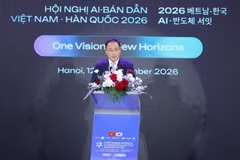
Vietnam, RoK seek to expand cooperation in AI and semiconductor sectors

Vietnamese Deputy Minister of Science and Technology Tran Trung Tinh stressed that the Politburo's Resolution No. 57-NQ/TW identifies science and technology, innovation and digital transformation as leading breakthroughs and key drivers of rapid and sustainable development. Semiconductors and artificial intelligence (AI) are among the strategic technologies prioritised for development.

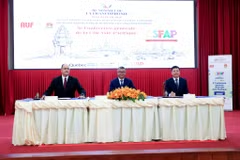
Representatives of Cambodia’s Ministry of Education, Youth and Sport (MoEYS), the Agence Universitaire de la Francophonie (AUF) and Viettel Cambodia (Metfone) sign a tripartite agreement to strengthen cooperation and accelerate digital transformation in Cambodia’s higher education sector. (Photo: khmertimeskh.com)

Vietnamese company joins Cambodia’s digital transformation efforts

The agreement establishes a cooperation framework to modernise higher education through digital governance, digital learning, artificial intelligence (AI) applications, and capacity building through training and knowledge sharing. It also aims to expand internship, employment and scholarship opportunities for students.