New insurance policies expand benefits, improve access

The amended Law on Health Insurance, which took effect on July 1, introduces changes to maximise benefits while removing unnecessary administrative barriers for patients.

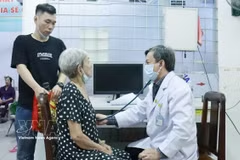
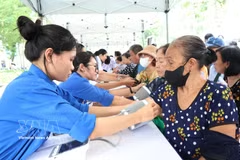
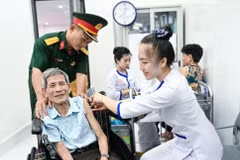
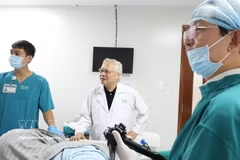
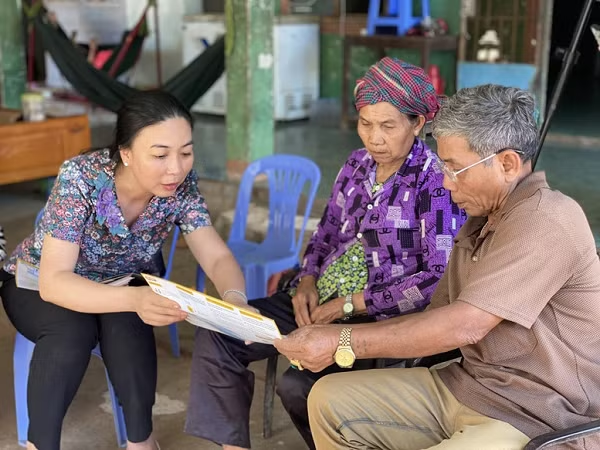
New policies on social and health insurance are to expand benefits, improve lives, and strengthen the social security system. (Photo: VietnamPlus)

Hanoi (VNA) – A series of new regulations on social and health insurance took effect on July 1, 2026, marking an important step in improving social security policies and expanding access to benefits and services.

The changes cover contribution and benefit levels based on the new statutory pay rate, reflecting a more people-centred approach to the social security policy. They are expected to make it easier for insurance participants to access healthcare and strengthen the social security safety network.

62 diseases eligible for direct access to specialised care

The amended Law on Health Insurance, which took effect on July 1, introduces changes to maximise benefits while removing unnecessary administrative barriers for patients.

A key measure is Circular No. 01/2026/TT-BYT issued by the Ministry of Health, which lists 62 diseases and disease groups for which patients can go directly to specialised medical facilities for treatment without a referral.

The list includes serious and rare diseases as well as conditions requiring advanced medical techniques, including cancer, blood, cardiovascular and neurological diseases, metabolic disorders and organ transplants.

Removing referral requirements is expected to save patients time and travel costs while giving them earlier access to advanced treatment at leading hospitals.

The scope of health insurance coverage and the conditions for reimbursement have also been revised to provide greater flexibility, particularly for patients with serious or long-term illnesses.

Digital transformation is also helping simplify access to health insurance services. Data connectivity between the social insurance and health sectors allows people to use their chip-based citizen ID cards or electronic applications such as VssID and VNeID when seeking medical care, reducing paperwork and waiting time.
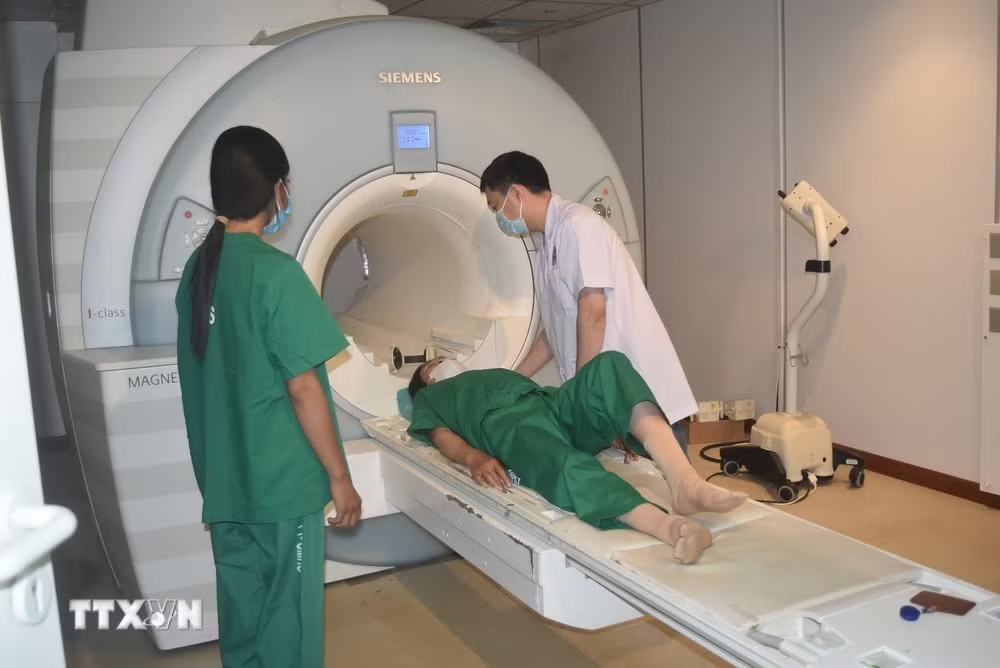
cds.jpg
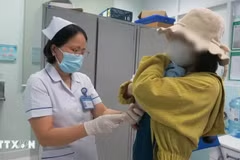
The list of 62 diseases and disease groups allows patients to go directly to specialised medical facilities for treatment without a referral as previously required. (Photo: VNA)

​The adjustment of the statutory pay rate to 2.53 million VND per month under Decree No. 161/2026/ND-CP also affects health insurance benefits. Health insurance funds now cover 100% of costs for a medical visit or treatment episode when total expenses are below 15% of the statutory pay rate, raising the threshold to 379,500 VND.

Social insurance policies have also been adjusted since July 1, with a focus on improving the living standards of pensioners and people receiving monthly benefits.

Under Decree No. 162/2026/ND-CP, pensions and social insurance benefits have increased by 8%. For people whose benefits remain at or below 3.5 million VND per month after the increase, an additional 300,000 VND will be provided, bringing the monthly benefit to 3.8 million VND.

The policy is intended to narrow income gaps among beneficiaries and provide greater support for those with low pensions amid changes in living costs.

Other short- and long-term social insurance benefits have also been adjusted in line with the new statutory pay rate. The one-off allowance for childbirth or adoption, for example, has increased to 5.06 million VND per child, while the funeral allowance has risen to 25.3 million VND.

The new policies are expected not only to improve benefits for current participants but also to encourage wider coverage of social and health insurance.

For informal-sector workers, the State continues to provide financial support for voluntary social insurance contributions, encouraging people to build up contribution periods towards future pensions and health insurance coverage in old age./.
VNA

See more

The Son Tra regional medical centre (Photo: benhviensontra.com.vn)

Da Nang: Satellite hospitals prove effective at grassroots level

The model is an important component of the roadmap to turn Da Nang into a specialised medical centre for the central and Central Highlands regions, with a number of key specialties, in line with the spirit of Politburo Resolution No. 72-NQ/TW dated September 9, 2025, on breakthrough solutions to strengthen the protection, care and improvement of people's health.

Illustrative image (Photo: daibieunhandan.vn)

Ho Chi Minh City digitises 99.4% of hospital records

As of July 2026, 163 of the city's 164 hospitals, or 99.4%, adopted electronic medical records, the report said. About 64% of public hospitals and 65% of private hospitals now run the technology across their entire operations

Yersin International Clinic in Ho Chi Minh City. (Photo: VNA)

Ho Chi Minh City eyes more foreign medical tourists

Director of the municipal Department of Health Tang Chi Thuong said a key prerequisite for attracting foreign patients is a strategy to develop centres of medical excellence. He proposed selecting hospitals and specialties with strong expertise for investment towards international standards, particularly in competitive fields such as cardiology, oncology, robotic surgery, assisted reproduction, paediatrics, dentistry, cosmetic medicine, specialised health check-ups, traditional medicine and rehabilitation.

A nurse from Children's Hospital No. 1, Ho Chi Minh City, collects a blood sample for HIV testing from an infant. (Illustrative photo: VNA)

Health cooperation adds fresh momentum to Vietnam-US relations

Through this MOU, the US Department of State, working with Congress, plans to provide 98.75 million USD in life-saving global health assistance over the next five years, including 21.385 million USD in dedicated Global Health Security funding, to support Vietnam’s transition to full country ownership of its HIV/AIDS and tuberculosis programmes while strengthening its capacity to detect and respond to emerging and re-emerging infectious disease threats.

Minister of Health Dao Hong Lan and US Ambassador to Vietnam Jennifer McNamara Wick sign the memorandum of understanding on health cooperation. (Photo: US Embassy in Vietnam)

Vietnam, US launch five-year health cooperation

The cooperation will also support Vietnam in strengthening its healthcare capacity and gradually enhancing self-reliance in HIV/AIDS and tuberculosis prevention and control programmes, as well as in responding to emerging and re-emerging infectious diseases.

Director of the Ho Chi Minh City Department of Health Tang Chi Thuong (third, right) presents flowers to congratulate six young doctors who have volunteered to work at grassroots-level health stations (Photo: VNA)

Ho Chi Minh City strengthens grassroots healthcare workforce

Ho Chi Minh City's Department of Health on September 10 reviewed a pilot programme combining hospital-based practice with work at grassroots health stations and organised the fourth healthcare job fair, attracting nearly 1,000 candidates and 94 recruiters offering 806 positions.

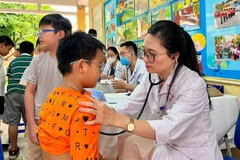
Children undergo health screening. (Photo: Dong Da General Hospital in Hanoi)

Vietnam to screen students nationwide for five health risks from 2028

Vietnam will launch nationwide screening for five groups of school-related diseases and health conditions among students from preschool through high school from 2028, including overweight and obesity, refractive errors, spinal curvature, oral diseases and mental health disorders.

A doctor provides dental checkup for a student. (Photo: VNA)

Free health checkups for children ahead of new school year

According to the Hanoi Department of Health, the city has 4,776 educational institutions with more than 2.2 million preschool and school students. The health campaign will run from August 18 to September 4, targeting 100% coverage before the new school year begins.