Oil company pays 278 million USD to state budget

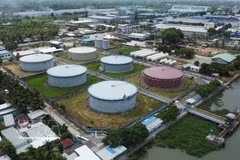
Binh Son Refining and Petrochemical Joint Stock Company (BSR) paid more than 6.33 trillion VND (nearly 278 million USD) to the state budget in the past 8 months.
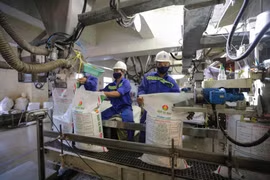
Oil company pays 278 million USD to state budget ảnh 1BSR contributes more than 6,330 billion VND to the state budget. (Photo: VNA) 
Hanoi (VNA)- Binh Son Refining and Petrochemical Joint Stock Company (BSR) paid more than 6.33 trillion VND (nearly 278 million USD) to the state budget in the past 8 months.

Deputy General Director Bui Ngoc Duong said due to the sharp decline indomestic gasoline consumption in the third quarter, the company is experiencing difficulties in productionand business activities. In thepast 8 months, it produced 4.48 million tonnes and sold 4.13 million tonnes for 60.805 trillion VND.

It has developed four production and business scenarios on the basis of the COVID-19 pandemic development and the forecast of the domestic and foreign petroleum markets.

Director of Vietnam Oil and Gas Group (PVN) Le Manh Hung asked the BSR toachieve 2 goals: cash flow management, and state budget paymenttarget./.
VNA

See more

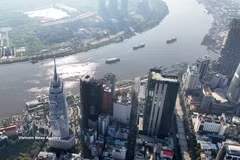
Financial buildings in central Ho Chi Minh City along the Saigon River, facing the Thu Thiem peninsula in An Khanh ward. (Photo: VNA)

Ho Chi Minh City attracts significant investment from France

Ho Chi Minh City is emerging as an attractive destination for French investors, particularly in infrastructure, sustainable urban development and green transition. French investment of more than 2.2 billion USD is contributing to economic growth and opening up broader prospects for long-term cooperation.

An aerial view of a crossroads in Hanoi (Photo: VNA)

Hanoi pushes SOEs to lead breakthrough growth

According to experts, Resolution 79-NQ/TW reaffirms the state economic sector’s leading role in the socialist-oriented market economy. The real shift, however, is moving SOEs from simply “holding” assets to actively “leading” development, and from traditional “management” to enabling growth across the board.

A representative of the Coast Guard speaks at the meeting. (Photo: VNA)

Ho Chi Minh City steps up decisive action to lift IUU “yellow card”

The city will fast-track eCDT implementation, study the feasibility of a fishing port in Can Gio, and propose granting accounts to border guard stations to strengthen oversight of vessel movements. Enhanced inter-provincial coordination, particularly with Lam Dong, Da Nang, Quang Tri and Ninh Binh, was also emphasised to tighten control and strictly handle violations, especially those related to VMS.

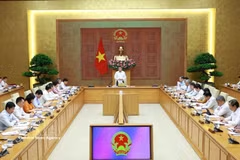
An overview of Prime Minister Le Minh Hung's working session with the Ministry of Finance on April 29 (Photo: VNA)

PM emphasises need for governance shift to drive growth

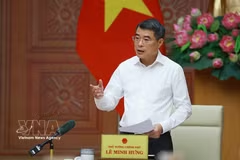
Ministries and agencies must enhance forecasting capacity, adopt more responsive policy tools, and fundamentally rethink how policies are designed and executed in a rapidly evolving environment, said PM Le Minh Hung.

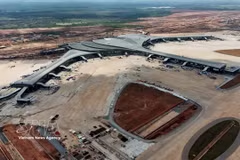
Long Thanh International Airport is currently under construction and is expected to be put into operation by the end of 2026. (Photo: VNA)

Dong Nai rolls out 4.3 billion USD plan for key transport links

Dong Nai will implement three major transport projects with a total capital exceeding 110 trillion VND (4.3 billion USD), aimed at strengthening connectivity between Dong Nai, Ho Chi Minh City, and key economic regions in the Central Highlands, central, and southwestern regions.

Vietnamese products are on show at the Home InStyle exhibition in Hong Kong (China). (Photo: VNA)

Vietnam’s eco-friendly products welcomed in Hong Kong

The Home InStyle and Fashion InStyle exhibitions, taking place at the Hong Kong Convention and Exhibition Centre from April 27 to 30, showcases the latest global trends in home products, interior décor, lifestyle goods, apparel and fashion.

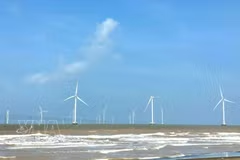
A wind farm in Vinh Long province (Photo: VNA)

Green growth: from imperative to a new growth engine

The 2026–2035 period is widely seen as a critical window. If leveraged effectively, Vietnam can upgrade its economic structure and move deeper into global value chains; if not, it risks losing competitiveness and market share.