Octogenarian veterans relive Dien Bien Phu memories

Octogenarian veterans relive Dien Bien Phu memories

“I dreamed of peace while in the battle and when it came true, my dreams are all about my comrades every night,” Dien Bien Phu veteran Luong Van Huong, now 96, told the Vietnam News Agency, weeping tears falling on his face at the memory of his fellow fighters at the Dien Bien Phu Campaign 70 years ago.

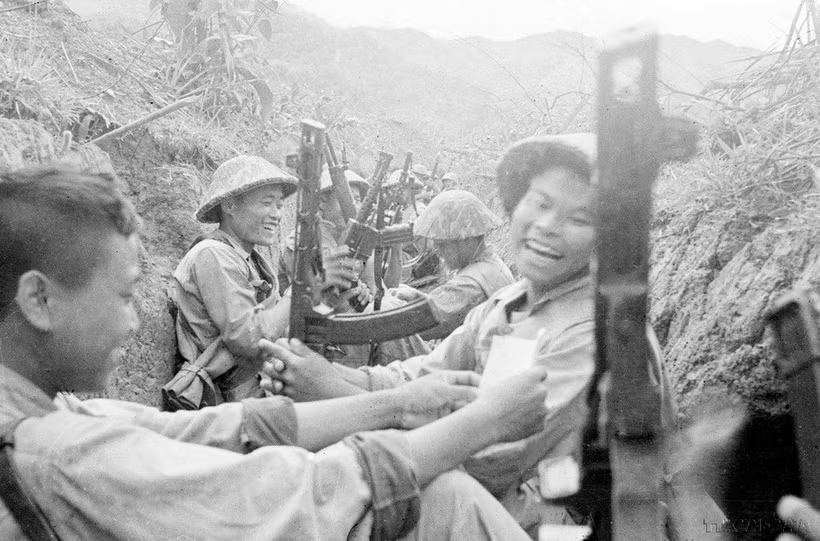
Dien Bien soldiers are driven by patriotism and a fierce thirst for independence. (Photo: VNA)

Hanoi (VNA) - “I dreamed of peace while in the battle and when it came true, my dreams are all about my comrades every night,” Dien Bien Phu veteran Luong Van Huong, now 96, told the Vietnam News Agency, weeping tears falling on his face at the memory of his fellow fighters at the Dien Bien Phu Campaign 70 years ago.

Huong is among a few survivors from his shock squad in the historic 56-day battle that brought Vietnam the globe-shaking victory Dien Bien Phu, precipitating both the collapse of France's colonial rule in Indochina and Vietnam's emergence as an independent nation.

Ferocious battle

Until now, Dien Bien Phu remains a bittersweet memory for many veterans like Huong who wear the victory as a badge of honour, but lament the steep death toll.
cu-huong-1-ok.jpg
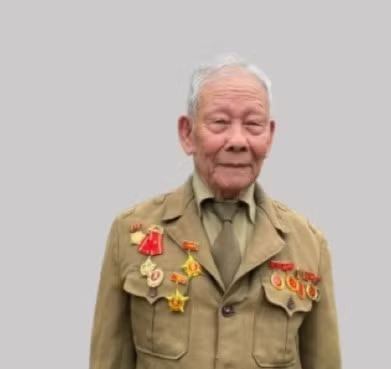
Veteran Luong Van Huong (Photo: VNA)

My comrades fell next to me, their bodies were removed and buried somewhere,” said the veteran from Le Loi commune, Gia Loc district, the northern province of Hai Duong, wearing his dark green military uniform decorated with medals.

Huong said after four of his 12-man squad died and two others were wounded in the first attack, four were supplemented to fill the vacancies, yet some of them lost their lives in the next attacks, their bodies even completely shattered by bombings. There were some platoons and squads wiped out entirely in a single day.

The 1954 battle in the rugged, remote valley killed thousands of soldiers on both sides in less than two months, from March 13 to May 7, as Vietnamese fighters hemmed in French forces - equipped with superior weapons - and bombarded them with heavy artillery.

It cost Vietnam 4,020 dead, 10,130 injured and 792 missing, with up to 3,976 fallen soldiers now resting at three cemeteries near Doc Lap (Independence), Him Lam and A1 hills where they fought, only four of them have been identified so far.

I was whimpering looking at dead soldiers all over the battlefield… I kept crying at night, I was only 16 then,” said Nguyen Duc Noi from Gia Tan commune, Gia Loc district, Hai Duong province.

“I had to face two things, one was the enemy and the other, death” the 88-year-old man said, recalling the last attack on the night of May 6 when he and his sleepless comrades had to carry countless wounded soldiers, many of them dead, back to shelter tunnels.

For Huong, the battle was even more fierce as he was fighting the enemy and getting informed that his little son was killed by French force raids back home.

Fierce thirst for independence

Driven by patriotism and a fierce thirst for independence, Huong and Noi, like tens of thousands of youths of their generation, headed to the frontline, fortified by bitter memories of foreign invasions throughout the nation’s history.

They were also buoyed by the call of the nation: "All for the frontline, all for victory."
Nguyen Duc Noi.jpg
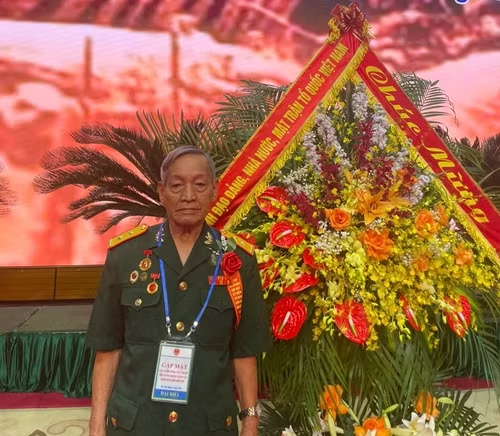
Veteran Nguyen Duc Noi at a meeting between Party and State leaders and Dien Bien soldiers and youth volunteers in Hanoi on April 23. (Photo: VNA)

“I was the youngest among my hometown boys to volunteer to go to the battle with the support of my mother,” Noi said, adding that he didn’t think much at that time and just wanted to follow his countrymen.

Huong was arrested during a raid by French forces in his village in 1950 and was jailed for one and a half months as he was a member of the National Salvation Youth Union Committee in the locality.

To get to the Dien Bien Phu battlefront in the Northwest, Huong and Noi trudged through forests for half a month from the central province of Thanh Hoa.

“We slept in jungles during the day and marched about four hours each night, with a gun and a 10-kg backpack on shoulders. Locals gave us rice, vegetables and other foods to survive,” Huong recalled.

For Noi, the most dangerous mission was individual reconnaissance, sometimes conducted by a small group of three, without water and food. “We had to quickly scout out enemy areas and chart maps,” said Noi, who had never received military training before.
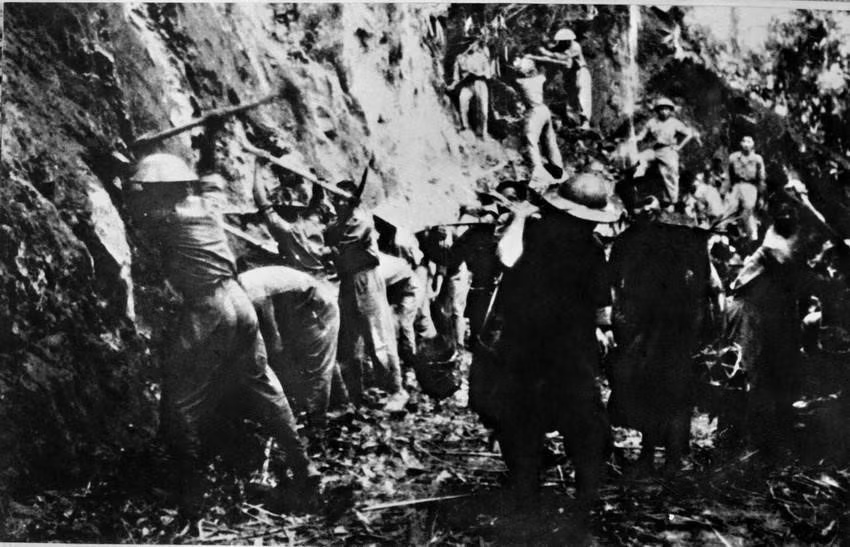
vna_potal_70_nam_chien_thang_dien_bien_phu_ca_nuoc_tap_trung_suc_manh_cho_mat_tran_dien_bien_phu__7268403 (2).jpg
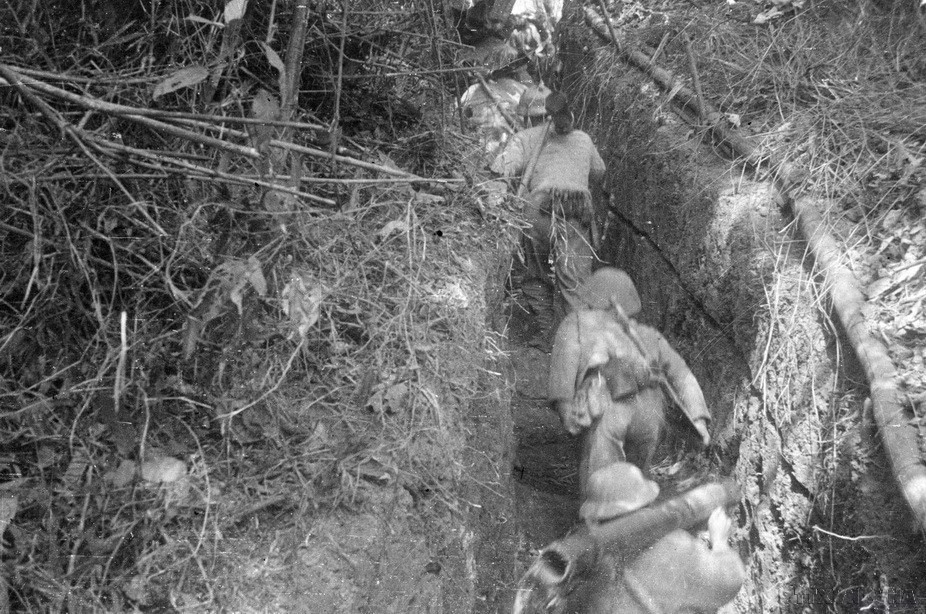
Soldiers and residents in the Northwest open routes to the Dien Bien Phu battlefield. (Photo: VNA)

Noi, Huong and all their comrades dug approach trenches and tunnels day and night, preparing for the historic battle at Dien Bien Phu, which was then the strongest fortified entrenched camp in Indochina under the Navarre Plan mapped out by French colonialists and US interventionists in the autumn - winter of 1953.

Peter Macdonald said in his book titled “The Victor in Vietnam: Giap”, first published in 1993, that “Perhaps, though, the most astonishing example of their digging ability was that when they took Dominique they did not establish positions on top of the hill, they dug right through it from behind; outwardly, it look as it always had, pock-marked and rugged; inside it was an ant’s nest of weapon pits.”

Heavy but glorious task

Noi said he was proud of joining all the major attacks from 1952 to 1954, notably one on the fortified French camp at Na San, the northwestern province of Son La, in 1952, when he was wounded, and another on the Dien Bien Phu fortress.
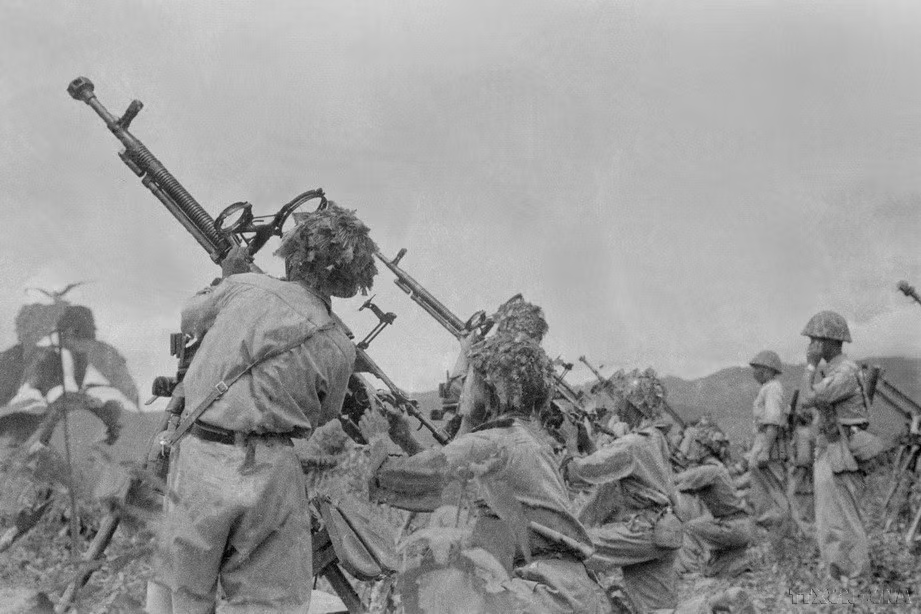
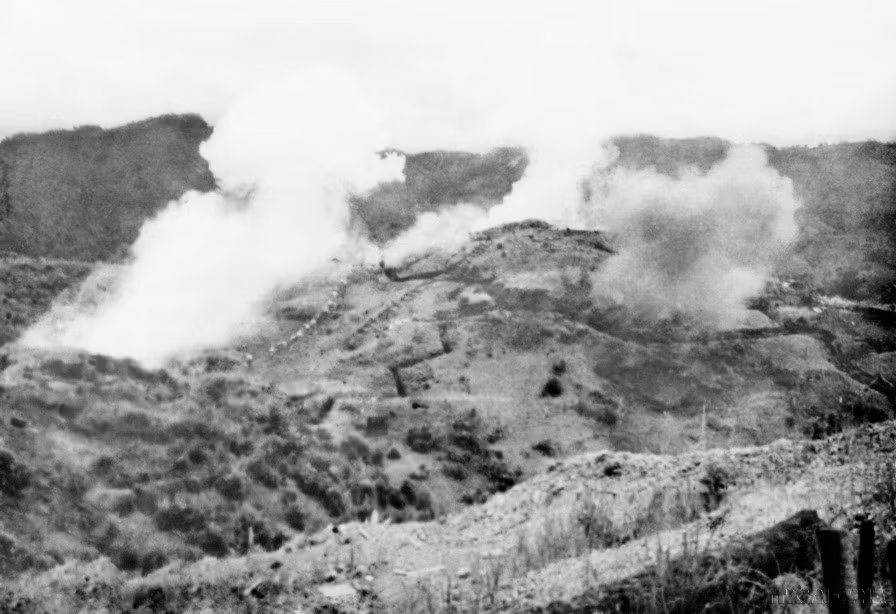
vna_potal_70_nam_chien_thang_dien_bien_phu_chien_dich_him_lam_danh_sap_“coi_xay_thit”_cua_tap_doan_cu_diem_“bat_kha_xam_pham”_7268677.jpg
vna_potal_70_nam_chien_thang_dien_bien_phu_chien_dich_him_lam_danh_sap_“coi_xay_thit”_cua_tap_doan_cu_diem_“bat_kha_xam_pham”_7268637.jpg
vna_potal_70_nam_chien_thang_dien_bien_phu_chien_dich_him_lam_danh_sap_“coi_xay_thit”_cua_tap_doan_cu_diem_“bat_kha_xam_pham”_7268671 (1).jpg
vna_potal_70_nam_chien_thang_dien_bien_phu_chien_dich_him_lam_danh_sap_“coi_xay_thit”_cua_tap_doan_cu_diem_“bat_kha_xam_pham”_115423289_7268643.jpg
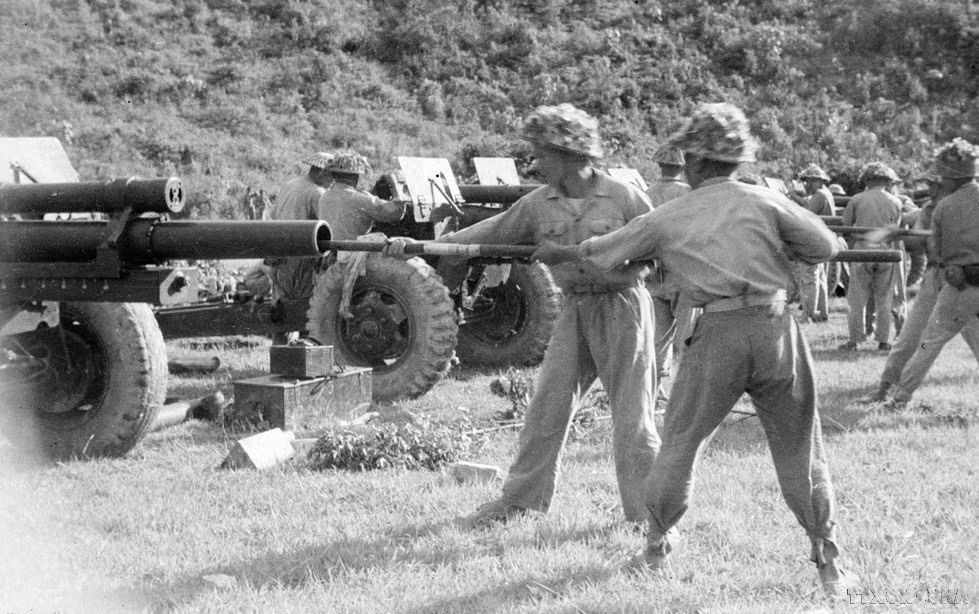
The soldiers always trust and follow the leadership of President Ho Chi Minh and the command of General Vo Nguyen Giap. (Photo: VNA)

Both the veterans said they had no idea about the much stronger power of the French forces or what were the tactics employed by President Ho Chi Minh and Vo Nguyen Giap in the Dien Bien Phu, but they always trusted and followed the leadership of President Ho Chi Minh and the command of General Vo Nguyen Giap.

The two veterans shared a firm belief that without the Party and its sound leadership, the globe-shaking victory would not be achieved.

Talking about the tremendous sacrifice of soldiers at Dien Bien Phu, the veterans expressed hope that present youths would carry forward the tradition of patriotism, consolidate their will and enrich their knowledge in order to contribute to national construction and development.

Professor Carl Thayer from the University of New South Wales said “Vietnam’s schools, universities and mass organisations should conduct educational programmes and conduct field trips to the Dien Bien Phu battlefield to remind the youths of today that Vietnam’s self-reliance and independence due to the sacrifice of those who fell to defeat the French.”

“Never was so much owed by so many to so few,” Thayer cited British statesman Winston Churchill./.
See more

“Google Digital Classroom”, a space that inspires passion and builds core digital skills for students. (Photo: VNA)

Hanoi scales up high-quality schools, raises standards

In addition to 23 accredited institutions, the city plans to establish 37 more, lifting the total to 60. The move signals a shift in approach rather than a mere technical adjustment, aligning with the Politburo’s Resolution 71-NQ/TW on education breakthroughs and Hanoi’s Action Programme 05-CTr/TU.

The exquisite mother-of-pearl inlaid cabinet that Lumban Sianipar meticulously brings back from Vietnam (Photo: VNA)

“Vietnam Museum” in the heart of Indonesia

The house of Lumban Sianipar, former Indonesian Defence Attaché in Vietnam, unfolds as a cultural journey through Vietnam, with walls adorned with mother-of-pearl inlay works, eggshell art, lacquer and oil paintings. Intricately crafted wooden cabinets, Bat Trang ceramics and various handicrafts are thoughtfully arranged, creating a space that is both elegant and warmly imbued with Vietnamese character.

More than 1,000 amateur performers take part in Ha Long Carnaval 2026. (Photo: VNA)

Ha Long Carnaval 2026 affirms cultural industry development mindset

More than a vibrant festival, Ha Long Carnaval 2026 served as a vivid demonstration of efforts to implement Resolution No. 80-NQ/TW of the Politburo on the development of Vietnamese culture, reaffirming Quang Ninh’s evolving mindset of turning heritage into a powerful internal resource to drive breakthroughs in cultural industries in a new era.

Numerous pieces of evidence and documents related to activities of individuals in “Hoi thanh Duc Chua Troi Me” (World Mission Society Church of God) are seized. (Photo: VNA)

Quang Tri warns of religious group promoting superstition for profit

A group linked to “Hoi thanh Duc Chua Troi Me” (World Mission Society Church of God) in Quang Tri reportedly operated under a tightly organised structure with direction from an overseas “head organisation”, employing various plans to approach and psychologically manipulate individuals.

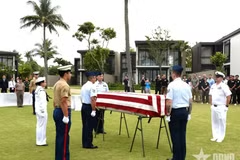
The 172nd repatriation ceremony of US serviceman’s remains held in Da Nang. (Photo: qdnd.vn)

Vietnam hands over more MIA remains to US

The remains were recovered during a recent joint Vietnam–US excavation in central Hue city. On April 27, Vietnamese and US forensic specialists conducted a preliminary examination, indicating the remains may be linked to a missing US serviceman. They will be sent to a forensic laboratory in Hawaii for further analysis and identification.

Activities within the Visit Vietnam Year – Hue 2025 attract a large number of visitors (Photo: VNA)

Ministry rolls out plan to promote national image

At its core, the plan emphasises mobilising the combined strength of the political system and society, linking communications with the promotion of cultural values and soft power of the country.

People donate blood at the launch of the Humanitarian Month 2026 in Hanoi on April 29. (Photo: VNA)

Humanitarian Month 2026 launched with community support activities

Over the past five years, Humanitarian Month campaigns have raised more than 3 trillion VND (nearly 114 million USD), assisting more than 6.6 million people. Beyond figures, the initiative has helped strengthen social trust and foster compassion across society.

The groundbreaking ceremony for the Truong Sa Museum in Cam Lam commune, the south central province of Khanh Hoa, on April 29 (Photo: VNA)

Truong Sa Museum to honour generations safeguarding national sovereignty

The museum covers a total area of approximately 17,100 square metres, with total investment estimated at 299.7 billion VND (11.37 million USD). Funding for the project is provided through sponsorship from Vinhomes JSC, and construction is expected to be completed in the first quarter of 2028.

Social housing projects help meet the housing needs of low-income earners and workers, while contributing to sustainable urban development. (Photo: VNA)

Social housing construction target exceeds by 44%

Minister of Construction Tran Hong Minh has issued an official dispatch urging localities to accelerate the development of social housing projects to meet the target of more than 158,700 units in 2026, as set out in Government Resolution No. 7/NQ-CP.

Deputy Director of the Ministry of Home Affairs’ Department of Local Government Nguyen Thi Tu Thanh speaks at the press briefing. (Photo: VNA)

Two-tier local administration model runs smoothly: ministry

After slashing layers of bureaucracy and pushing more power down to the commune level, a substantial volume of work has shifted to the grassroots officials. In many areas, the workforce is unevenly skilled, with a shortage of specialists. Additionally, certain units operate across multiple locations, making management, coordination, and day-to-day operations a real mess.