Shipbuilding industry poised to become new growth engine

Vietnam’s shipbuilding industry could emerge as a new growth pillar if developed as a comprehensive maritime industry ecosystem, with stronger supporting industries, technological self-reliance, modern logistics and deeper integration into global value chains, said insiders.

The development of the shipbuilding industry also lays the foundation for large-scale logistics and maritime industry centres. (Photo: VietnamPlus)

Hanoi (VNA) – Vietnam’s shipbuilding industry could emerge as a new growth pillar if developed as a comprehensive maritime industry ecosystem, with stronger supporting industries, technological self-reliance, modern logistics and deeper integration into global value chains, said insiders.

Shipbuilding is not merely a manufacturing sector but a foundational industry capable of generating broad spillover effects across the economy. Its development is closely linked with mechanical engineering, metallurgy, electronics, automation, information technology and maritime logistics.

Each shipbuilding order generates demand across an entire industrial ecosystem

Dr. Pham Hoai Chung, Vice Chairman of the Vietnam Shipbuilding Industry Association (VISIA), underlined the right direction by General Secretary of the Communist Party of Vietnam Central Committee and President To Lam, who requested positioning the national maritime industry appropriately in the strategy for developing Vietnam into a strong maritime nation.

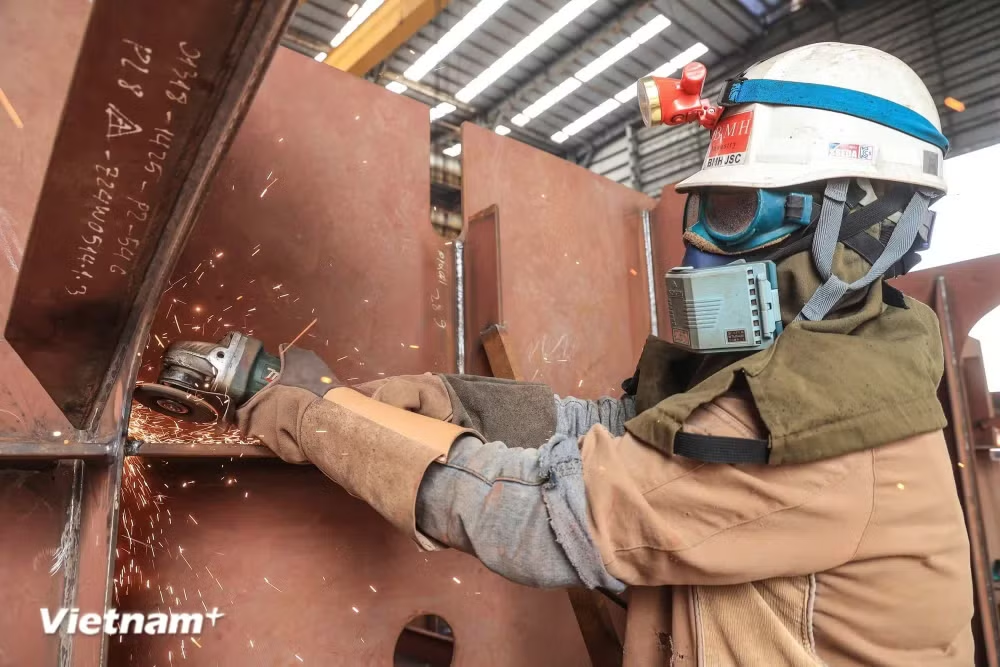
He stressed that shipbuilding should be viewed as a foundational industry with significant spillover effects. Each shipbuilding order generates demand for production, supplies and services across a wider industrial ecosystem, including steel, mechanical engineering, electronics and automation, while creating substantial employment for skilled workers.
tau2.jpg
Shipbuilding is not merely a manufacturing sector but a “backbone” industry. (Photo: VietnamPlus)

Investment in the shipbuilding industry should be viewed as a long-term national industrial development strategy. If developed in tandem with supporting industries, maritime logistics, science and technology, this industry can become a new growth engine and directly contribute to the realisation of the double-digit economic growth target in the coming period, Chung said.

He noted that the competitiveness of the shipbuilding industry cannot be separated from the development of supporting industries. Leading shipbuilding nations such as China, the Republic of Korea and Japan have built comprehensive maritime supporting-industry ecosystems and mastered core technologies, including high-quality shipbuilding steel, marine engines, control and automation systems, marine electronics and green-ship technologies.

“In modern shipbuilding, countries no longer compete simply by assembly capacity, but by the development of supporting industries and their mastery of core technologies across the maritime value chain,” Chung said.
tau3.jpg
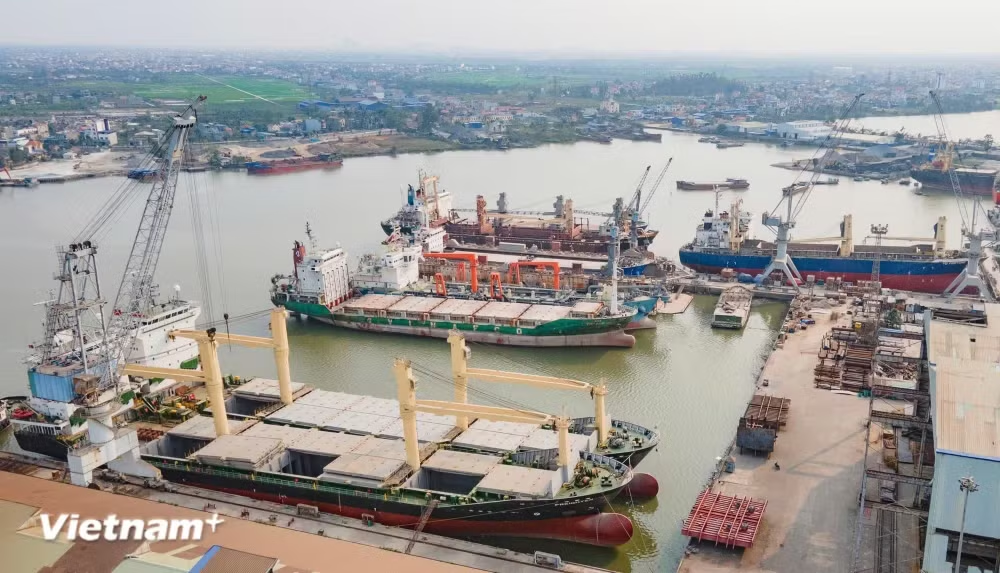
Each shipbuilding order generates demand for production, supplies and services across an entire industrial ecosystem. (Photo: VietnamPlus)

This approach is also consistent with the Political Bureau’s Resolution No. 57-NQ/TW, which identifies science – technology development, innovation and national digital transformation as strategic breakthroughs for improving the economy’s productivity, growth quality, and competitiveness.

Opportunities for the shipbuilding industry

Tran Manh Ha, General Director of the Shipbuilding Industry Corporation (SBIC), said General Secretary and President Lam’s direction has opened up opportunities for the shipbuilding industry, maritime transport, maritime industry and related services.

SBIC’s shipbuilding and ship-repair enterprises are pushing ahead with restructuring and recovery efforts under the Government’s Resolution No. 220 while maintaining jobs and stable incomes for their employees and preserving their production foundations.

Many shipyards have orders secured through 2028 and even 2030. At the same time, they are working to improve quality, accelerate production, reduce costs and increase profit margins from new contracts, he added.
tau4.jpg
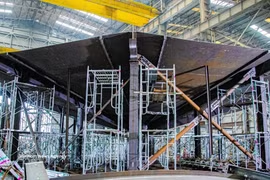
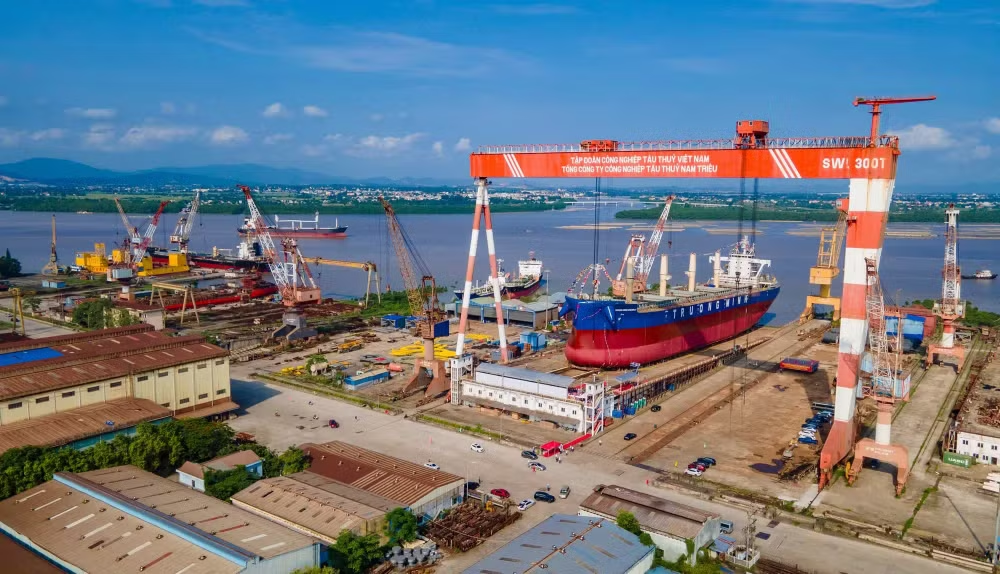
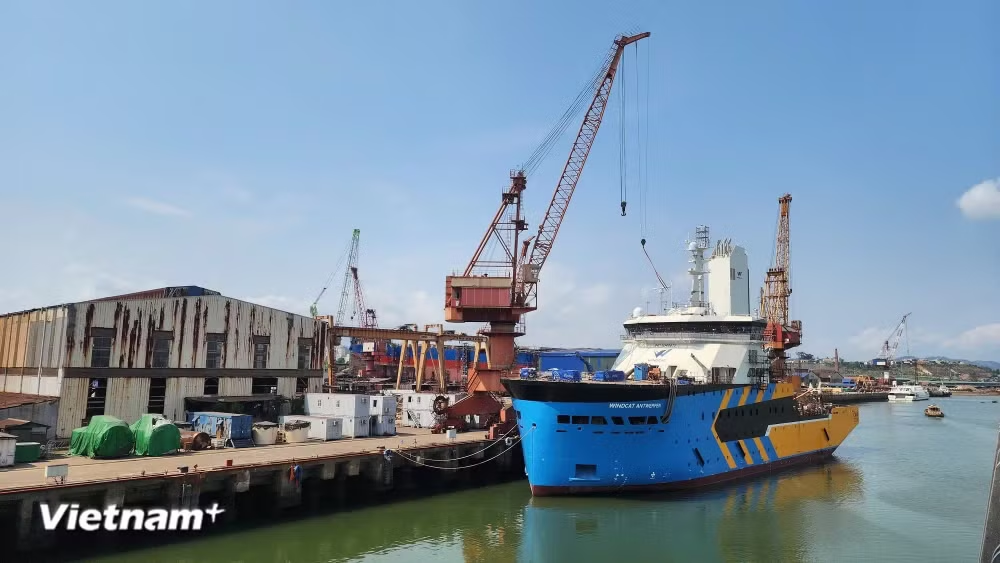
SBIC’s shipbuilding enterprises are capable of building almost all major types of vessels, from general cargo ships, bulk carriers, oil tankers and car carriers to offshore wind vessels. (Photo: VietnamPlus)

Stable employment has made SBIC’s subsidiaries increasingly attractive to workers. Recruitment has shown positive signs although the companies still have to provide more training for new recruits, Ha said, adding that they continue to train and develop managers and technicians to maintain a core workforce for the development of Vietnam’s shipbuilding industry.

With SBIC building and delivering various types of vessels to domestic and foreign shipowners, the industry can supply modern vehicles, helping reduce dependence on imported ships, cut operating costs, strengthen national transport capacity and improve the stability of logistics chains.
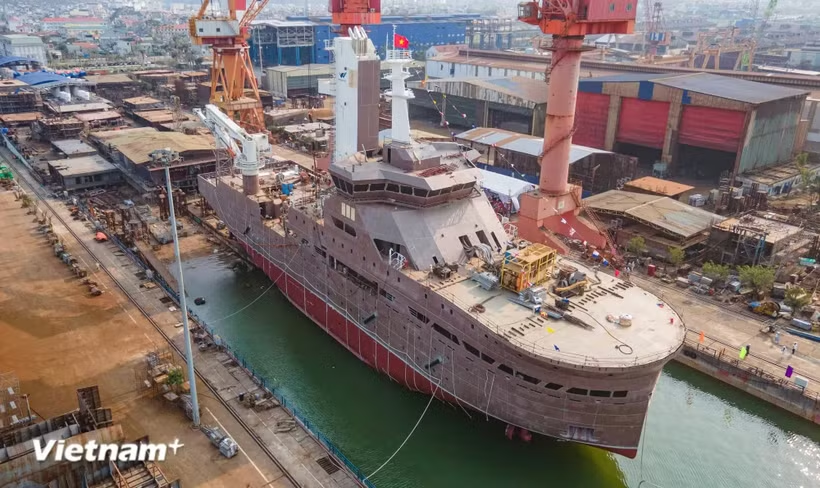
Ha Long Shipbuilding Company builds CSOV offshore wind service vessels, which require high standards throughout both shipbuilding and operation. (Photo: VietnamPlus)

Ha Long Shipbuilding Company builds CSOV offshore wind service vessels, which require high standards throughout both shipbuilding and operation. (Photo: VietnamPlus)

Shipbuilding development will also lay a cornerstone for large-scale logistics and maritime industry centres to take shape. He said that a modern shipbuilding ecosystem encompasses not only shipyards but also seaports, supporting industrial parks, warehouses, maintenance and repair centres, technical services and maritime supply networks, helping improve links among production, transport and import-export activities and reduce intermediate logistics costs.

He believes that with favourable institutional conditions for international integration, stronger ship design and technology transfer, and participation in dual-use shipbuilding, Vietnamese shipbuilders could integrate rapidly into the global market and further establish their position among the world’s major shipbuilding nations./.

VNA

See more

Ben Thanh Market in Ho Chi Minh City attracts a large numbers of domestic and international visitor.( Photo: VNA)

Vietnam targets 50 million international visitors by 2030

The Ministry of Culture, Sports and Tourism has outlined three scenarios for 2027–2030. Under the high-growth scenario, international arrivals would rise 15–18 percent annually to reach 45–50 million, while domestic tourism would reach around 160 million trips. Total tourism revenue is projected at 80–90 billion USD.

Factories and production facilities in the Chu Lai Open Economic Zone, Da Nang city, are equipped with modern production lines. (Photo: VNA)

Ready-built factories gain from new manufacturing FDI wave

Ready-built factories attracted 73% of new manufacturing FDI in northern Vietnam over the past two quarters, as foreign investment continued to surge at the region's industrial hubs during the first eight months of 2026. The trend points to growing demand for premises that can be put into operation quickly.

Vietnamese durian industry pivots from volume to value

Vietnamese durian industry pivots from volume to value

Durian has morphed from a high-value crop into a strategic Vietnamese export. But as output climbs and importing markets tighten rules on quality, food safety and traceability, the industry must pivot from volume growth to sustainable value chains, better quality and diversified markets.

A display area for Mid-Autumn Festival cakes at a supermarket (Photo: VNA)

Mid-Autumn Festival cake market heats up at affordable end

Industry insiders say competition is no longer just about the cake itself. Product quality, packaging, brand reputation, delivery services and personalisation are increasingly shaping consumer choices in a market crowded with both domestic and foreign players.

Minister of Foreign Affairs Le Hoai Trung (Photo published by VNA)

Vietnam, India set 25 billion USD trade goal

Vietnam and India agreed to make better use of complementary strengths, ease market access difficulties and facilitate business activities toward achieving the 25 billion USD bilateral trade target.

Delegates at the meeting between Vietnamese businesses operating in Cambodia and the Council for the Development of Cambodia (CDC) on September 14. (Photo: VNA)

Vietnamese businesses seek to expand investment in Cambodia

Vietnam currently has 223 investment projects in Cambodia with total registered capital of nearly 3.4 billion USD. Vietnamese companies operate in agriculture, particularly large-scale farming, finance and banking, telecommunications, aviation, processing, trade and services.

Children visit President Ho Chi Minh's hometown and learn about his childhood. (Photo: VNA)

Vietnam's tourism sector faces labour shortage

A 2026 survey by Hoteljob.vn found that nearly 90% of tourism businesses planned to recruit. In Ho Chi Minh City alone, 89.7% of businesses were hiring, while 71.8% said recruitment was difficult or very difficult. The biggest shortages were among frontline workers, particularly in housekeeping, engineering, food service, front-office operations, and kitchens.

Octopus processing for export at Huy Nam Company in An Giang province. (Photo: VNA)

New opportunities for Vietnam’s seafood exports

The Vietnam-EFTA Free Trade Agreement brings together two groups of highly complementary economies. EFTA members Switzerland, Norway, Iceland and Liechtenstein have strengths in technology, innovation, finance, clean energy and sustainable development, while Vietnam is one of Asia’s most dynamic economies and is emerging as a major regional manufacturing, trade and investment hub.

The saponin content of Lai Chau ginseng can reach as high as 23.85% in its natural state, a remarkably high level compared to many other ginseng species. (Photo: baolaichau.vn)

Lai Chau ginseng development gains momentum

Blessed with rare and distinctive ecological values, the northern mountainous province of Lai Chau is stepping up efforts to conserve and develop its native ginseng, with the medicinal plant expected to play a growing role in the forest-based economy and local livelihoods.