Strong earthquake hits Malaysia

A 6-magnitude earthquake shook Sabah state on Borneo island of Malaysia on early June 5, but no tsunami warning is issued, according to the US Geological Survey (USGS).
A 6-magnitude earthquake shook Sabah state on Borneo island ofMalaysia on early June 5, but no tsunami warning is issued, according tothe US Geological Survey (USGS).

The quake struck at a depth of 10 km with its epicentre located 54 km from Kota Kinabalu city.

The epicentre was initially determined to be at 6.084 degrees north latitude and 116.5489 degrees east longitude.

No injuries and damage have been reported so far.

Strong quakes rarely occur in Malaysia though the country sits justoutside the Ring of Fire – a belt of seismic activity running around thebasin of the Pacific Ocean.-VNA


See more

The scene of the fire at the Fonusa Agung Mulia factory in Indonesia’s Banten province on November 22 (Photo: Xinhua/VNA)

Fire leaves 40 missing in Indonesia

Indonesian rescue forces are searching for 40 people missing after a fire broke out at a confectionery and sugar products factory in western Jakarta.

Malaysia prioritises domestic rare earth processing industry

Malaysia prioritises domestic rare earth processing industry

The Malaysian government has established a mechanism to consider the limited and conditional export of REE for research, development and processing purposes, aiming to develop the entire mineral industry value chain, covering upstream mining, midstream processing and separation, and downstream production of high-value-added products.

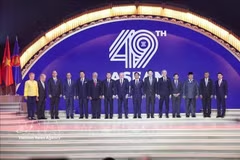
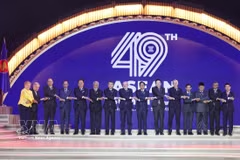
ASEAN Secretary-General Kao Kim Hourn announces the outcomes of the 49th ASEAN Summit and related meetings at the ASEAN headquarters in Jakarta, Indonesia, on November 18, 2026. (Photo: VNA)

49th ASEAN Summit highlights action-oriented regional cooperation

As 2026 marks the first year of implementing the ASEAN Community Vision 2045, leaders underlined the bloc's solidarity and centrality as well as closer coordination among the three community pillars in response to global economic uncertainties and security challenges, with priorities including digital transformation, AI application, energy security and supply chain resilience.

ASEAN Secretary-General Kao Kim Hourn (Photo: VNA)

Growing together: 11 nations, one ASEAN home

The new emblem signals an ASEAN that is growing more inclusive while holding to its founding principles of building a peaceful, stable, dynamic region based on equality and cooperation. Its colours come from member states’ national emblems, reflecting diversity inside a single community.

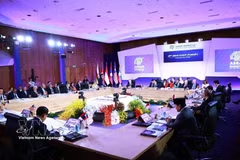
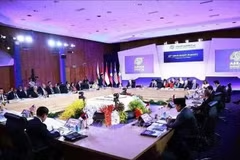
An overview of the dialogue between ASEAN leaders and the ASEAN Business Advisory Council (ASEAN-BAC) in Manila on November 15 (Photo: VNA)

Vietnam puts forward priorities to advance ASEAN cooperation

Appreciating ASEAN-BAC’s report and recommendations, Deputy Minister of Foreign Affairs Dang Hoang Giang, head of Vietnam’s ASEAN Senior Officials’ Meeting (SOM) delegation, called for simplifying procedures, reducing costs, accelerating digitalisation, upgrading the ASEAN Single Window (ASW) and effectively implementing the ASEAN Digital Economy Framework Agreement (DEFA) to make the regional market more accessible.

ASEAN signs Digital Economy Framework Agreement

ASEAN signs Digital Economy Framework Agreement

The Digital Economy Framework Agreement (DEFA), the bloc’s first standalone and legally binding digital economy agreement, establishes common rules covering digital trade, cross-border data flows, electronic payments, cyber security and artificial intelligence (AI).

Minister Counsellor Nguyen Hai Luu, Deputy Permanent Representative of Vietnam to the UN, speaks at the discussion on November 12, 2026. (Photo: VNA)

Vietnam supports peace, reconstruction efforts in Gaza: diplomat

Minister Counsellor Nguyen Hai Luu, Deputy Permanent Representative of Vietnam to the UN, expressed deep concern over the dire humanitarian situation in Gaza, particularly as recent heavy rains and flooding have worsened living conditions for residents.

Thailand diversifies oil sources to ensure energy security

Thailand diversifies oil sources to ensure energy security

Although the diversification of oil import sources has helped reduce the risk of domestic oil shortage, it has not immediately reduced energy costs because import prices depend on market mechanisms, transportation costs, foreign exchange rates and the terms of oil contracts.