Malaysia prioritises domestic rare earth processing industry

The Malaysian government has established a mechanism to consider the limited and conditional export of REE for research, development and processing purposes, aiming to develop the entire mineral industry value chain, covering upstream mining, midstream processing and separation, and downstream production of high-value-added products.

Kuala Lumpur (VNA) – Malaysia will maintain its moratorium on raw rare earth element (REE) exports, which took effect on January 1, 2024, to promote domestic processing and reduce reliance on the export of unprocessed mineral resources.

Deputy Minister of Natural Resources and Environmental Sustainability Minister Syed Ibrahim Syed Noh said on November 19 that the government established a mechanism to consider the limited and conditional export of REE for research, development and processing purposes, following a Cabinet decision on July 15.

He said the policy aims to develop the entire mineral industry value chain, covering upstream mining, midstream processing and separation, and downstream production of high-value-added products.

Malaysia's REE industry development is guided by the third National Mineral Policy, approved by the Cabinet on January 17, 2024, which focuses on developing the full value chain, from extraction to the manufacturing of value-added products.

On October 1, the Ministry of Natural Resources and Environmental Sustainability also issued guidelines for reviewing applications to export raw REE. The guidelines aim to ensure that approved exports contribute to technology development, skills enhancement and the establishment of domestic processing facilities.

Regarding environmental protection, Syed Ibrahim stressed that all REE mining activities must comply with relevant laws and approval conditions, including environmental impact assessment requirements and approved mining plans.

The Malaysian government will strengthen monitoring of water quality, waste management and environmental rehabilitation at mining sites, while taking strict enforcement action against violations, he said.

On international cooperation, the official said Malaysia's partnership with France in the REE industry focuses on technology development, technical knowledge exchange and the building of the entire value chain.

Malaysia is also open to negotiations with other countries, including the US, Japan and India, to attract strategic partnerships. However, technological mastery and national sovereignty over its natural resources will remain top priorities, he added./.

VNA

See more

ASEAN Secretary-General Kao Kim Hourn announces the outcomes of the 49th ASEAN Summit and related meetings at the ASEAN headquarters in Jakarta, Indonesia, on November 18, 2026. (Photo: VNA)

49th ASEAN Summit highlights action-oriented regional cooperation

As 2026 marks the first year of implementing the ASEAN Community Vision 2045, leaders underlined the bloc's solidarity and centrality as well as closer coordination among the three community pillars in response to global economic uncertainties and security challenges, with priorities including digital transformation, AI application, energy security and supply chain resilience.

ASEAN Secretary-General Kao Kim Hourn (Photo: VNA)

Growing together: 11 nations, one ASEAN home

The new emblem signals an ASEAN that is growing more inclusive while holding to its founding principles of building a peaceful, stable, dynamic region based on equality and cooperation. Its colours come from member states’ national emblems, reflecting diversity inside a single community.

An overview of the dialogue between ASEAN leaders and the ASEAN Business Advisory Council (ASEAN-BAC) in Manila on November 15 (Photo: VNA)

Vietnam puts forward priorities to advance ASEAN cooperation

Appreciating ASEAN-BAC’s report and recommendations, Deputy Minister of Foreign Affairs Dang Hoang Giang, head of Vietnam’s ASEAN Senior Officials’ Meeting (SOM) delegation, called for simplifying procedures, reducing costs, accelerating digitalisation, upgrading the ASEAN Single Window (ASW) and effectively implementing the ASEAN Digital Economy Framework Agreement (DEFA) to make the regional market more accessible.

ASEAN signs Digital Economy Framework Agreement

ASEAN signs Digital Economy Framework Agreement

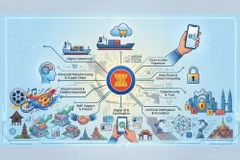
The Digital Economy Framework Agreement (DEFA), the bloc’s first standalone and legally binding digital economy agreement, establishes common rules covering digital trade, cross-border data flows, electronic payments, cyber security and artificial intelligence (AI).

Minister Counsellor Nguyen Hai Luu, Deputy Permanent Representative of Vietnam to the UN, speaks at the discussion on November 12, 2026. (Photo: VNA)

Vietnam supports peace, reconstruction efforts in Gaza: diplomat

Minister Counsellor Nguyen Hai Luu, Deputy Permanent Representative of Vietnam to the UN, expressed deep concern over the dire humanitarian situation in Gaza, particularly as recent heavy rains and flooding have worsened living conditions for residents.

Thailand diversifies oil sources to ensure energy security

Thailand diversifies oil sources to ensure energy security

Although the diversification of oil import sources has helped reduce the risk of domestic oil shortage, it has not immediately reduced energy costs because import prices depend on market mechanisms, transportation costs, foreign exchange rates and the terms of oil contracts.

ST Telemedia Global Data Centres (Thailand), an affiliate of Singapore Telecom, is developing three data cehtres in Thailand including this facility on Rama IX Road in Bangkok. (Photo: bangkokpost)

Thailand tightens regulations on data centres

The new rules focus on controlling investment scale, electricity and water consumption, environmental impacts, and preventing investors from reserving resource quotas beyond their actual needs.

A road is under construction in Dong Nai city, Vietnam. (Photo: VNA)

ADB: Southeast Asia needs 7.1 trillion USD in infrastructure investment by 2040

ADB estimates that the region will need an average of 476 billion USD in infrastructure investment annually during 2026–2040, equivalent to 8.7% of GDP. However, at current investment levels, government budget resources would cover only around 45% of this demand, leaving an annual financing gap of 264 billion USD.