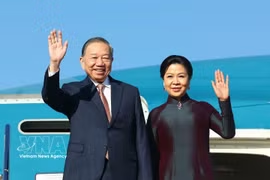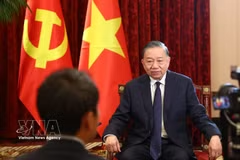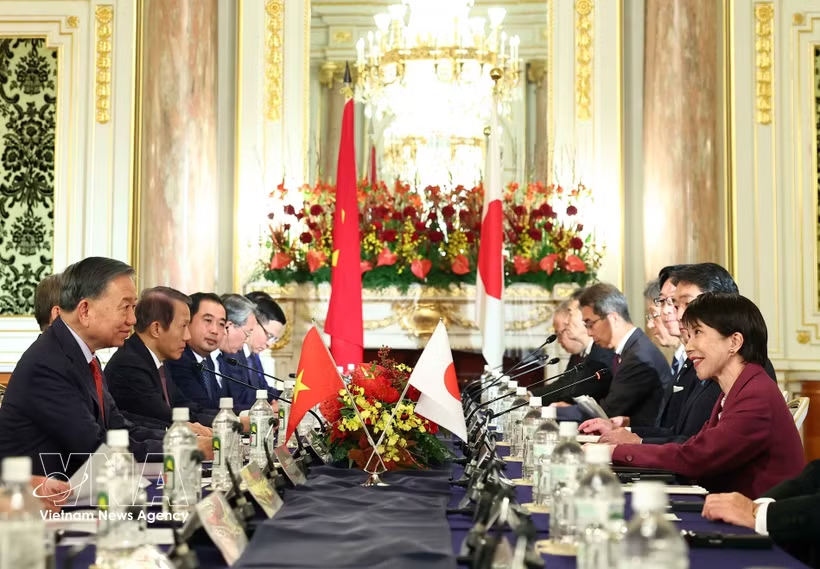
Hanoi (VNA) – Pasaxon, the official newspaper of the Lao People’s Revolutionary Party Central Committee, published an editorial on November 11 affirming that the official visit to Japan by General Secretary of the Communist Party of Vietnam Central Committee and President To Lam, his spouse and a high-level Vietnamese delegation from November 8 to 11 yielded significant results, contributing to peace, stability and cooperation in Southeast Asia, including Laos.
The editorial noted that the visit took place amid continued changes in the regional and international landscape, intensifying strategic competition among major powers and mounting challenges to the global economy, as countries stepped up adjustments to their development strategies, with a stronger focus on economic security and supply chain diversification.
Against this backdrop, General Secretary and President Lam’s official visit to Japan was regarded as an important diplomatic event that would strengthen Vietnam-Japan ties, expand the framework for cooperation and create fresh momentum for the socio-economic development of both countries.
Reviewing the visit’s major achievements, the editorial highlighted its outcomes in various fields, including politics, economy, science, technology and innovation, human resources training, and people-to-people ties.
Assessing the visit from a regional perspective, the editorial affirmed that General Secretary and President Lam’s official visit to Japan was significant not only for bilateral relations but also reflected the trend towards stronger cooperation among Asian countries amid an increasingly complex international geopolitical and economic environment. Vietnam and Japan’s efforts to promote cooperation in the economy, technology, energy and economic security indicate that the two countries are working towards a high-level mutually supportive partnership, helping strengthen their capacity to respond to external shocks.
For Vietnam, Japan is also an important partner in mobilising development resources, accessing advanced technologies, training human resources and improving its position in regional and global value chains. The new cooperation commitments, particularly in science and technology, energy and human resources development, are expected to help Vietnam achieve its socio-economic development goals, strengthen its ability to determine its own strategic course and improve the quality of growth.
For Japan, Vietnam is an important partner in Southeast Asia, with a dynamic market, a strong workforce and a favourable geoeconomic position. Stronger cooperation with Vietnam will enable Japan to expand its investment network, diversify supply chains, promote technological cooperation and deepen its links with ASEAN, in line with Japan’s policy of promoting a free, open, peaceful and stable Indo-Pacific region.
From Laos’ perspective, the editorial observed that the increasingly deep Vietnam-Japan relationship represents a positive development for the environment for cooperation and development in Southeast Asia. Vietnam is a neighbour with which Laos shares longstanding friendship and comprehensive cooperation, while Japan is one of ASEAN and the Mekong region’s important development partners. Stronger Vietnam-Japan cooperation in infrastructure, energy, science and technology, green transition and human resources development could help promote regional economic integration, broaden opportunities for cooperation and enhance the development capacity of Southeast Asian countries.
In particular, as countries in the Mekong subregion face numerous challenges related to economic development, energy security, the transition to new growth models and climate change response, stronger partnerships can help mobilise capital, technology and development experience. The stable and substantive development of Vietnam-Japan relations could create further favourable conditions for promoting regional cooperation initiatives, strengthening links between ASEAN and its partners, and enhancing the region’s economic autonomy and resilience in the face of fluctuations.
Furthermore, Vietnam and Japan’s affirmation that they would continue coordination within multilateral mechanisms, particularly ASEAN and APEC, shows that both countries attach importance to regional cooperation in addressing shared challenges.
For Laos, as an ASEAN member and a country in the Mekong subregion, a peaceful, stable, cooperative and development-oriented environment is essential to achieving its socio-economic development goals, deepening regional integration and improving people’s living standards.
Drawing lessons from the visit and the achievements of Vietnam-Japan cooperation, Laos should proactively study and apply relevant experience and make use of similar cooperation opportunities to serve its national development goals.
The editorial concluded that General Secretary and President Lam’s official visit to Japan achieved important results, providing fresh impetus for the comprehensive, practical and effective development of Vietnam-Japan relations.
The adoption of the Joint Vision Statement, the signing of cooperation documents and the identification of priority areas for the next phase demonstrate the strong political will of the two countries’ leaders. Amid continued regional and international uncertainties, stronger Vietnam-Japan ties, with a focus on high-quality growth, strategic autonomy and sustainable development, will serve not only the interests of the two countries but also help consolidate peace and stability and promote cooperation across Asia, including Southeast Asia and the Mekong subregion./.