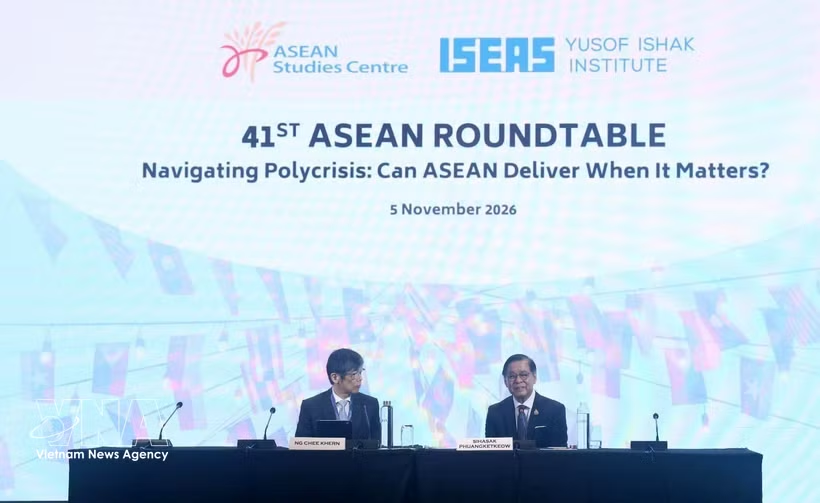
Singapore (VNA) - Thai Deputy Prime Minister and Minister of Foreign Affairs Sihasak Phuangketkeow stressed on November 5 that ASEAN needs to reform its working methods, strengthen its resilience and enhance coordination to proactively address overlapping crises, rather than merely responding after challenges emerge.
Sihasak made the remarks in his keynote address at the 41st ASEAN Roundtable, organised by the Yusof Ishak Institute (ISEAS) under the theme “Navigating Polycrisis: Can ASEAN Deliver When It Matters?” on November 5 in Singapore, The Straits Times reported.
He noted that no single member state could tackle challenges ranging from major-power competition and economic fragmentation to climate change and energy and food security on its own. Regional cooperation is therefore a strategic imperative, enabling ASEAN not only to overcome crises but also to sustain its development momentum.
Regarding ASEAN’s working methods, the Thai official proposed applying the principle of consensus more flexibly to prevent prolonged decision-making processes from delaying responses to urgent situations.
He also called for a stronger role for the ASEAN Chair and the continued use of the “Troika” mechanism, comprising the previous, current and incoming ASEAN Chairs, to ensure continuity in regional coordination and the handling of emerging issues.
He outlined three priorities for ASEAN: promoting regional integration, strengthening resilience and ensuring that cooperation delivers tangible benefits to the people. Intra-ASEAN trade currently accounts for less than 25% of the bloc’s total trade, indicating considerable room to expand markets, remove non-tariff barriers and advance the ASEAN Digital Economy Framework Agreement (DEFA).
To enhance its resilience to external shocks, ASEAN needs to diversify supply chains, develop the ASEAN Power Grid, expand cross-border trade in clean electricity and strengthen emergency food reserves. Sihasak cited the power integration project involving Laos, Thailand, Malaysia and Singapore as an example of practical cooperation. He added that the bloc’s effectiveness should also be reflected in its ability to create jobs, combat online scams and address risks arising from artificial intelligence (AI).
Addressing regional issues, the Thai Deputy PM stressed that differences between Thailand and Cambodia should be managed and resolved through dialogue and peaceful means in accordance with international law, without undermining ASEAN unity or its common agenda.
On Myanmar, he reaffirmed that ASEAN’s Five-Point Consensus remains an important framework, but stressed the need to translate it into feasible and concrete steps. Thailand is pursuing a parallel approach, addressing issues directly along the border while maintaining contacts and promoting broader dialogue among relevant parties.
On maritime security, the Thai official underscored the importance of freedom of navigation, the right of peaceful passage and compliance with international law. He also called for stronger coordination to ensure the safety of energy and goods transport routes amid geopolitical uncertainties.
He further stressed that ASEAN should accelerate the harmonisation of procedures, reduce trade barriers and expand cooperation with the European Union (EU)./.
ASEAN–China Dialogue spotlights AI, digital education
Discussions ran across three topics: AI-based innovation in future teaching and learning, AI in professional education and specialised practice, and digital transformation and regional cooperation ecosystems.