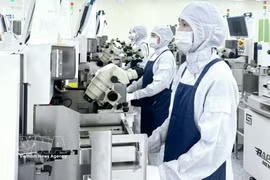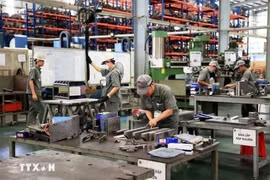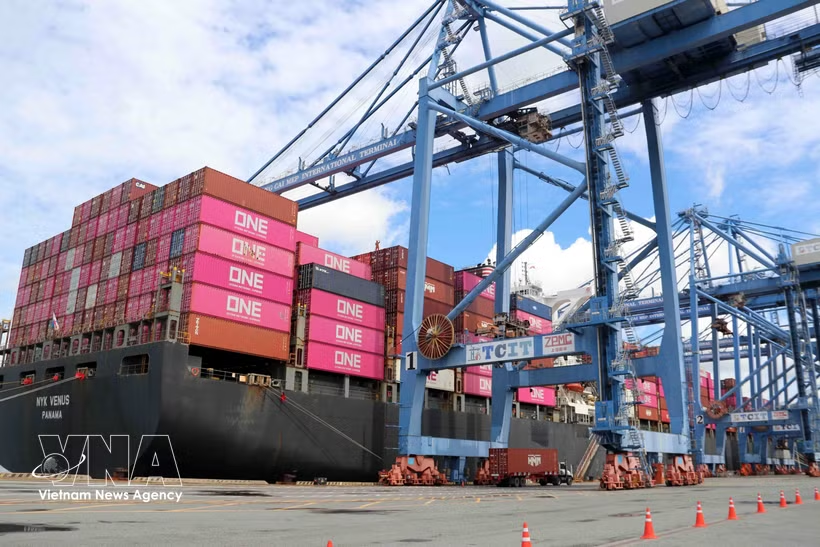
Jakarta (VNA) – An article entitled “Indonesia’s Factories Lag as Vietnam Races Ahead”, recently published by the Jakarta Globe, has noted that Indonesia’s manufacturing sector is struggling to compete with Vietnam, which boasts faster economic growth, a more stable investment environment and an increasingly developed industrial base, thereby attracting global manufacturers.
The article noted that Indonesia’s economy grew 5.47% year-on-year in the third quarter of 2026, its highest Q3 growth since 2023. Vietnam, meanwhile, recorded growth of 9.95%, despite having a nominal GDP nearly three times smaller. Vietnam’s industrial and construction sector expanded 11.2% in the first nine months while industrial production rose 12.3%.
The newspaper said that Vietnam’s GDP per capita is expected to increase 8.9% to 5,259 USD in 2026, surpassing Indonesia’s projected 5,153 USD. This would place Vietnam fifth in ASEAN, after Singapore, Brunei, Malaysia and Thailand.
Bob Azam, chairman of employment and manpower division at the Indonesian Employers Association (Apindo), attributed the shift partly to differences in economic growth and exchange rate movements. The Indonesian rupiah has depreciated by around 8% while the Vietnamese dong has appreciated 1.9%.
He stressed that Indonesia needs to improve not only growth rates but also growth quality by developing integrated supply chains, modernising agriculture and promoting both high-tech industries and export-oriented manufacturing. Removing investment barriers, particularly in licensing procedures, land costs and workforce skills, is also essential.
Mohammad Faisal, executive director of CORE Indonesia, said Vietnam’s appeal goes beyond relatively low labour costs, citing consistent policies, clear regulations and long-term investment incentives. Investors, he noted, prioritise stability and predictability in the business environment.
The writing traced Vietnam’s economic transformation to the Doi Moi (Renewal) process launched in 1986, which gradually opened the economy to international trade and foreign investment. Realised foreign direct investment reached 27.62 billion USD in 2025, up 9% year-on-year and the highest in five years.
Vietnam has also benefited from global manufacturers diversifying production away from China amid US trade tensions, attracting major companies such as Samsung and Foxconn. Its industrial structure is gradually shifting towards higher-value electronics and technology manufacturing.
The country’s export performance further demonstrates this progress. In 2025, Vietnam’s merchandise exports exceeded 475 billion USD, significantly higher than Indonesia’s approximately 282.5 billion USD.
Yusuf Rendy Manilet, a researcher at CORE Indonesia, said Indonesia would find it difficult to achieve Vietnam’s position in the short term but could establish itself as a manufacturing and distribution hub for ASEAN by reducing inter-island transport costs and ensuring more consistent industrial policies.
Meanwhile, Nailul Huda, director of digital economy at the Centre of Economic and Law Studies (CELIOS), described Indonesia as a “high-cost economy”, citing taxes, import barriers and expensive raw materials. He also pointed to its investment efficiency, with an incremental capital-output ratio (ICOR) of 6.4, compared with around 4.2 in Vietnam.
The Jakarta Globe, also highlighted difficulties surrounding Chinese automaker BYD’s 887-million-USD electric vehicle factory project in West Java, which is facing pressure from local groups demanding more employment opportunities for residents.
Despite these challenges, Indonesia’s manufacturing sector has shown signs of recovery. Its manufacturing Purchasing Managers’ Index (PMI) rose to 54 points in October 2026 from 52.4 in September, marking its strongest expansion since March 2024./.
See more
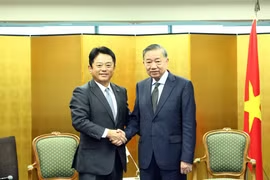
Vietnam’s top leader seeks more investment, cooperation from Japan: Japanese media
The Vietnamese leader said he hopes Japanese businesses will expand their investments and cooperation as there is a need for his country to develop human talent and enhance technological capability in advanced fields such as semiconductors, AI and clean energy.
Laos considers opening BRICS Women’s Business Alliance representative office
A representative office in Laos could help connect business networks, create new opportunities for Lao women entrepreneurs and strengthen economic cooperation between Laos, BRICS and ASEAN.
Indonesia designates 31 mln ha of waters as conservation areas
Head of the Convention and Marine Resource Balance working team at the ministry’s Directorate of Ecosystem Conservation Ahmad Sofiullah said this week that it is a strategic effort to ensure the sustainability of Indonesia’s marine ecosystems.
Singapore targets at least 40% reduction in emissions from aviation fuels
Singapore aims to have sustainable aviation fuel (SAF) account for 1% of total jet fuel consumption at Changi and Seletar airports in 2027, rising to 3-5% by 2030.
Cambodia launches “Clean Phnom Penh 2026” campaign
Cambodia has launched the “Clean Phnom Penh 2026” campaign to raise public awareness, promote a civilised lifestyle and foster positive social behavioural standards.
Indonesia to share forest fire control experience at COP31
At COP31, Indonesia plans to host 67 dialogue sessions at its pavilion, focusing on clean energy transition, green industry, nature-based solutions, climate finance and climate justice.
Cambodia applies modern technology to dolphin conservation
The project is being supported by the World Wildlife Fund For Nature (WWF) and the Lancang–Mekong Cooperation Special Fund.
Oil stockpiling cooperation can save ASEAN hundreds of millions of USD annually: ERIA
Recent fluctuations in global energy markets highlighted the need for ASEAN member states to improve preparedness and cooperation. Stockpiling cooperation will enable ASEAN to strengthen energy security while optimising costs through resource sharing.
Thailand calls on ASEAN to proactively address polycrisis
Thai Deputy Prime Minister and Minister of Foreign Affairs Sihasak Phuangketkeow noted that no single member state could tackle challenges ranging from major-power competition and economic fragmentation to climate change and energy and food security on its own. Regional cooperation is therefore a strategic imperative, enabling ASEAN not only to overcome crises but also to sustain its development momentum.
Philippines harnesses natural ecosystems to combat rising sea levels
Rather than relying entirely on concrete sea walls and embankments, the project combines bamboo poles, tree branches and oyster shells to reduce wave energy, trap sediment and create favourable conditions for mangrove restoration.
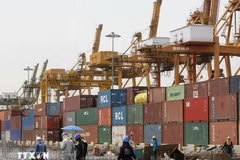
Malaysia steps up transport infrastructure investment to become global logistics hub
The centre marks a shift from handling larger cargo volumes to developing higher-value activities. Goods will be sorted, stored and repacked there before being sent overseas, creating skilled jobs for Malaysians.
Indonesia to launch commodity export monitoring platform next year
DSI will draw on data from customs authorities, trade activities and the financial system, alongside contracts and documents uploaded by exporting companies. The platform will monitor the volume, quality, prices and destination markets of various commodities, as well as transactions between related parties.
Singapore tightens cross-border haze pollution law
Fines for companies failing to comply with regulations will increase tenfold to nearly 800,000 USD per day, while the maximum penalty will rise to more than 15.6 million USD.
Thailand rolls out three-pillar strategy to create new growth momentum
Thai Prime Minister Anutin Charnvirakul affirmed that the country’s current political stability provides a foundation for the consistent implementation of economic policies and structural reforms, enabling Thailand to make strong progress in the new economic era.
Cambodia calls for stronger ASEAN cooperation to combat misinformation
Cambodian Minister of Information Neth Pheaktra said the rapid spread of false and misleading information, coupled with advances in generative artificial intelligence (AI), is posing increasingly complex challenges to regional societies.
Philippines increases rice imports from Cambodia
Cambodia has contracted to supply a further 87,344 tonnes to the Philippines between September and December. If all orders are fulfilled, its rice exports to the market could reach around 209,000 tonnes in 2026.
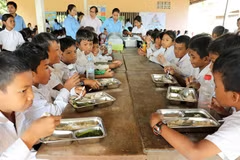
Cambodia expands school meal programme
Cambodian Prime Minister Hun Manet stressed that his Government would proactively allocate budget and strengthen management capacity, with the aim of expanding the school meal programme to more than 7,000 primary schools nationwide. The move is expected to improve students' nutrition and learning conditions.
Indonesia attracts fresh data centre investment amid AI boom
Indonesia’s data centre market is expanding rapidly. According to a report by Research and Markets, the market was valued at approximately 2.81 billion USD in 2025 and is projected to reach 6.08 billion USD by 2031.
Cambodia, EU strengthen investment cooperation
In his opening remarks, Deputy Prime Minister and First Vice President of the Council for the Development of Cambodia (CDC) Sun Chanthol highlighted the Cambodian Government's efforts to improve the investment climate and facilitate trade, stressing the importance of close public-private cooperation in promoting Cambodia as an attractive investment destination.
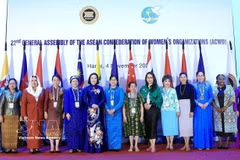
Women play key role in building united, resilient, sustainable ASEAN Community
Hosted by the Vietnam Women’s Union (VWU), the 22nd ACWO General Assembly marked another milestone in ACWO’s cooperation and development, allowing ASEAN women’s organisations to strengthen solidarity and mutual trust, share experience and identify cooperation priorities for the region’s next stage of development.