ASEAN adopts declaration to strengthen protection of migrant workers

The declaration aims to promote transparent, fair and responsible recruitment practices, prevent excessive or unreasonable recruitment fees, ensure equal employment opportunities and strengthen the protection of migrant workers' rights and interests.

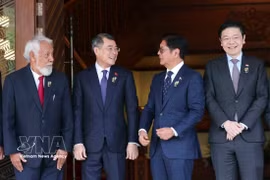
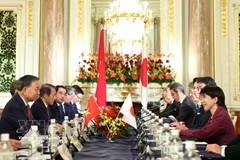
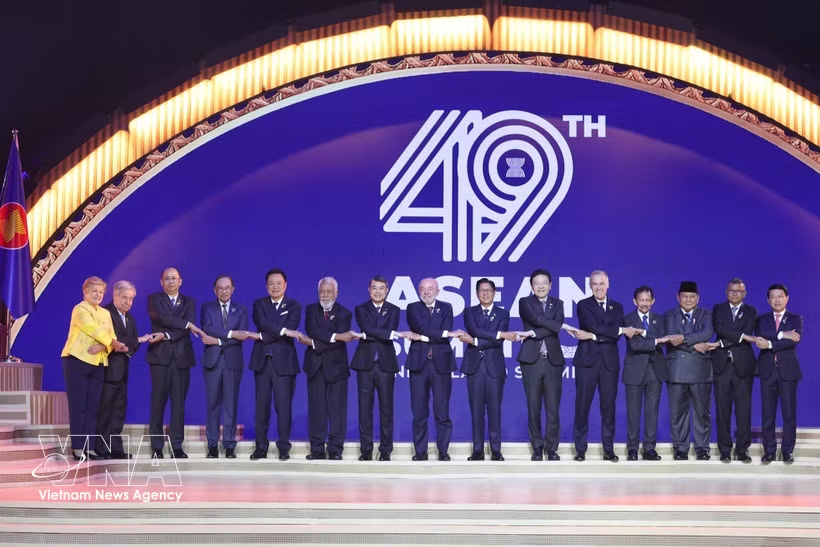
Vietnamese Prime Minister Le Minh Hung (seventh, left) and heads of delegations pose for a group photo at the opening ceremony of the 49th ASEAN Summit. (Photo: VNA)

Manila (VNA) – Leaders of ASEAN member states adopted the Declaration on Fair, Ethical and Sustainable Recruitment for Empowered Migrant Workers at the 49th ASEAN Summit in Manila, the Philippines, on November 15, aiming to prevent illegal recruitment practices, labour exploitation and cross-border employment scams.

The declaration aims to promote transparent, fair and responsible recruitment practices, prevent excessive or unreasonable recruitment fees, ensure equal employment opportunities and strengthen the protection of migrant workers' rights and interests. It also emphasises tighter regulation and supervision of labour recruitment agencies, improved access to justice and measures to safeguard workers' legitimate rights, alongside enhanced cooperation among ASEAN member states.

Speaking at a press conference the same day, Secretary of the Philippine Department of Migrant Workers Hans Leo Cacdac said the declaration will help strengthen protection for migrant workers in general and Filipino workers in particular who are employed in ASEAN countries by reinforcing safeguards throughout the recruitment and employment process.

He said the declaration builds on ASEAN's existing commitments to protecting and promoting the rights of migrant workers while addressing emerging challenges, particularly online recruitment and employment scams that expose workers to the risk of exploitation.

Cacdac stressed the need to enhance coordination between countries of origin and destination, including through mutual recognition of licensing systems and recruitment procedures. The declaration also seeks to prevent excessive recruitment fees while strengthening the regulation, licensing and supervision of recruitment and labour supply agencies.

Notably, he said the new cooperation framework will help ASEAN member states coordinate efforts to rescue and repatriate citizens stranded in online scam centres, while facilitating migrant workers' access to legal assistance and welfare services in host countries.

Meanwhile, Levinson Alcantara, Assistant Secretary of the Philippine Department of Migrant Workers, said the ASEAN Committee on the Protection of Migrant Workers will oversee implementation through its 2026–2030 work plan.

Preparations for implementation initiatives are underway, with the first activities expected to begin in early 2027, he said.

However, the declaration does not prescribe penalties or sanctions against member states that fail to effectively address unethical recruitment practices. Instead, it focuses on capacity building, institutional strengthening and enhanced regional cooperation.

Alcantara said the long-term goal is to work towards eliminating recruitment fees for migrant workers across ASEAN although member states have yet to reach consensus on a common regulatory framework and management mechanism.

The new declaration builds on ASEAN's previous commitments, particularly the 2007 ASEAN Declaration on the Protection and Promotion of the Rights of Migrant Workers and the 2017 ASEAN Consensus on the Protection and Promotion of the Rights of Migrant Workers.

Its adoption is expected to provide an additional basis for ASEAN countries to coordinate efforts to address emerging challenges in labour migration, particularly illegal brokerage, human trafficking and online recruitment scams, which have become growing concerns across the region./.

VNA

See more

ASEAN signs Digital Economy Framework Agreement

ASEAN signs Digital Economy Framework Agreement

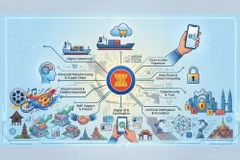
The Digital Economy Framework Agreement (DEFA), the bloc’s first standalone and legally binding digital economy agreement, establishes common rules covering digital trade, cross-border data flows, electronic payments, cyber security and artificial intelligence (AI).

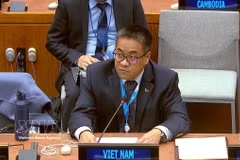
Minister Counsellor Nguyen Hai Luu, Deputy Permanent Representative of Vietnam to the UN, speaks at the discussion on November 12, 2026. (Photo: VNA)

Vietnam supports peace, reconstruction efforts in Gaza: diplomat

Minister Counsellor Nguyen Hai Luu, Deputy Permanent Representative of Vietnam to the UN, expressed deep concern over the dire humanitarian situation in Gaza, particularly as recent heavy rains and flooding have worsened living conditions for residents.

Thailand diversifies oil sources to ensure energy security

Thailand diversifies oil sources to ensure energy security

Although the diversification of oil import sources has helped reduce the risk of domestic oil shortage, it has not immediately reduced energy costs because import prices depend on market mechanisms, transportation costs, foreign exchange rates and the terms of oil contracts.

ST Telemedia Global Data Centres (Thailand), an affiliate of Singapore Telecom, is developing three data cehtres in Thailand including this facility on Rama IX Road in Bangkok. (Photo: bangkokpost)

Thailand tightens regulations on data centres

The new rules focus on controlling investment scale, electricity and water consumption, environmental impacts, and preventing investors from reserving resource quotas beyond their actual needs.

A road is under construction in Dong Nai city, Vietnam. (Photo: VNA)

ADB: Southeast Asia needs 7.1 trillion USD in infrastructure investment by 2040

ADB estimates that the region will need an average of 476 billion USD in infrastructure investment annually during 2026–2040, equivalent to 8.7% of GDP. However, at current investment levels, government budget resources would cover only around 45% of this demand, leaving an annual financing gap of 264 billion USD.

Kyodo News publishes an article titled “Sculptures by Japanese, Vietnamese artists on display in Yokohama,” (Screenshot photo)

Japanese media widely cover top Vietnamese leader ’s visit

Japanese media have continued extensive coverage of General Secretary of the Communist Party of Vietnam (CPV) Central Committee and President To Lam’s activities in Japan, highlighting his meetings with representatives of leading financial institutions at the Tokyo Stock Exchange, witnessing of cooperation agreement signing and participation in cultural exchanges.

Thailand pushes for establishment of ASEAN emergency public health centre

Thailand pushes for establishment of ASEAN emergency public health centre

The draft agreement stipulates that ACPHEED will comprise three specialised centres based in three ASEAN member states. Vietnam will oversee the centre for prevention and preparedness; Indonesia will host the centre for detection and risk assessment; and Thailand will be responsible for the centre for response and risk communication.

Indonesia designates 31 mln ha of waters as conservation areas

Indonesia designates 31 mln ha of waters as conservation areas

Head of the Convention and Marine Resource Balance working team at the ministry’s Directorate of Ecosystem Conservation Ahmad Sofiullah said this week that it is a strategic effort to ensure the sustainability of Indonesia’s marine ecosystems.