Traditional culture finds new life in contemporary Vietnam

Under Resolution 80-NQ/TW, dated January 7, 2026, November 24 was designated Vietnam Culture Day, to be observed annually. The occasion aims to give the public opportunities to participate in, create and enjoy cultural activities, helping spread positive values and foster pride in Vietnamese culture.

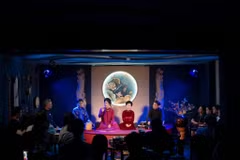
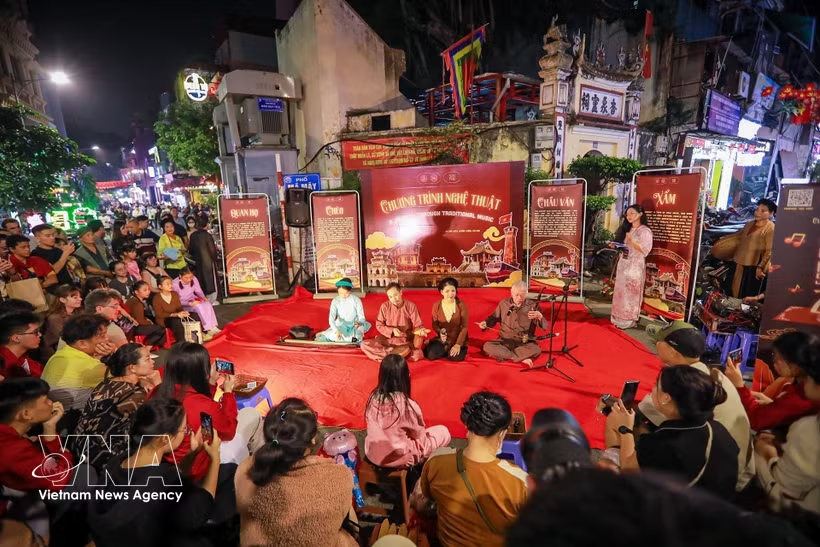
Excerpts from tuong (classical dramma), cheo (traditional Vietnamese opera), xam (blind buskers’ singing), and chau van (ritual singing) performed at the Traditional Arts Space in Hanoi’s Old Quarter have attracted great interest from local residents and tourists (Photo: VNA)

Hanoi (VNA) – Many localities have recently launched activities to preserve festivals, promote traditional arts, renew cultural and arts education, and expand creative spaces, bringing culture closer to the public in line with the Politburo’s Resolution No. 80-NQ/TW. By remaining relevant to contemporary life, traditional cultural values are being preserved and promoted.

Preserving cultural values through contemporary life

On September 19, the Vietnam State Artists Association organised the 17th Vietnam Stage Day 2026 and a ceremony commemorating the founders of the traditional theatre sector in Hanoi, giving artists an opportunity to honour their predecessors and reaffirm their responsibility to preserve and promote national theatre.

In Ho Chi Minh City, a September 17 seminar marking the 50th anniversary of the Tran Huu Trang Cai Luong Theatre reviewed the institution’s contribution to the city’s cultural life and discussed its future development.

Established in 1976, the theatre has brought together generations of artists, writers, directors and musicians, contributing to the preservation and promotion of Southern Vietnamese cai luong, a traditional form of musical theatre.
vnanet-art2.jpg
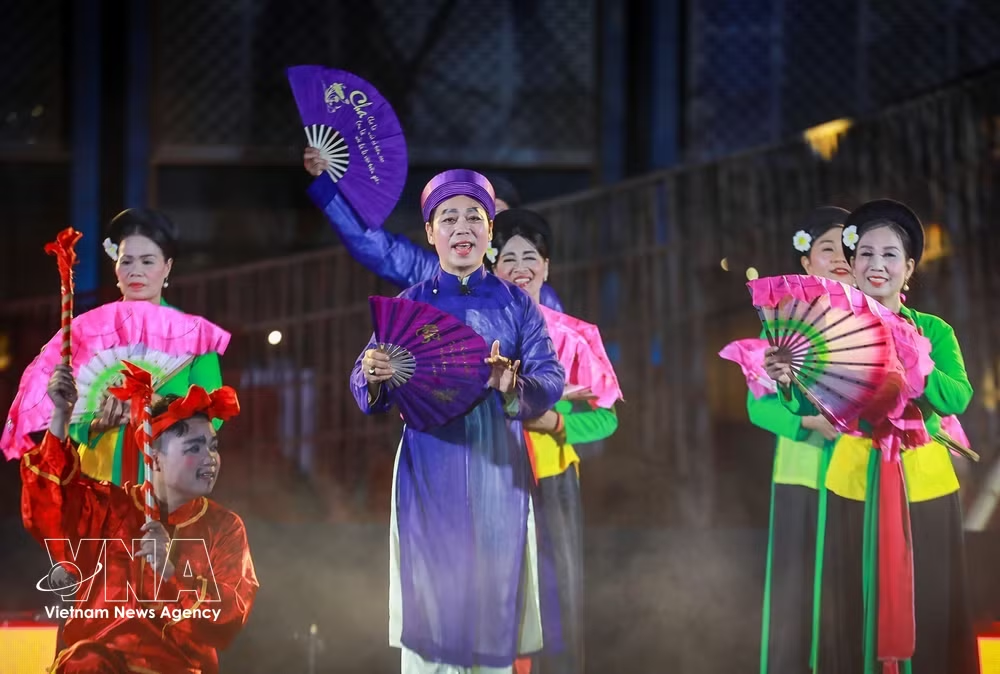
Artists and folk singers of Cheo (traditional Vietnamese opera) present performances that have been preserved and practiced in community life (Photo: VNA)

People’s Artist Trinh Kim Chi, Chairwoman of the Ho Chi Minh City Theatre Association, said developing a successor workforce, passing on professional skills and nurturing young artists’ passion and responsibility are crucial. Cai luong should also renew its approach to audiences while maintaining its traditional features and embracing innovation in staging and creative thinking.

Nguyen Thi Thanh Thuy, Deputy Director of the municipal Department of Culture and Sports, stressed that preservation must go hand in hand with creativity and innovation. Priorities include safeguarding the roots and identity of Southern cai luong while developing new forms of expression and themes for contemporary audiences, particularly young people, alongside training human resources, digitising archives and expanding international exchanges.

Renewing cultural education in the digital era

The rapid development of digital technology, particularly artificial intelligence (AI), is changing how cultural and artistic products are created and enjoyed, creating a need to renew education and workforce training.

At a September 18 workshop at Ho Chi Minh City University of Culture, experts said education should not only train arts professionals but also develop creative human resources capable of mastering technology, understanding markets, managing products and adapting to the digital environment.

Assoc. Prof. Dr. Lam Nhan, rector of the university, said learners need technological skills, data literacy, project management, digital content distribution, intellectual property awareness and interdisciplinary collaboration alongside professional knowledge.

Dr. Nguyen Thi Thu Thuy of the university noted that technology should expand creative capacity while remaining under human supervision. AI proficiency without cultural foundations, aesthetic appreciation, critical thinking and social responsibility would not be enough to create meaningful works.

The workshop also highlighted stronger links between educational institutions, businesses, digital markets and cultural institutions, as well as the need to build audiences for cultural industries.

Meanwhile, the Bac Ninh Library on September 16 opened an exhibition featuring more than 121 documents and images on the Kinh Bac region, 114 books and documents on national history, and nearly 100 images and materials on the province’s development achievements, connecting cultural heritage with contemporary development.

Responding to Vietnam Culture Day

The Department of Performing Arts under the Ministry of Culture, Sports and Tourism on September 14 issued an open letter calling on cultural and arts bodies, theatres, art troupes, businesses, artists and creators to mark the first Vietnam Culture Day on November 24.

Under Resolution 80-NQ/TW, dated January 7, 2026, November 24 was designated Vietnam Culture Day, to be observed annually. The occasion aims to give the public opportunities to participate in, create and enjoy cultural activities, helping spread positive values and foster pride in Vietnamese culture.

Beyond political and traditional themes, the department urged units to curate shows that are highly entertaining yet carry cultural depth, aesthetic value and positive messages suited to today's audiences.

Activities can include performances at theatres, public spaces, schools, industrial parks, remote and disadvantaged areas, border regions and islands, while live shows can be combined with television, radio and digital platforms./.
VNA

See more

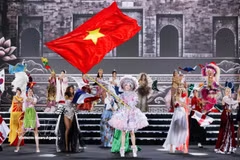
Vietnamese representative Le Nguyen Bao Ngoc and other Miss World 2026 contestants at the opening performance at the "Dances of the World" grand finale in Nha Trang ward, Khanh Hoa province, on September 5. (Photo: VNA)

"Beauty ambassadors" promote image of Vietnam to the world

The greatest value lies in the contestants themselves, who can become “beauty ambassadors” and authentic storytellers. Through their first-hand experiences and perspectives, they can naturally share Vietnam’s landscapes, culture and people with audiences around the world, said an organiser.

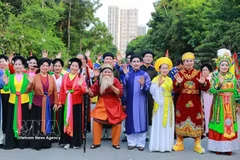
The programme opens with an artistic parade, with artisans and artists dressed in traditional costumes characteristic of Cheo, Tuung and Ca tru, creating an impressive festival scene. (Photo: VNA)

Traditional arts bring closer to public through “Music and Heritage” programme

The key message the organisers want to convey to the public and international friends is that heritage is not a collection of artefacts or values frozen in the past, but a living flow that continues to evolve, adapt and be enriched by each generation, Le Thi Anh Mai, Deputy Director of the Hanoi Department of Culture, Sports and Tourism, said.

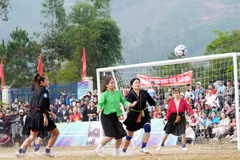
An action during the final between Lam Thuong (Lao Cai province) and Mong Duong (Quang Ninh) on December 7, 2025, as part of the 2025 Quang Ninh Open Ethnic Minority Women’s Football Tournament – VTV5 Cup. (Photo published by VNA)

Potential of ethnic minority women’s football

Women’s football movements in local communities have been quietly growing, but they’ve now built up enough momentum to inspire organisers to launch the first Vietnam Ethnic Minority Women’s Football – VTV Cup in 2026.

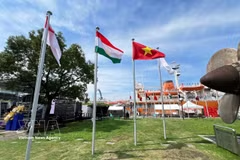
The national flag of Vietnam flies alongside the flags of other countries at the 2026 Asian Games. (Photo: VNA)

Vietnamese national flag flies at 2026 Asian Games

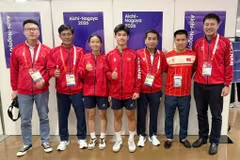
As the Vietnamese national anthem played, the red flag with a yellow star was raised at Nagoya Port, marking the official presence of the Vietnamese delegation at ASIAD 2026 and boosting the athletes’ morale ahead of the competitions.

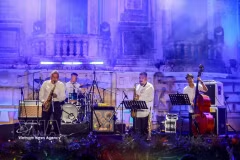
The Song Hong Jazz Band perform at the opening ceremony of the Hanoi International Jazz Festival 2026 on September 17. (Photo: VNA)

Hanoi International Jazz Festival 2026 kicks off

With open and free-of-charge activities held at both professional performance venues and public spaces, Hanoi Jazztival 2026 seeks to expand access to jazz and make the genre more visible in the capital’s urban cultural life.

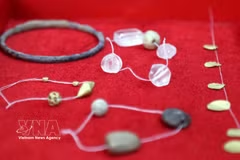
Glass beads, gold-coloured metal beads and leaf-shaped objects uncovered in the tombs. (Photo: VNA)

Archaeologists uncover artefacts in two 1,500-year-old tombs

Based on their structure, construction techniques and unearthed artefacts, the two tombs are identified as brick-built burial chambers. Such tombs, commonly known as brick tombs or Han tombs, were relatively widespread in areas along major rivers and waterways, including the Luc Dau, Bach Dang, Y Bich and Lam river systems, which served as important links between settlements and the sea.

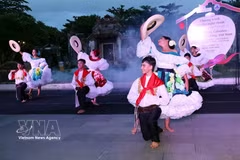
A performance staged by Colombian dancers at the artistic exchange in Hoi An town, Da Nang city, on September 16, 2026. (Photo: VNA)

Artistic exchange helps foster Vietnam-Colombia friendship

Co-organised by the Embassy of Colombia, the Da Nang Department of Foreign Affairs, the municipal Department of Culture, Sports and Tourism, and the Hoi An World Cultural Heritage Conservation Centre, the programme contributed to strengthening cultural exchanges, connecting young people and promoting friendship between the two countries.

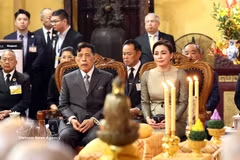
Thai King Maha Vajiralongkorn and Queen Suthida Bajrasudhabimalalakshana at the prayer ceremony (Photo: VNA)

Thai King, Queen visit Quan Su pagoda for prayer ceremony

The King and Queen offered candles and flowers, after which monks and Buddhists chanted prayers for their peace and well-being, and deeper progress in the Vietnam-Thailand Comprehensive Strategic Partnership as well, timed to the 50th anniversary of diplomatic ties.

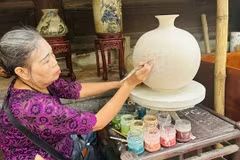
An artisan from Bat Trang Village demonstrates part of the ceramic making process. (Photo: baovanhoa.vn)

Hanoi's old streets and crafts available at Temple of Literature

Inspired by the streetscapes and their architecture, traditional craft streets and daily life of ancient Thang Long, the programme presents images and historical artefacts of Hanoi’s historic '36 Streets' while offering hands-on workshops with traditional craftspeople. It unfolds the story of a Hanoi rich in history and culture, yet dynamic and constantly evolving amid modern life.