Hanoi (VNA) - Vietnam has made important efforts to strengthen child protection in the digital environment and has built a strong foundation for further progress, according to UNICEF Representative Silvia Danailov.
Building a stronger legal framework
Silvia Danailov, UNICEF Representative in Vietnam, said the country has every reason to be proud of its remarkable achievements in developing, adopting, and implementing policies to protect children in the digital environment.
She pointed to provisions on child protection in key laws, including the Law on Children and the Law on Cybersecurity, as well as the national programme on protecting and supporting children in healthy and creative interactions in the online environment for 2021 - 2025.
Vietnam is not only focusing on improving existing regulations but is also taking a forward-looking approach by proactively identifying and addressing emerging risks at an early stage, she said, elaborating that Vietnamese policymakers are currently discussing and considering issues related to social media use among children under 16. This reflects a strong commitment to further strengthening policies and legal frameworks to address new challenges in the context of rapidly evolving digital technologies.
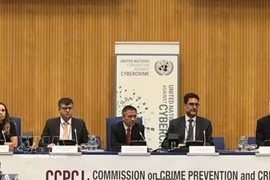
This strategic vision has not only been translated into action at the national level but has also been strongly affirmed on the international stage. A historic milestone was reached in April 2026, when Vietnam officially became the second country in the world to ratify the United Nations Convention against Cybercrime, also known as the Hanoi Convention. The ratification reflects Vietnam's commitment to strengthening international cooperation against cybercrime and protecting children online.
UNICEF is truly delighted and proud to stand alongside and support the Government of Vietnam in this important effort, emphasised Silvia Danailov.
Technology moving faster than regulation
Alongside acknowledging legal progress, the UNICEF Representative also offered insightful analysis of the practical barriers, viewing them as a basis for lawmakers to further strengthen the protection system. The greatest challenge, she pointed out, is the dizzying pace of development in the digital environment, which puts constant pressure on laws and regulations to be continuously updated and adapted so that they do not fall behind.
Statistics at both the global and national levels paint a challenging picture and provide evidence of UNICEF’s concerns about the scale of online threats. According to estimates by the WeProtect Global Alliance, more than 300 million children under the age of 18 worldwide were directly affected by online sexual abuse and exploitation within a single 12-month period.
In Vietnam, the 2022 “Disrupting Harm” study, jointly conducted by ECPAT International - the only global network solely focused on ending the sexual exploitation of children, the International Criminal Police Organisation (INTERPOL), and UNICEF, found that as many as 89% of children aged 12–17 regularly use the internet. Even more alarming, 2% of children aged 15–17 admitted to having shared sensitive images or videos of themselves online in exchange for money or gifts.

These figures reinforce Silvia Danailov’s assessment that the digital environment is developing too quickly, and one of the biggest challenges is how to keep pace with this development. Alongside the opportunities that technology brings, children are also facing new risks online, ranging from cyberbullying and online grooming to increasingly sophisticated forms of exploitation and abuse.
Danailov stressed that while Vietnam has established important legal and policy foundations, effective implementation remains critical. She highlighted the need for trained professionals, accessible services for children, stronger cooperation across sectors, and practical measures that ensure laws translate into real protection for children.
A multi-stakeholder approach
Silvia Danailov called for a comprehensive strategic roadmap to help Vietnam build a safe, healthy, and child-friendly digital ecosystem for every child. She emphasised several key priorities that need to be advanced simultaneously to create a safer digital environment for children.
First, laws and policies need to be regularly reviewed and adapted to keep pace with technological change. The regulatory framework should be coherent and coordinated, protecting children from risks while ensuring they can access the opportunities offered by digital technology. Effective enforcement is equally important.
Second, greater emphasis should be placed on strengthening comprehensive prevention capacity. Children need to equip themselves with necessary knowledge, skills, and digital capabilities to build their own “digital immunity.” Parents and teachers need guidance to help children navigate the digital environment, while law enforcement and judicial officials should also receive regular professional training.
Third, multi-stakeholder cooperation needs to be strengthened, with greater accountability for digital platforms and technology firms. Digital platforms and technology companies should place children’s rights and safety at the centre of the design and operation of their products and services. Appropriate mechanisms are needed to ensure that digital businesses genuinely contribute to and are held accountable for protecting children.
Silvia Danailov also stressed the need to listen to the voices of children and adolescents and place them at the centre of solutions relating to the digital environment. Children’s real-life experiences and needs should be fully considered in the development and implementation of policies, ensuring that children can both benefit from the opportunities offered by technology and remain safe and protected from online risks.
According to Silvia Danailov, creating a safe digital environment for children requires a coordinated approach and the engagement of all parts of society. While government plays a leading role in developing legal and policy frameworks, effective implementation depends on collaboration with technology companies, parents, teachers, children and young people themselves. She stressed that children should be able to benefit from opportunities for learning, creativity and self-development online while being protected from risks and harm./.