Argentine ex-revolutionary details lifelong bond with Vietnam

​From Argentina, Jorge Gessaga, a young man of Italian, Spanish and indigenous descent, followed Vietnam's resistance against foreign intervention. Vietnam's steadfastness in defending its sovereignty became a defining lesson: a small nation could achieve what seemed impossible with strong belief and determination under the leadership of the Communist Party of Vietnam.

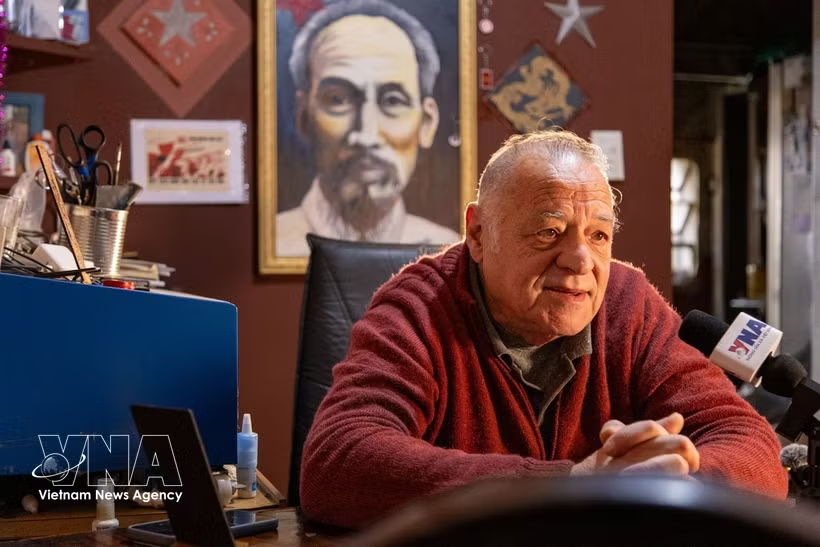
Jorge Gessaga, a 73-year-old former Argentine revolutionary, grants an interview to the Vietnam News Agency (Photo: VNA)

Buenos Aires (VNA) – As Vietnam marks the 81st anniversary of its National Day on September 2, Jorge Gessaga, a 73-year-old former Argentine revolutionary, spoke to the Vietnam News Agency in Buenos Aires about his decades-long connection with Vietnam.

Vietnam – A light from halfway around the globe

The story began in the late 1960s and early 1970s when Jorge was 16 or 17 and growing up in Argentina under military dictatorship. Questions about his country's future, social justice and workers' path to struggle prompted him to search for an ideal to pursue.

From Argentina, the young Jorge of Italian, Spanish and indigenous descent, followed Vietnam's resistance against foreign intervention. Vietnam's steadfastness in defending its sovereignty became a defining lesson: a small nation could achieve what seemed impossible with strong belief and determination under the leadership of the Communist Party of Vietnam.

Vietnam and Cuba became central inspirations for Argentina's revolutionary youth. Vietnam transformed from a distant country into a symbol of courage and self-determination, contributing to Jorge's decision to join the Workers' Revolutionary Party and the People's Revolutionary Army.

Prison years

In December 1974, at 21, Jorge was arrested. He spent nine years in detention under the military dictatorship. Vietnam remained a source of strength for political prisoners.

He Gessaga recalled how inmates hid revolutionary materials under floor tiles and wrapped thin paper in cigarette-pack foil to protect it from moisture before passing documents between cells. The hidden texts included excerpts from Ho Chi Minh's "Prison Diary", writings on revolutionary morality and materials by then General Secretary of the Communist Party of Vietnam Central Committee Le Duan. Inside the prison, those fragile pages helped political prisoners maintain their resolve.

When news of southern Vietnam's liberation reached the prison on April 30, 1975, the reaction was immediate. "It was the greatest joy for all of us. It was Vietnam's victory, but we also saw it as our own, the victory of revolutionaries," he said.

At 22, still imprisoned, Gessaga promised himself he would one day visit Vietnam.

First visit

After his release in 1983, Jorge waited decades to fulfill that promise. He chose April 30, 2025 - the 50th anniversary of the liberation of the South and national reunification for his first visit. "No matter what, I must be in Vietnam for this anniversary", he told himself.
vnanet-b.jpg
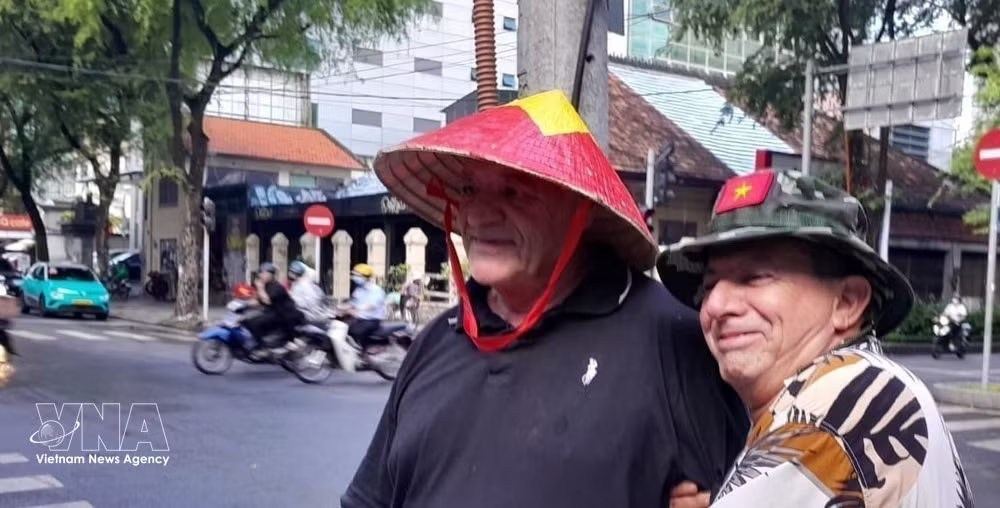
Jorge Gessaga visits Ho Chi Minh City (Photo: VNA)

He spent a month in the country. In Ho Chi Minh City on April 30, he saw red flags with yellow stars fill the streets as crowds celebrated. Images he had once followed from halfway around the world were now in front of him.

Sitting on plastic chairs along the pavement, drinking juice and watching the city's daily rhythm left a deep impression. "Coming to Vietnam felt very special. I felt as if I was at home”, he said.

From the Cu Chi Tunnels and the Mekong Delta to Da Nang and Hanoi, he observed Vietnam's infrastructure improvements, living standards and socio-economic progress. He noted that Vietnam had moved beyond safeguarding peace to national construction and development.

"President Ho Chi Minh's final wish for a peaceful, reunified, independent, democratic and prosperous Vietnam has been fulfilled by the Vietnamese people", he said.

Second visit

In March this year, Jorge returned. The first trip brought the excitement of finally reaching a country he had long followed; the second felt like returning to a place of deep attachment.

He revisited sites, met Vietnamese people and tracked the country's changes. Each visit reinforced his view that Vietnam today is a dynamic, rapidly developing country moving confidently toward the future.

"Me enamoré de Vietnam," Jorge said in Spanish. "I have fallen in love with Vietnam".

His affection, he said, is shared by many Argentines who supported Vietnam's struggle, followed its development or admire a nation that overcame wars to build a peaceful life.

Preserving memory through arts

Jorge studied fine arts from a young age but put painting aside for decades. During the COVID-19 pandemic, he returned to the easel. His first work after the long hiatus was a portrait of President Ho Chi Minh.

He has since painted multiple portraits of the Vietnamese leader and created artworks featuring the red star, giving them to friends. In his workshop, he also welded a sculpture of an AK-47 from scrap metal, evoking his visit to Cu Chi. Spent bullet casings brought from Vietnam are kept as keepsakes.

More than half a century after Vietnam first captured his imagination, Jorge spoke of the country not as a place he once visited, but as one he still wants to return to.

"Whenever I can, I will return to Vietnam", he said./.
VNA

See more

Quang Ninh's seaport infrastructure, including the Ha Long International Cruise Port, is capable of serving large cruise ships. (Photo: VNA)

Quang Ninh 2030: Ambitious targets for a breakthrough

These objectives reflect the principle that economic development must not become detached from living standards; rather, the benefits of growth should create opportunities for all residents to share in its achievements.

A police officer guides a citizen on how to use VNeID app. (Photo: VNA)

Shift to data-driven administrative procedures needs acceleration

Under a draft decree replacing Decree 63, authorities will have to proactively pull information from databases and records for informational or technical procedures. Applicants would no longer be required to resubmit documents, and certification or information requests could not be turned into discretionary licensing through an “ask – give” mechanism.

Cuban journalist Luis Manuel Arce Isaac, author of the article published in Mexico’s Voces del Periodista magazine. (Photo: Screenshot/VNA)

Mexican journalist praises Vietnam’s profound transformation

According to the article, Vietnam’s progress over the past decades has turned President Ho Chi Minh’s aspiration for a country that would be more dignified and more beautiful into reality in ways that have far exceeded what was initially envisioned.

The Liaison Board of the Vietnamese Community in Singapore organises the annual Mid-Autumn Festival to strengthen community bonds and spread Vietnamese language and culture. (Photo: VNA)

Continued efforts made to nurture love for homeland through mother tongue

From language classrooms and community activities to digital platforms, Vietnamese is being preserved through increasingly diverse approaches. More than a means of communication, the mother tongue carries memories, culture and affection for the homeland. Ensuring that Vietnamese remains naturally present in the daily lives of overseas Vietnamese is therefore an important way to nurture their lasting bond with the Fatherland.

Deputy General Director of the Vietnam News Agency Doan Thi Tuyet Nhung (fifth, right) and representatives of regional news agencies and media organisations attend the launch of the Asia-Pacific Media Partnership Organising Committee at the Asia-Pacific Media Forum. (Photo: VNA)

VNA attends Asia-Pacific Media Forum in Shenzhen

Participants in the forum highlighted the need to increase coverage of the region's rapid opening-up and integration, provide comprehensive information on the progress and achievements of cooperation among economies across various fields, and help create a favourable environment for regional development.

Ngo Phuong Ly (right), the spouse of General Secretary of the Communist Party of Vietnam Central Committee and President To Lam, and Kyu Kyu Hla, the spouse of Myanmar President Min Aung Hlaing, visit Van Phuc silk village on September 5. (Photo: VNA)

First ladies of Vietnam, Myanmar visit Van Phuc silk village

Ngo Phuong Ly, the spouse of General Secretary of the Communist Party of Vietnam Central Committee and President To Lam, said the two countries share similarities in silk weaving and can enrich their cultural heritage through exchanges and experience sharing.

Prime Minister Le Minh Hung join students and teachers of the Muong Khuong Inter-level Primary and Secondary Boarding School, Lao Cai province, in the opening ceremony of the 2026–2027 academic year on September 5. (Photo: VNA)

PM urges substantive education reform in 2026–2027 school year

PM Le Minh Hung called on the education sector to continue making strong changes in management mindset and teaching methods, putting learners at the centre, and viewing schools as the foundation, teachers as the driving force, families as a source of support and society as a resource accompanying education development.

General Secretary of the Communist Party of Vietnam Central Committee and President To Lam (Photo: VNA)

Top leader extends message to education sector on new school year

Party General Secretary and President To Lam expressed confidence that with the nation’s traditional fondness for learning, the dedication of teachers and the aspirations of the younger generation, the 2026–2027 academic year will open a new chapter of progress for the country’s education sector.

Students attend the opening ceremony for the 2026–2027 academic year at the primary school campus of the Gia Quat Primary and Secondary School in Hanoi on September 5, 2026. (Photo: VNA)

Students across Vietnam begin 2026–2027 academic year

This milestone school year marks a pivotal transition from laying the groundwork for reform to delivering substantive changes as the country pushes ahead with implementing Politburo Resolution No. 71-NQ/TW on breakthroughs in education and training development.