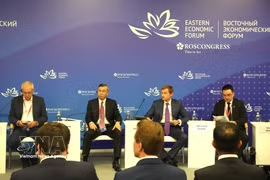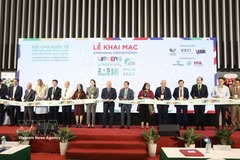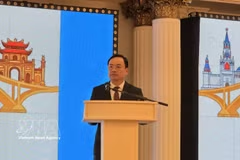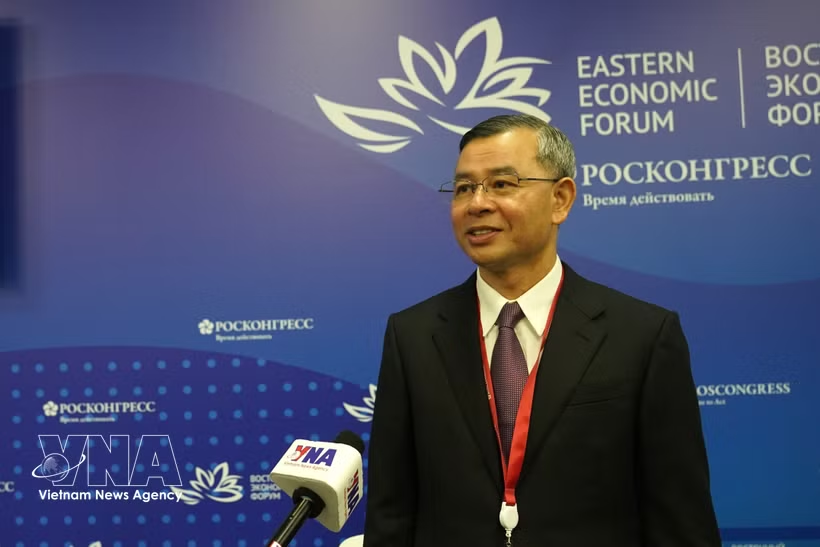
Moscow (VNA) – The 11th Eastern Economic Forum (EEF), taking place in Vladivostok, Russia’s Far Eastern region, from September 1-4, is opening up major opportunities for Vietnamese businesses, Minister of Finance Ngo Van Tuan told a Vietnam News Agency correspondent in Russia.
Tuan, who leads the Vietnamese delegation to the Russia-ASEAN Business Dialogue held as part of the forum, said Vietnam’s participation in this year’s forum demonstrates the strong determination of the Party and State to elevate economic cooperation with Russia, particularly in trade, investment, science and technology, and education and training.
Following the elevation of bilateral ties to a comprehensive strategic partnership and the entry into force of the Vietnam-Eurasian Economic Union Free Trade Agreement, Vietnam-Russia trade increased by an average of 10.8% annually during 2016-2025. However, it reached only about 4.7 billion USD in 2025, remaining modest compared to the two countries' potential and strong political ties.
Assessing the extensive discussions at the 11th EEF, Tuan expressed his belief that the forum would create major new opportunities for Vietnamese and ASEAN businesses to strengthen economic cooperation with Russian partners and enterprises across the Asia-Pacific region.
Covering about 6 million sq.m, Russia’s Far East is rich in minerals and natural resources, while holding significant potential in agriculture, fisheries and forestry. Meanwhile, Vietnam is entering a new development period with ambitious economic growth targets, including the goal of double-digit expansion.
According to the official, the strengths and potential of Russia and its Far East match many of Vietnam’s development needs, particularly in agriculture and the exploitation of coal, iron ore and other minerals.
Vietnam currently has only one relatively large project in the Far East, invested by TH Group, with capital of about 22 million USD. Meanwhile, the region, with a population of nearly 6 million, has substantial demand for labour and economic development while Vietnam boasts a population of more than 100 million, who are young, industrious and increasingly skilled. This gives both sides an advantage in complementing each other in the course of their cooperation.
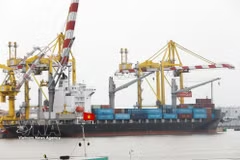
Tuan stressed the need to make better use of traditional transport networks to boost trade, including cargo routes linking Vladivostok with Hai Phong and Ho Chi Minh City, which take about 7-10 days.
The two sides have also discussed cooperation in artificial intelligence, digital transformation and information technology - areas offering significant potential.
He said the two countries should enhance exchanges, gain a deeper understanding of each other’s markets and legal systems, and strengthen strategic trust.
To make bilateral cooperation more substantive, Tuan proposed improving the Vietnam-Russia intergovernmental cooperation mechanism, making full use of the Vietnam-EAEU FTA, increasing information sharing and market research, improving banking and payment connectivity, and strengthening transport and logistics links.
He also called for greater attention to warehousing and cold storage systems and the gradual development of cargo consolidation and transit hubs to facilitate trade between Vietnam and Russia in the coming period./.