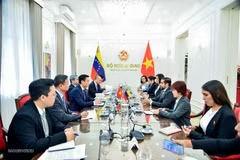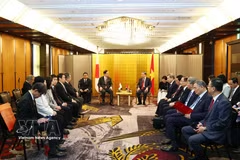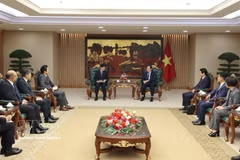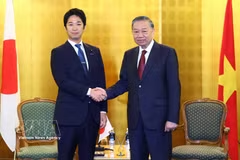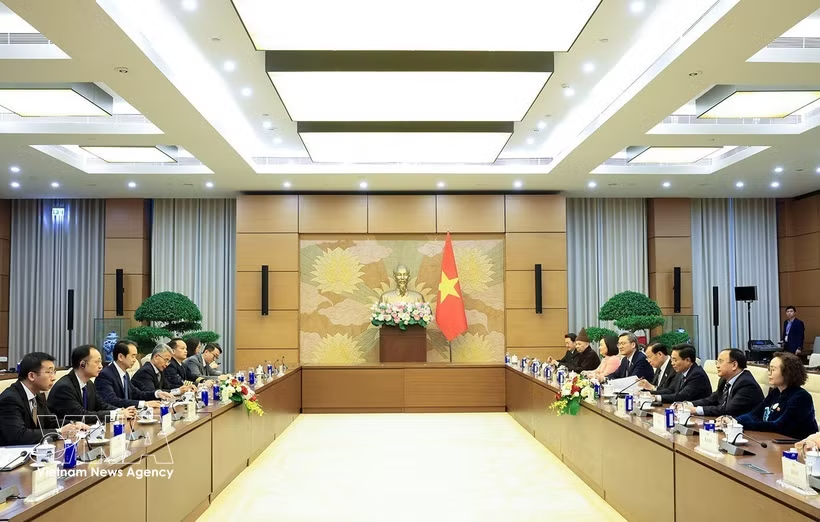
Hanoi (VNA) – National Assembly (NA) Vice President Nguyen Doan Anh, who is also Chairman of the Vietnam-China Friendship Parliamentary Group, received Chinese Ambassador to Vietnam He Wei in Hanoi on November 10.
Anh spoke highly of He and the Chinese Embassy’s coordination in arranging the recent official visit to China by NA President Tran Thanh Man and the second session of the Cooperation Committee between the Vietnamese NA and the National People’s Congress of China. The visit was a success, helping promote cooperation between the two legislative bodies, he noted.
He expressed his pleasure at the continued positive, comprehensive and substantive development of relations between the two Parties and the two countries.
Economic, trade and investment cooperation, as well as strategic infrastructure connectivity, have made progress, while exchanges among localities and people from both countries have become increasingly vibrant. He affirmed that Vietnam always gives top priority to its relations with China, regarding them as a strategic choice within its overall foreign policy.
Regarding parliamentary cooperation, the NA Vice President noted that exchanges of delegations between the Vietnamese NA and the National People’s Congress of China, together with their co-chairing of sessions of the Cooperation Committee, are important milestones demonstrating political trust and determination to elevate parliamentary cooperation.
This mechanism provides a framework for regular dialogue and experience sharing, helping translate high-level common perceptions into action and enabling legislative bodies to play their role in institutional improvement and creating a favourable legal framework for strategic development connectivity, as well as cooperation in science and technology, innovation and digital transformation.
The NA Vice President called on the Chinese Ambassador and the Chinese Embassy to continue coordinating the effective implementation of outcomes from NA President Man’s official visit to China and the second session of the Cooperation Committee between the two legislative bodies.
He proposed maintaining exchanges of high-level delegations between the two legislatures, and strengthening links among specialised committees and local elected bodies.
Highlighting the role of the Vietnam-China Friendship Parliamentary Group as a bridge between the two sides, he proposed maintaining regular exchanges and expanding engagement among young parliamentarians, female parliamentarians and representatives of local elected bodies. He suggested organising thematic exchanges on science and technology, innovation, digital transformation, infrastructure development, trade, investment, logistics, environmental protection, agriculture, education and training.
For his part, Ambassador He noted that exchanges between the two legislative bodies have focused on sharing experience in carrying out their functions and duties, promoting strategic development connectivity and strengthening the foundation of friendship between the two countries' people.
He said that Vietnam-China relations are making positive progress, with considerable potential and room for further expansion in trade, investment, tourism and agriculture.
Looking ahead, the Chinese Ambassador expressed his hope that the two legislative bodies will continue to play their role in implementing the common perceptions reached by the two countries’ senior leaders, refining the legal framework and facilitating cooperation in the economy, trade, infrastructure connectivity and emerging fields such as artificial intelligence.
He proposed stepping up exchanges among specialised committees, friendship parliamentary groups and local legislative bodies, and expanding research and field visits to learn from each other’s experience in economic development, science and technology, innovation and social governance. Cultural exchanges and tourism cooperation should also be maintained to deepen mutual understanding and bonds between the two peoples.
The ambassador affirmed that the Chinese Embassy in Vietnam will continue close coordination with the Vietnamese National Assembly and serve as a bridge to promote parliamentary cooperation. He expressed his hope that the two countries’ friendship parliamentary groups will organise more field visits and exchanges with localities to identify potential and broaden opportunities for cooperation.
Both sides expressed confidence that, with the attention of the senior leaders of the two Parties and countries and coordination among relevant agencies, Vietnam-China relations as a whole, and cooperation between their legislative bodies in particular, will continue to develop in a substantive, effective and sustainable manner./.
VNA