Vietnam pins high hope on economic locomotives for higher growth

The economic picture in the first eight months of 2025, whether viewed from the overall economy or from a local perspective, is very positive. Major economic centres have recorded extremely impressive growth in the period, the Ministry of Finance stated in its recent report on the socio-economic situation, sent to the Government.

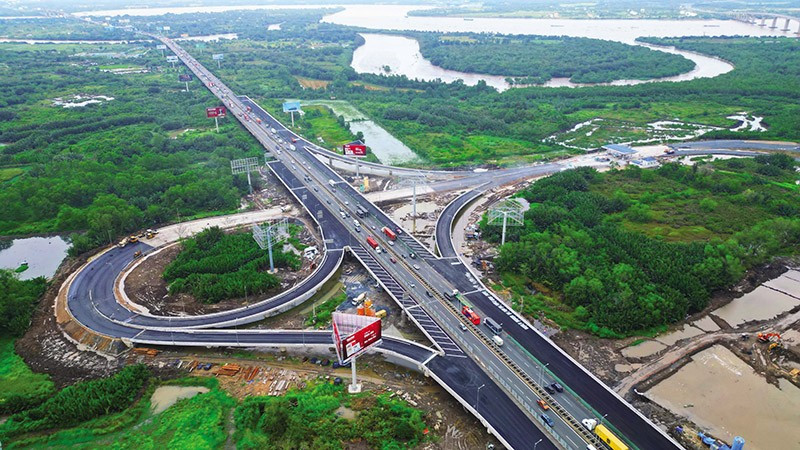
To promote growth and achieve the challenging goal of high growth in 2025, Ho Chi Minh City is focusing on accelerating the disbursement of public investment. (Illustrative image: VNA)

Hanoi (VNA) - Given that the growth task for 2025 still faces many challenges, achieving the growth target of 8.3–8.5% relies heavily on the acceleration of localities that are key economic drivers of the country.

The economic picture in the first eight months of 2025, whether viewed from the overall economy or from a local perspective, is very positive. Major economic centres have recorded extremely impressive growth in the period, the Ministry of Finance stated in its recent report on the socio-economic situation, sent to the Government.

Notably, all 34 localities reported increases in their Index of Industrial Production (IIP) for the eight months compared to the same period last year. Among them, Phu Tho increased the most, with 26.22%; followed by Ninh Binh (22.8%), Hue (18.7%), Nghe An (16.4%), and Quang Ninh (15.6%).

Each locality has envisioned a clear economic development direction to break through in the first eight months of 2025. For instance, Hanoi’s estimated GRDP growth rate reached 7.8%, focusing on developing a green economy and digital economy; and Hai Phong stood out with a strong IIP growth of 10.2% and an investment capital disbursement rate of nearly 70%.

To promote growth and achieve the challenging goal of high growth in 2025, Ho Chi Minh City is focusing on accelerating the disbursement of public investment. According to Chairman of the municipal People’s Committee Nguyen Van Dut, the disbursement of public investment in the city is not sustainable, and this will affect the city’s growth rate. In fact, in the first six months, the city’s disbursement rate reached 43%, but after two more months, by the end of August, the rate only increased slightly to 43.3%.

It’s not just about public investment disbursement; many factors influence the city’s GRDP growth. Currently, this economic locomotive still makes a significant contribution to growth. However, according to Nguyen Dinh Cung, a senior economist, although the merged Ho Chi Minh City has an economic strength far exceeding other localities and remains one of the most important parts of the national economy, the city’s GRDP growth in recent years has consistently been lower than the national average and is showing signs of slowing down.

Similarly, according to Cung, since 2024, Hanoi’s GRDP growth has always been higher than the national average, but it has not truly made a breakthrough.

One of the issues affecting the GRDP growth rate of these two localities, according to the economist, may stem from problems related to the mobilisation and allocation of investment capital for economic sectors and investment efficiency.

From this perspective, it can be seen that both economic locomotives, Hanoi and Ho Chi Minh City, have consistently been among the localities with the highest growth rates nationwide. However, clearly, higher expectations can be placed on localities with strong spillover effects and leadership capabilities over other localities, such as Phu Tho, Bac Ninh, and Quang Ninh./.

VNA
See more

The expanded Hoa Binh Hydropower Plant (Photo baochinhphu.vn)

EVN launches major power projects

Among the flagship projects inaugurated was the expanded Hoa Binh Hydropower Plant with a total installed capacity of 480MW per year and average annual output of about 488 million kWh.

An ultra-intensive shrimp farming model linked with environmental protection in Ca Mau province. (Photo: VNA)

Fisheries take the lead in the Mekong Delta’s green transition

Across the Mekong Delta, leading aquaculture producers, processors and exporters, along with suppliers of inputs, are transitioning to circular, high-tech and clean production models that cut greenhouse gas emissions and comply with international certification standards.

A perspective view of the Red River Landscape Boulevard project in Hanoi (Photo: VNA)

Works starts on Hanoi’s Red River Landscape Boulevard Axis project

The project is among the 234 key works and projects being launched, inaugurated or technically opened simultaneously across 34 cities and provinces nationwide to mark the 14th National Party Congress. Its launch contributes to implementing the country’s strategic development orientations while concretising Hanoi’s development goals in the new period.

The ground-breaking ceremony of the Yen Bai 1 biomass power plant in Lao Cai province on December 19. (Photo: VNA)

Work starts on 114-million-USD biomass power plant in Lao Cai

The project, developed by Erex Yen Bai Biomass Power Co. Ltd. is located in Dong Cuong commune, Lao Cai province. It is backed by Japan’s Erex Group and falls under the Joint Crediting Mechanism, a bilateral initiative between Vietnam and Japan to reduce greenhouse gas emissions.

At the inauguration ceremony (Photo: VNA)

Vietnam Railways Corporation unveils upgraded coaches, digital tools

These moves reflect the VNR's commitment to fulfilling six priority tasks set by the Prime Minister, including leading in innovation and digital transformation, applying sci-tech in line with the Politburo’s Resolution No. 57-NQ/TW, and spearheading advances in digital, green and circular economy.

Producing MDF panels for export at Hai Duong MDF Construction and Manufacturing Co., Ltd., in Ho Chi Minh City (Photo: VNA)

HCM City targets 15 billion USD in wood exports by 2035

The merger of HCM City with Binh Duong and Ba Ria – Vung Tau is expected to give the local wood industry a strong boost into a phase of high-quality growth driven by linkages, innovation, sustainability, and deeper integration into global value chains.

Delegates cut a ribbon to inaugurate the expanded Terminal T2 at Noi Bai International Airport in Hanoi on December 19, 2025. (Photo: VNA)

Expanded Terminal T2 at Noi Bai International Airport makes debut

The project expands the terminal’s floor area to over 200,000 sq.m, increases passenger capacity from 10 million to 15 million, even up to 18 million per year, and boosts operational capacity with boarding gates rising from 17 to 30 and jet bridges from 14 to 27, meeting strong growth in international travel demand.

A section of Can Tho - Ca Mau Expressway (Photo: VNA)

Can Tho – Ca Mau travel time halves from December 19

Stretching more than 110 km with a total investment of over 27.5 trillion VND (1.04 billion USD), the project not only resolves long-standing traffic bottlenecks in the Mekong Delta, but also opens up new development opportunities for the entire region - especially Ca Mau, the last locality in the country to be directly connected to the eastern North–South expressway axis.