Vietnam races to DNA-test 18,000 samples of martyrs’ remains by July 2027

The Ministry of Public Security will fast-track a project to build a repository capable of storing about 2 million biological samples from relatives for at least 50 years.

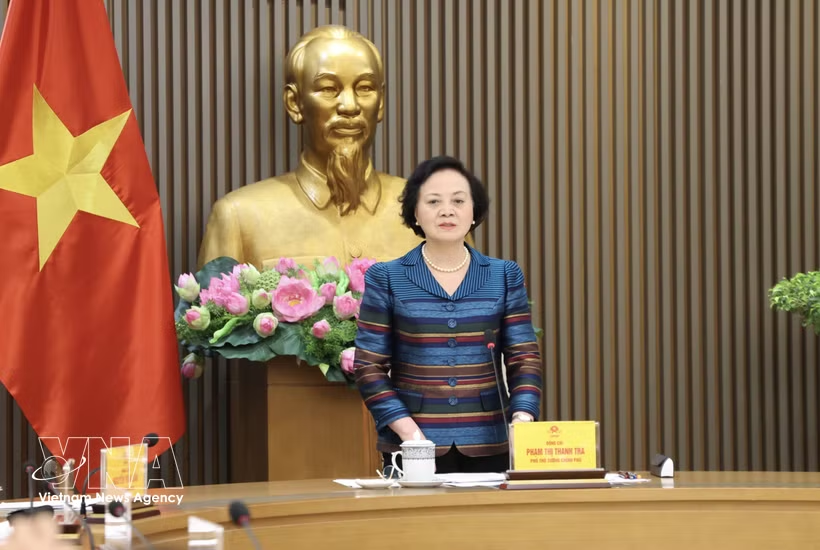
Deputy Prime Minister Pham Thi Thanh Tra speaks at the event. (Photo: VNA)

Hanoi (VNA) – Deputy Prime Minister Pham Thi Thanh Tra ordered relevant forces to speed up the collection of remains’ samples from unidentified fallen soldiers in cemeteries nationwide, setting a November 30 deadline.

Search and recovery of remains will continue, with recovered remains preserved and stored properly pending identification. The goal is to complete DNA testing on 18,000 samples by July 27, 2027, Tra, who is also head of the National Steering Committee for the Search, Collection and Identification of Martyrs’ Remains, told a working session with its standing body in Hanoi on September 14.

Repository to hold 2 million relatives' DNA samples

The Ministry of Public Security (MOPS) was ordered to accelerate the collection of paternal-line DNA samples from martyrs' relatives by the end of 2026. The ministry will fast-track a project to build a repository capable of storing about 2 million biological samples from relatives for at least 50 years.

Tra also called for swift approval of amendments to the Government’s Resolution 26/2026/NQ-CP, which sets special mechanisms to clear obstacles in sample collection, DNA testing and identification. Rules on economic-technical norms and collection procedures are due under a fast-track process by September 30.

The Ministry of Finance was tasked with drafting procurement mechanisms for testing equipment, chemicals and biological materials, while other agencies must revise their 2027 budget estimates to cover the work.

The Deputy PM approved a plan for Vingroup to fund four DNA testing lines and labs, with state funds directed toward core infrastructure and equipment for the Military Institute of Forensic Medicine and the Institute of Forensic Science.

On technology and staffing, she directed agencies to coordinate with Vingroup and finalise plans by September 25, ahead of the installation, handover and operation of new testing lines in October.

The Vietnam Academy of Science and Technology will serve as the focal point to coordinate training plans.

The MOPS, through its Police Department for Administrative Management of Social Order, will lead efforts to complete a data system that ensures interoperability, consistency and shared access.

Only 210 DNA samples tested so far

A Ministry of Home Affairs report showed that units must complete DNA testing on 18,000 samples under the 500-day-and-night campaign, with a 2026 target of testing 9,000 samples received before July 1, 2025.
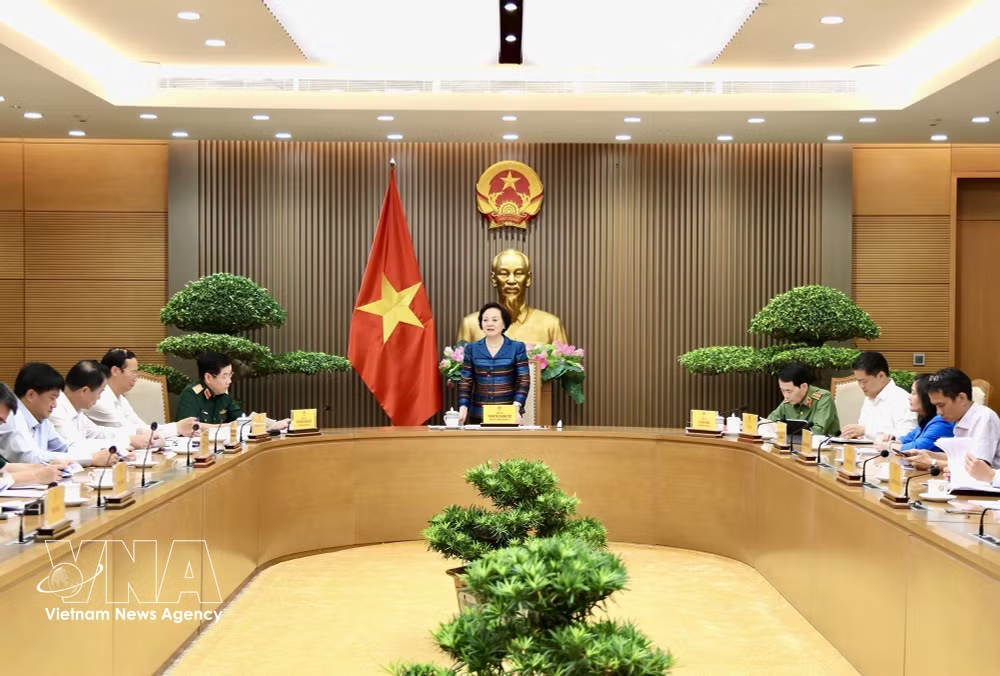
vnanet-3.jpg
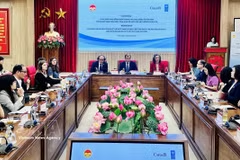
The working session of the National Steering Committee for the Search, Collection and Identification of Martyrs’ Remains on September 14 (Photo: VNA)

Those tasked with handling the testing include the Military Institute of Forensic Medicine under the Ministry of National Defence, the Institute of Forensic Science under the MOPS, the National Institute of Forensic Medicine under the Ministry of Health, and the Institute of Biology under the Vietnam Academy of Science and Technology.

The Military Institute of Forensic Medicine currently runs a Sanger-based mitochondrial DNA testing line with capacity for about 800 samples a year. Between 2021 and 2025, the institute received nearly 15,000 samples and tested about 4,000, or 40%, successfully matching and identifying 558 fallen soldiers. Its staff have trained at the Vietnam Academy of Science and Technology under a technology-transfer roadmap for NGS-SNP testing backed by Vingroup's Thien Tam Foundation.

On sample intake, Deputy Minister of Home Affairs Nguyen Thi Ha said the National Institute of Forensic Medicine received 16,636 samples from localities. The Military Institute of Forensic Medicine got 35,776 samples as of September 11, 2026, and the Institute of Biology received and stored 37,610.

Software tracking the 500-day-and-night campaign shows just 210 samples tested so far, with only 10 fallen soldiers identified./.
VNA

See more

A view of a workshop on advancing gender equality in the public sector amid the restructuring and streamlining of the political system in Hanoi on September 15 (Photo: VNA)

Vietnam seeks to advance gender equality amid public-sector reform

Organisational restructuring presents an opportunity to review personnel standards, procedures and working methods. If gender considerations are integrated into the process, it can help remove long-standing barriers, make better use of female talent and build a fairer and more accountable working environment.

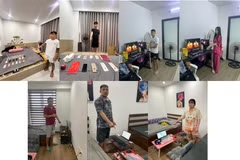
Some of the suspects arrested in the case (Photo: Quang Ninh city's Public Security Department)

Quang Ninh police bust 38.4 million USD transnational cybercrime ring

Quang Ninh city's Public Security Department warned individuals, agencies and businesses not to publicly disclose or provide personal information or bank account details on social media, and urged organisations and businesses to strictly comply with regulations on protecting customers’ personal data.

Teachers and children at Hoa Hong Kindergarten in Ha Giang 2 ward, Tuyen Quang province (Photo: VNA)

Vietnam to provide tuition support for preschoolers

Eligible children will be entitled to tuition exemptions, reductions or support, assistance with learning costs and other benefits in accordance with laws on education, children, people with disabilities, ethnic affairs and social assistance.

More than 100 delegates, including nearly 30 delegates from countries in Asia and Africa, attend the event. (Photo courtesy of the ActionAid)

Ecological agriculture for sustainable future

The workshop “Ecological agriculture for a sustainable future”, organised by ActionAid International in Vietnam, emphasised that women and young people must be the subjects and leaders of change, rather than merely participants or beneficiaries.

International delegates attend the 7th national congress of the Vietnam Union of Friendship Organisations in Hanoi on September 14. (Photo: VNA)

Phan Anh Son re-elected VUFO president

For the 2026–2031 term, the Vietnam Union of Friendship Organisations (VUFO) will follow the motto “Proactive adaptation, creative breakthroughs, practical effectiveness”.

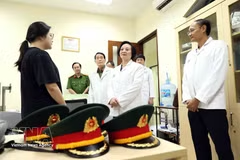
Deputy Prime Minister Pham Thi Thanh Tra encourages the staff of the Centre for DNA Identification. (Photo: VNA)

Identifying martyrs’ remains requires whole political system’s efforts: Deputy PM

Deputy Prime Minister Pham Thi Thanh Tra inspected the practical implementation of DNA identification technology at the Centre for DNA Identification under the Institute of Biology of the Vietnam Academy of Science and Technology, and the Military Institute of Forensic Medicine under the Military Medical Department of the Ministry of National Defence on September 14.

Doan Duc Hao, Director of the Department of Youth Affairs and Gender Equality under the Ministry of Home Affairs, speaks at a working session with a 16-member delegation of young Korean civil servants in Hanoi on September 14, 2026. (Photo: VNA)

Vietnam, RoK promote cooperation, youth’s role

Le Thi Viet Lam, Deputy Director of the Department of International Cooperation under the Ministry of Science and Technology, said Vietnam wishes to continue building an ecosystem that connects the State, research institutes, universities and businesses, enabling them to share resources and create value. This is also an area in which Vietnam is interested in learning from Korean experience.

To operate Metro Line No. 1 (Ben Thanh–Suoi Tien), Ho Chi Minh City Urban Railway Company No. 1 (HURC1) currently employs 700 people to keep nearly 200 train trips running each day. (Photo: nhandan.vn)

Ho Chi Minh City addresses manpower shortage for urban railway development

Under the human resources training scheme serving the development of the urban railway network approved by the municipal People’s Committee, the city will need around 70,000 workers by 2030 to support investment in and development of its metro system, including project management personnel, operations and maintenance staff, engineers, technical workers, consultants and designers.