Vietnam, US cooperate in developing sustainable industry toward net-zero

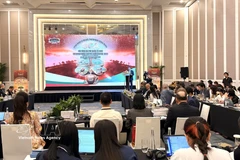
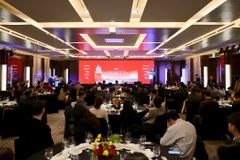
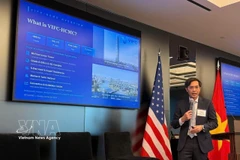
A workshop themed US-Vietnam Getting to Net-Zero: Roadmap to Sustainable Industrial Development was held in Ho Chi Minh City on January 14 by the US Commercial Service in the city, in partnership with the International Financial Centre (IFC) and Saigon Tel.

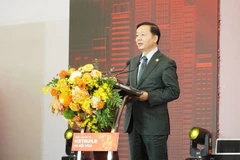
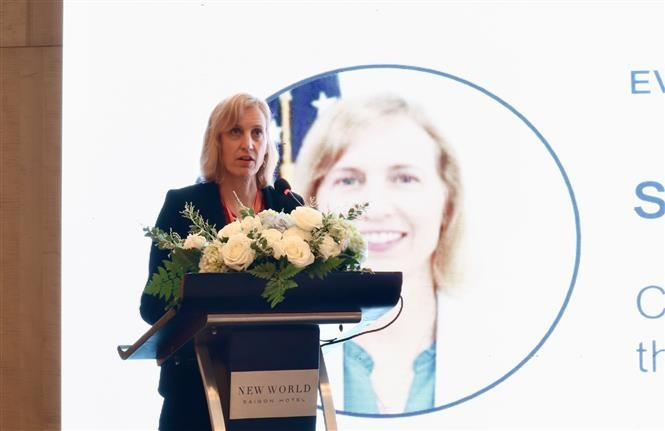
Susan Burns, US Consul General in Ho Chi Minh speaks at the event. (Photo: VNA)

HCM City (VNA) - A workshop themed US-Vietnam Getting to Net-Zero: Roadmap to Sustainable Industrial Development was held in Ho Chi Minh City on January 14 by the US Commercial Service in the city, in partnership with the International Financial Centre (IFC) and Saigon Tel.

Susan Burns, US Consul General in the city, said that Vietnam has emerged as one of the leading manufacturing hubs in Southeast Asia, attracting foreign investors thanks to its policies focused on building an export-oriented economy.

Additionally, Vietnam's logistics sector is continuously developing. However, Vietnam is also one of the countries most vulnerable to climate change. The country has set ambitious targets to achieve net-zero emissions by 2050, but the industrial manufacturing sector remains a significant source of emissions, she stressed.

According to the Consul General, achieving climate change mitigation and carbon emissions reduction goals requires cutting carbon emissions from the industrial sector. Furthermore, international market demands and trade agreements are increasingly pushing for green certifications to minimise the environmental impact of supply chains. In light of these factors, Vietnam needs to seek solutions to meet the growing energy demand and address other environmental factors in key industrial sectors.

To support Vietnam in its pursuit of the net-zero goal, the US can introduce resources from both its public and private sectors, share initiatives on energy efficiency, water management, and technological processes, she stated, adding that through these solutions, Vietnam's industrial sector can use fewer resources to produce the same output of goods while simultaneously measuring and managing carbon emissions, improving market opportunities, and enhancing its competitiveness.

Pham Minh Hung, Deputy Director of the Department of Industrial and Services Economy under the Ministry of Planning and Investment, said that the development of science and technology, digital transformation, and the dual transition across all aspects of the economy, coupled with the intensifying competition among nations to attract investment, present both opportunities and challenges for Vietnam to achieve breakthrough development, especially in attracting investment and integrating into the value chains of emerging industries such as green energy and semiconductor.

Developing sustainable industries and building green industrial zones are not only economic development goals but also commitments to the future of the next generations. With the aim of becoming a regional leader in sustainable industrial development, Vietnam aspires to continue receiving support from the business community, investors, and partners in providing resources and solutions to optimise resources, and promote cleaner production in order to reduce the carbon footprint, and meet the demands for rapid, sustainable, and environmentally friendly development, emphasised Hung.

Assistant Secretary at the US Department of Commerce Arun Venkataraman said that the US and Vietnam play a crucial role in driving the energy transition in the Pacific region.

Noting that Vietnam currently has only seven out of over 400 industrial zones designated as eco-industrial parks and more than 500 green-certified buildings, he said that this highlights significant potential for the country to advance energy transition and green production.

With their expertise and resources, US businesses can offer numerous technological solutions to support Vietnam in developing a low-emission industrial sector for a cleaner, more sustainable environment, contributing to the achievement of its net-zero goal by 2050, he added.

Harry Hughes, Vice President of Strategic Board at SaigonTel - one of the leading enterprises in the field of telecommunications, IT and communications in Vietnam, proposed the Vietnamese Government continue improving policies and mechanisms to facilitate green and renewable energy transition and distribution.

At the local level, efforts should focus on developing the infrastructure for eco-industrial parks to attract green investment flows, he stated, advising the business community to prioritise adopting low-emission solutions and technologies, and integrating circular economy principles into production, business, and trade./.

VNA

See more

The Quang Tri coastal road project, spanning nearly 55km, is among key projects with regional connectivity that play an important role in promoting socio-economic development in the central province of Quang Tri. The project is expected to be completed by the end of 2026.(Photo: VNA)

Public investment disbursement slow despite record capital scale

As of February 28, total disbursed capital reached 55.74 trillion VND, equivalent to 5.6% of the plan assigned by the Prime Minister. Of the figure, disbursement of the central budget was estimated at 10.18 trillion VND, or 2.9% of the plan, while that of local budgets totalled 45.56 trillion VND, reaching 7% of the target.

Delegates taste UK food (Photo: VNA)

Taste of UK week promotes British foods in Vietnam

The “Taste of the UK” food week, held for the first time in Ho Chi Minh City from February 26 to March 11, is an opportunity to promote British food products and strengthen their presence in Vietnam, while giving local consumers a chance to experience the diversity of UK cuisine.

A customer purchases E5RON92 bioethanol fuel at a PVOIL gas station on Thai Thinh street, Hanoi (Photo: VNA)

Retail fuel prices rise sharply in March 5 adjustment

According to the Ministry of Industry and Trade, the global fuel market during the latest price adjustment period from February 26 to March 4, 2026 was influenced by several major factors, including the escalating military conflict between the US – Israel coalition and Iran.

Workers at a textile factory in Hanoi (Photo: VNA)

Supporting industries seek fresh growth momentum

Against a backdrop of global uncertainty and supply chain restructuring, the Government has introduced a range of measures aimed at injecting new momentum into domestic manufacturing. New provisions covering workforce training, testing and certification, trade promotion and technology upgrades have been implemented.

Workers package fruits at the factory of Vina T&T Group (Photo: nhandan.vn)

Vietnamese exporters adapt to escalating Middle East conflict

The Ministry of Industry and Trade’s Export-Import Department forecasts upward pressure on global prices for consumer goods, fuel, and crude oil in the coming time. Such hikes could exert indirect but broad negative effects on Vietnam’s overall production and trade, with particular exposure in exports destined for the Middle East.

The MoIT will closely monitor global oil prices, output, inventories and trade flows to adjust imports and domestic supply accordingly. - Illustrative image (Photo: VNA)

Vietnam triggers fuel contingency plan over Middle East crisis

The Ministry of Industry and Trade will closely monitor global oil prices, output, inventories and trade flows to adjust imports and domestic supply accordingly. It will also intensify oversight of key traders’ compliance with their 2026 minimum reserve obligations.

Workers process tra fish for export. (Photo: VNA)

Agro-forestry-fishery exports up over 17% in first two months

Of the total export value in the January–February period, agricultural products accounted for 6.09 billion USD, up 17.1% year-on-year. Seafood exports reached 1.76 billion USD, marking a sharp increase of 23.3%, while forestry products brought in 2.82 billion USD, up 7.4%.

Many private businesses are investing in the service and real estate sectors in Da Nang. (Photo: VNA)

Da Nang augments efforts to attract high-quality investments

Da Nang has consistently implemented business support policies and a selective investment attraction strategy, prioritising high technology, smart city building and sustainable development, thereby strengthening investor confidence and enhancing the city’s competitiveness in the new development phase.

Export activities at the Cai Mep - Thi Vai port cluster (Photo: VNA)

Southern region opens wide to new wave of US investment

Since 2025, US enterprises have increasingly explored investment opportunities across provinces in the Southern Key Economic Region. Ho Chi Minh City has emerged as a leading destination, highlighted by multiple cooperation agreements concluded in late 2025.

Visitors explore Vietnamese furniture products at HawaExpo 2026. (Photo: VNA)

Ho Chi Minh City’s HawaExpo 2026 triples in scale

Held under the theme “Gateway to Vietnam Furniture Prowess” and featuring more than 2,500 booths, the four-day event is expected to serve as a gateway to exploring the genuine capabilities of Vietnam’s wood and furniture industry, as well as a strategic trading hub for international markets.