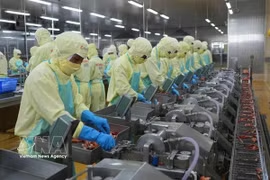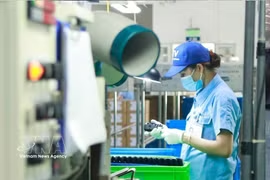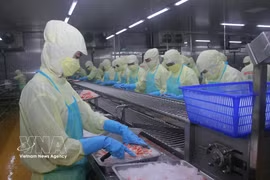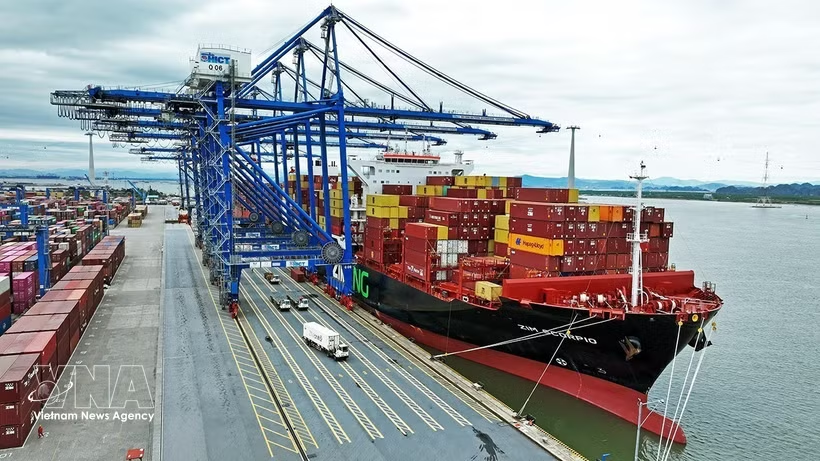
Hanoi (VNA) - Vietnam’s total goods trade reached an estimated 1.01 trillion USD in the first 10 months of 2026, up 32.3% from a year earlier, surpassing the 1 trillion USD mark for the first time, the Ministry of Industry and Trade’s Agency of Foreign Trade said on October 29.
Trade turnover in October alone was estimated at 122.2 billion USD, up 47.6% year-on-year.
Exports continued to post strong growth, reaching an estimated 499 billion USD in the January-October period, jumping 27.4%. The performance has put Vietnam on track to meet or exceed its full-year 2026 export growth target of 15-16%.
According to the agency, export growth was recorded in both the domestic and foreign-invested sectors. Processed and manufactured goods remained the mainstay, accounting for 87.4% of total exports. Shipments also grew strongly to major markets, including China, the United States, the European Union, the Republic of Korea and ASEAN.
Vietnam recorded a trade surplus of an estimated 6.8 billion USD in October, marking the second consecutive month of surplus and narrowing the cumulative trade deficit for the first 10 months to around 12.7 billion USD.
The results underscore the continued momentum in trade and its important contribution to economic growth.
The agency said that the Ministry of Industry and Trade is drafting a goods import-export strategy through 2030, with a vision to 2045.
The strategy aims to drive strong export and import growth to support Vietnam’s ambition of achieving double-digit economic growth in 2026-2030. It targets average annual export growth of 15-16% over the period, with Vietnam aspiring to rank among the world’s 10 largest exporting nations by 2045.
Imports are targeted to grow by an average of 12-13% annually in 2026-2030, naming Vietnam in the world’s top 10 importers by 2045.
The strategy seeks to establish a sustainable trade surplus in 2026-2030, with the surplus equivalent to an average of 3-6% of total exports during the period, rising to 7-10% by 2045.
To improve the quality of trade growth and increase the value added from processing and technology, the draft strategy aims to raise the share of domestic firms in total exports to around 28-30% by 2030 and 38-40% by 2045.
Processed and refined goods are expected to account for 89-90% of total exports by 2030 and more than 92% by 2045. High-tech products are targeted to make up around 50% of processed and manufactured exports by 2030 and more than 55% by 2045.
The strategy also calls for broader market diversification to reduce concentration risks and strengthen resilience to trade shocks.
By 2030, no single export market should account for more than 25% of total exports, while no single import market should represent more than 35% of total imports.
The combined share of Vietnam’s three largest export markets or regions is targeted to fall below 55% by 2030 and below 50% by 2045.
Vietnam aims to export more than 1 billion USD worth of goods to over 45 markets by 2030 and 55 markets by 2045. The share of exports to emerging markets in South Asia, the Middle East, Africa and Latin America is targeted to reach around 10% by 2030 and 15% by 2045.
For the fourth quarter, the Ministry of Industry and Trade has identified export promotion, market diversification and stronger compliance capabilities as key priorities.
The ministry will seek to make more effective use of existing free trade agreements (FTAs) and expand access to new markets. It will also strengthen early-warning mechanisms for trade defence investigations, tariff barriers, green standards, traceability requirements and rules of origin.
Other priorities include helping businesses improve product quality, develop brands and enhance supply-chain transparency.
The ministry will also promote official export channels, expand agreements and protocols on agricultural quarantine, increase investment in cold-chain logistics infrastructure, and standardise growing areas and packing facilities to meet the requirements of individual trading partners./.
See more
Vietnam, EU expand cooperation in advanced materials development
The EU hopes to work with Vietnam to increase added value in global supply chains and support the country’s ambition to become a high-income nation by 2045.
Vietnam, Mexico step up trade connectivity
At the 32nd Mexican Foreign Trade Congress (Congreso COMCE 32), many Mexican businesses expressed interest in Vietnam as a potential sourcing market and sought information on its production capacity, product ranges and opportunities to connect with suppliers.
AEF 2026: Vietnam, China step up supply chain cooperation
With Vietnam-China trade reaching USD 256.4 billion in 2025 and the two economies having complementary strengths, the two countries' businesses have ample opportunities to become more deeply involved in regional and global production networks.
Ca Mau, Vietjet prepare Hanoi route with three weekly flights
Vietjet is set to launch the route with at least three weekly flights on Mondays, Wednesdays, and Fridays, using A320/A321 aircraft that can seat 180–186 passengers. The service will cater to both domestic and international travellers heading to Vietnam’s southernmost tip.
Fuel prices rise from 3pm on October 29
Under the latest adjustment, the retail price of E5RON92 petrol was capped at 26,027 VND (1.01 USD) per litre, up 666 VND per litre from the previous ceiling price.
Vietnam, UK seek stronger investment ties to build high-value economy
Ho Chi Minh City hopes to work with British financial institutions, credit rating agencies and businesses to develop capital markets and the International Financial Centre, an official said, adding that British expertise in market standards, risk management and international fundraising could help connect Vietnam with global capital flows.
Vietnam, Nordics push to turn new frameworks into business deals
Chairman of the Nordic Chamber of Commerce in Vietnam (NordCham Vietnam) Thue Quist Thomasen said bilateral ties are gaining momentum through new agreements covering sci-tech and innovation cooperation, the Vietnam–Norway Green Strategic Partnership, and the newly-signed Vietnam–Europian Free Trade Association (EFTA) Free Trade Agreement (FTA).
Vietnam, Algeria seek to boost local, business cooperation
Vietnam exports key products such as coffee, cashew nuts, pepper, seafood and chemicals to Algeria, while importing dates, olive oil and wheat flour, aiming to raise bilateral trade to 1 billion USD.
Vietnam pushes to fast-track licensing of member banks at int’l financial centre
The State Bank of Vietnam was asked to coordinate with the centre’s executive body to finalise guidance on applications, procedures and licensing conditions, with the aim of admitting an official member bank in November 2026.
Autumn Economic Forum 2026 seeks to establish new growth poles
Vietnam has built an impressive growth model, becoming a major manufacturing hub, an investment destination and an increasingly interconnected economy. It now needs to move beyond simply building connections and become a smartly connected economy.
Quang Ninh firm exports first transformer shipment to the Philippines
The shipment, valued at more than 700,000 USD, comprises 69 Kv to 13.8 Kv distribution transformers. The products were exported to Cotabato Light and Power Company, a subsidiary of the Philippines’ Aboitiz Power Group, to serve electricity transmission in the country.
VEFTA opens opportunities for high-tech cooperation, innovation
According to Vice President of the Foreign Trade University Associate Professor Dr. Dao Ngoc Tien, the VEFTA’s long-term value lies largely in its non-tariff commitments, which establish institutional frameworks, principles and cooperation mechanisms with lasting economic impacts.
Reference exchange rate goes up on October 29
With the current trading band of ±5%, the ceiling rate applicable to commercial banks stood at 26,926 VND/USD, while the floor rate was 24,352 VND/USD.
Vietnamese aircraft fleet climbs to 261
Among them, Vietjet registered 107 aircraft, including 16 Airbus A320s, 83 A321s and eight A330s. Vietnam Airlines has 94, including four A320s, 59 A321s, 14 A350s and 17 Boeing 787s.
Ca Mau approves wind power project worth nearly 154.7 million USD
To ensure the project stays on schedule, Huynh Chi Nguyen, Vice Chairman of the provincial People’s Committee, has assigned the Department of Agriculture and Environment to take the lead and coordinate with relevant agencies in guiding procedures for land allocation and leasing, the allocation of marine areas, and environmental protection. Relevant departments and agencies are responsible for state management, inspection, supervision and handling issues arising within their respective jurisdictions.
Autumn Economic Forum 2026 connects economies into value chains
Over three working days, more than 20 in-depth sessions and dozens of technology showcases produced concrete results, showing cooperation moves beyond vision into substantive links and action. The sessions generated strategic insights and recast thinking on new growth forces, core drivers and breakthrough cooperation models as the global economy shifts deeply.
Ho Chi Minh City seeks to expand energy cooperation with UAE
A Ho Chi Minh City official called on major UAE energy groups to consider investing in the project in the Ba Ria–Vung Tau area, which aims to establish an energy hub in southern Vietnam to serve domestic and regional markets.
Gold's headline price tells only part of trading story
Gold prices are often quoted as a single figure, making it easy to compare movements across different periods. However, a change in the quoted price does not translate into the same financial outcome for everyone exposed to the market. The result depends on how gold is traded, the size of the position, and the costs and contractual terms attached to the transaction.
Autumn Economic Forum 2026: Connecting new growth drivers to unlock potential
Global investment in new digital projects has nearly tripled since 2020, while the digital economy has recorded annual growth of 10–12% for several years, significantly outpacing global GDP growth, she said, adding that industrial digitalisation and cross-border digital services are also expanding rapidly.
Vietnam must strengthen domestic capacity to move up global supply chains: Deputy PM
Thang stressed that Vietnam could not remain a passive recipient or an outside observer. Instead, it must build its own capacity and actively define its role in global production networks. The goal is not simply to join existing or emerging value chains, but to create the conditions, mechanisms and capabilities for Vietnam and its international partners to participate more directly in value creation.