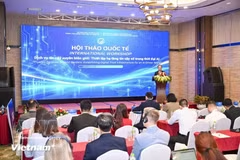
Capital needs breakthrough solutions to sci-tech firm development issues

Housing 149 out of Vietnam’s 712 sci-tech companies, Hanoi remains in need of breakthrough solutions so that the capital city can quickly raise the local quality and quantity of businesses to reflect its true potential.
Capital needs breakthrough solutions to sci-tech firm development issues ảnh 1Transformer production line at the Dong Anh Electrical Equipment Corporation - Joint Stock Company (EEMC), one of three sci-tech enterprises with key industrial products of Hanoi city. (Photo: hanoimoi.com.vn)

Hanoi (VNA) – Housing 149 out of Vietnam’s 712 sci-tech companies, Hanoi remains in need of breakthrough solutions so that the capital city can quickly raise the local quality and quantity of businesses to reflect its true potential.

In 2020, the municipal People’s Committee issued Plan 49/KH-UBND on supporting the growth of local enterprises toward 2025. The city is now taking the lead nationwide in the assistance and development of sci-tech firms who operate across a diverse range of sectors including ITC, biotechnology for agriculture and health, new material technology, and environmental protection technology.

Le Thanh Hieu, former head of the Hanoi Department of Science and Technology’s technology management office, said that 90% of the companies conduct research using their own capital or receive technology transfers from other organisations and individuals and make them part of their production, while a mere 10% of them incubate and develop technology from outcomes of State-funded projects.

According to Director of the department Nguyen Hong Son, the city has always paid attention to supporting science and technology enterprises via programmes and plans serving the implementation of various related development measures. As a result, the group has boldly invested in technological innovation and improved products’ quality and value.

The capital aims to have at least 200 firms of this kind by 2025. The current number of 149 is considered falling short of its potential. The local related support mechanism and measures still show shortcomings and shortages.

In particular, its incomplete legal framework regulating the type of sci-tech enterprises poses a significant barrier to the establishment and development of the firms. In addition, a few of them are allowed to participate in and lead projects to create new technologies and directly translate research and testing results into the production of commercial goods. Meanwhile, there are only three sci-tech enterprises recognised as key industrial manufacturers of the city.

Luu Hai Minh, Chairman of the Board at the Nhat Hai New Technology JSC – one of the three key manufacturers, said capital is the biggest difficulty facing enterprises in the field of science and technology. They cannot bring intellectual property to the bank as mortgage, while concessional loans are difficult to access, he explained.

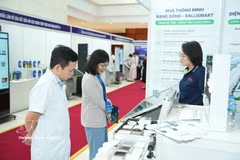
Capital needs breakthrough solutions to sci-tech firm development issues ảnh 2At an exhibition showcasing the capital's 60 years of sci-tech achievements. (Photo: hanoimoi.com.vn)

Recently, Hanoi has designed a plan to develop itself into a smart, modern, green, clean, beautiful and safe city and the leading centre of innovation, development research and technology application and transfer of the country, heading to be a sci-tech hub in Southeast Asia.

Accordingly, its rate of high-tech agricultural production in overall production value of the agricultural sector is set to hit 70% in 2025 and over 85% in 2030. The city will also strive for its rate of high-tech value in the processing-manufacturing sector to reach over 70% in 2025 and 85% in 2030.

The capital will also work to have 12 science-technology researchers and developers out of each 10,000 people in 2024, and 14 out of each 10,000 people in 2030.

To this end, the city will set aside 1.2-1.5% of its GRDP to invest in related development. The rate will be 1.5-2% in 2030./.

VNA

See more

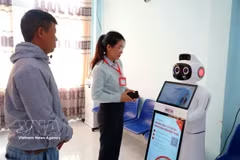
AI robots have become effective assistants in providing administrative services and reducing the workload of officials in Lam Dong province (Photo: VNA)

AI robots help streamline administrative procedures

Operating around the clock, AI robots provide information on administrative procedures, required documents, processing times, fees and relevant regulations, complementing assistance from civil servants.

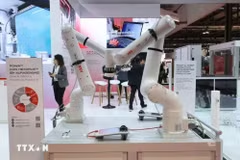
High prospects for Vietnam-Italy cooperation in robotics industry

High prospects for Vietnam-Italy cooperation in robotics industry

Vietnam and Italy have highly complementary strengths in this robotics field. Italy has experience in machinery manufacturing, industrial robotics applications and an established business network, while Vietnam has a dynamic market, strong demand for production modernisation and a promising young engineering workforce.

General Secretary of the Communist Party of Vietnam (CPV) Central Committee and President To Lam and the foreign ambassadors at the meeting (Photo: VNA)

Top leader receives new foreign ambassadors

Vietnam wishes to step up cooperation with the countries in such areas as economy, trade and investment; cutting-edge science and technology applications, semiconductors, artificial intelligence, new materials, digital transformation, sustainable agriculture, the environment, energy and renewable energy, the marine economy and maritime transport.

Delegates at the event (Photo: VNA)

Over 400 scientists attend international material conference

Discussions focus on six key areas, including advanced materials and their applications for sustainable development; environmentally friendly material processing technologies; product lifecycle engineering; sustainable machine design; low-carbon industries and the circular economy; and artificial intelligence and digital transformation in material and mechanical engineering.

Deputy Prime Minister Ho Quoc Dung (R) and Pierre Barnabé, Chief Operating Officer of French technology group Dassault Systèmes. (Photo: VNA)

Vietnam, France step up cooperation in AI, digital twin technology

At the meeting, the Deputy PM praised the group's contributions to promoting technology cooperation between Vietnam and France, particularly its collaboration with the Ministry of Finance and the National Innovation Centre (NIC) to establish a Centre of Excellence (CoE) for digital twins and artificial intelligence (AI) in Hanoi.

Rigobert Pinga Pinga, Acting Representative of OIF for Asia-Pacific speaks at the event. (Photo: VNA)

Franconomics 2026 explores human-centred technological transformation

Addressing the opening ceremony, Nguyen Anh Tuan, Rector of VNU-IS, said Franconomics was launched in 2019 as a multidisciplinary platform connecting scientists, policymakers, businesses and international organisations to discuss socio-economic issues relevant to Vietnam and the Francophone community.

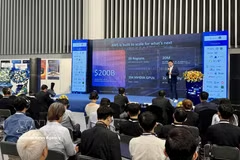
A new technology exhibition area arranged within the framework of the International Research and Innovation Funders Forum in Hanoi (Photo: VNA)

Vietnam promotes int'l cooperation in science, technology and innovation

Science is opening up new opportunities in artificial intelligence, healthcare, semiconductors and clean energy, while challenges such as climate change, energy security and epidemics require international cooperation. Science, technology, innovation and digital transformation are central to Vietnam’s new growth model.

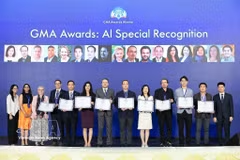
GMA Awards are presented to honour outstanding AI courses at the Global MOOC & Online Education Conference 2026. (Photo: VNA)

Responsible AI, teaching overhaul, global ties dominate GMC 2026

Panelists said AI can support knowledge delivery, information processing and personalised learning, but cannot replace teachers in building independent thinking, critical capacity, emotional intelligence and humanistic values. Universities therefore need to overhaul teaching, testing and assessment and redefine lecturers’ role in an AI-integrated environment.

An overview of the seminar (Photo: VNA)

Coordinated development of energy, AI and infrastructure needed for industrial growth

Vietnam is emerging as a regional bright spot for data infrastructure development, driven by growing demand for AI, cloud computing, 5G commercialisation and digital transformation. However, the country needs coordinated preparations, including green power supplies, international submarine cable connectivity and operational capabilities meeting global standards.

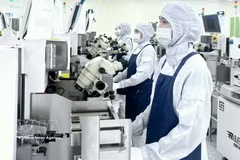
Production line at Hana Micron Vina Co., Ltd in Bac Ninh city (Photo: VNA)

Vietnam works to bridge gap between chip research and commercialisation

According to the Ministry of Science and Technology, Vietnam’s semiconductor industry has made notable progress. In 2025, it generated more than 21 billion USD in revenue and attracted over 14 billion USD in foreign investment through more than 240 projects. The country is now home to around 60 chip design companies and over 7,000 semiconductor design engineers.

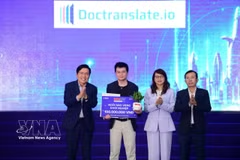
The Golden Startup Star award, worth 100 million VND, is presented to the Doctranslate.io project (Photo: VNA)

AI-powered translation platform wins Golden Startup Star award

Doctranslate.io offers contextual translation, audio recording, transcription and content summarisation services for communication, meetings and international events. Supporting 80 languages, the platform aims to add more less widely spoken languages.

Participants at the Vietnam–RoK AI and Digital Technology Forum 2026. (Photo: VNA)

Vietnam, RoK promote AI cooperation

Vietnam attaches importance to international cooperation while building its own technological capabilities, gaining greater mastery of key technologies and strengthening its participation in global AI value chains, and the RoK is its important partner in this process.

Deputy Minister of Science and Technology Pham Duc Long speaks at the international seminar entitled “Trusted Services Beyond Borders: Establishing Digital Trust Infrastructure for an AI-Driven World” on October 29, 2026. (Photo: VNA)

Vietnam promotes cross-border digital trust in AI era

As AI becomes increasingly involved in digital transactions, digital content's origin and integrity must be verified proactively, rather than merely detecting false information after it emerges, an official has said.

An overview of the reception (Photo: Quang Ninh Newspaper)

Quang Ninh, China’s Guangxi seek stronger cooperation in digital economy, AI

The city leader expressed his hope that the delegation would engage in professional exchanges with Quang Ninh’s departments and agencies to translate into concrete initiatives the cooperation areas in science and technology, artificial intelligence (AI) and the digital economy agreed upon by senior leaders of the two sides.