Cybersecurity event looks at APAC’s digital reputation economy

Asia Pacific (APAC), a fertile land for social media, houses more than half of the total users worldwide and is at the centre of Facebook’s growth.
Cybersecurity event looks at APAC’s digital reputation economy ảnh 1Kaspersky's Cybersecurity Weekend, which was held online for the first time, explores the impacts of social media activities on individuals’ personal identities and companies’ brand perceptions. (Photo courtesy of the company)

HCM City (VNS/VNA)
- Asia Pacific(APAC), a fertile land for social media, houses more than half of the totalusers worldwide and is at the centre of Facebook’s growth.

The latest numbers from German company Statista, which specialises in marketand consumer data, show that East Asia has logged the most number of virtualnetwork users at over 1 billion as of 2020 so far, with Southeast Asia andSouth Asia both trailing behind with over 400 million users, respectively.

As the region first hit by the COVID-19 pandemic, different forms of lockdownshave been implemented, eased and re-issued across APAC, putting forwarduncharted opportunities for the internet and social media.

The rapid rise and ever-evolving usage of these platforms -- from postingpictures, sending messages, to becoming an expanding marketplace -- makes itessential to examine this new economic frontier.

Speaking at Kaspersky’s sixth Cybersecurity Weekend recently, Vitaly Kamluk, Director of Global Research andAnalysis (GReAT) for APAC, at Kaspersky, said: “One of the most visible effectsof this pandemic is how it forced everyone, from individuals to the biggestcompanies, to shift a lot of their activities online.

“This dependence, triggered by our need to secure our physical health, alsopushed us to increase our social media use, either to connect with our distantloved ones, to give support to our community, to entertain ourselves, or to gethold of products and services that we need. Parallel to this trend is theopening of wider doors for cybercriminals to exploit.”

Aside from the heavier reliance on the internet, the pandemic situation alsoprovided an effective tool for cybercriminals – a “hook” that could make oneclick a phishing email, share a malicious link, forward an infected image, andmore.

“From detecting and analysing 350,000 unique malware samples a day pre-COVID,we currently see a total of 428,000 new samples per a 24-hour window.

“Add the geopolitical events across APAC, the uptick on e-commerce and e-walletadoption, the continuous remote work set-up and online learning, and theemotional and psychological stresses of the situation, the 2020 threatlandscape seems to favor cybercriminals.

“However, hope is in our hands as we are the controller of our onlineactivities. Improved vigilance to protect our digital identities and assets isnecessary,” Kamluk said.

Rafizah Amran, deputy chief marketing and communication officer for PrasaranaMalaysia and an integrated marketing communications and public relationsspecialist, said: “From my experience, the digital reputation of a company isimportant. Our hyperconnected community made it easier for consumers to voicetheir opinions in favour or against our products and services.

“This forced us, marketers and companies, to focus beyond closing sales andrunning campaigns, and to know our end-users, put customers’ experiences in themiddle, and involve them in our decision-making process. Most importantly, inthis era of quick postings and virality, it is important for brands to be veryhonest and be excellent listeners.”

With the theme “Secure Your Digital Reputation”, the Cybersecurity Weekendexplored the impact of social media activities on individuals’ personalidentities and companies’ brand perceptions.

The annual media conference, which was held online for the first time, wasattended by Kaspersky’s elite researcher, an industry expert, and journalistsfrom the 12 APAC countries./.
VNA
See more

The signing and implementation ceremony for the Vietnam–Thailand–Singapore submarine cable project on November 26, 2026 (Photo: VNA)

Vietnam–Thailand–Singapore submarine cable project launched

Designed with eight fibre pairs, the system will employ next-generation wavelength-division multiplexing (WDM) technology and an open-cable architecture. It is expected to deliver a round-trip data latency of just 12 milliseconds, about 50% lower than the current average.

Deputy Prime Minister Ho Quoc Dung, together with Government leaders, representatives of the Ministry of Science and Technology and CMC Technology Group, performs the official launch ceremony of the Clex legal AI platform. (Photo courtesy of the company)

Vietnamese-made legal AI platform Clex launched

Clex was researched and developed by CMC based on a large language model specialising in Vietnamese law, which was trained and fine-tuned on a knowledge base comprising more than two million legal documents.

The VGC v1.0 security chip, designed and developed by Vietnam (Photo: VNA)

Vietnam builds initial semiconductor foundation

Experts said the first step is not another broad strategy but a hard-headed audit of what Vietnam can actually do and a clear-eyed map of its advantages, technology gaps and opportunities in the global value chain.

The inauguration ceremony of the ASEAN-China Health Exchange and Cooperation Centre in Chongqing. (Photo: VNA)

Vietnam proposes stronger ASEAN-China cooperation in AI

For Vietnam, AI-driven transformation is both a strategic opportunity and an inevitable requirement for development. Science, technology and innovation are becoming key drivers of growth, productivity and competitiveness, said Deputy Minister of Foreign Affairs Nguyen Manh Cuong.

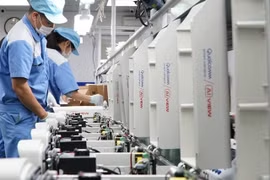
Assembling electronic components on the production line of Bao Sen Co., Ltd in Bac Ninh City. (Photo: VNA)

Vietnam builds technological capacity in digital era

As science, technology and digital transformation become increasingly integrated into production, governance and daily life, they can help create new drivers of growth and advance the development goals set out in the resolution.

The beauty of Dong Van Karst Plateau (Photo: VNA)

Vietnam tourism’s competitive future runs on digitalisation

The Vietnam National Authority of Tourism (VNAT) reported that Vietnam drew about 19.5 million foreign arrivals in the first 10 months of 2026, up 13.8% from a year earlier. That growth, along with changing consumer behavior, is forcing travel companies to rethink sales, service quality and how they mine customer data.

Visitors at the exhibtion held within the framework of the 16th Business of IP Asia Forum. (Photo: VNA)

Vietnam promotes innovation links at Hong Kong Entrepreneur Day 2026

Van expressed her hope that the NIC would serve as a bridge to encourage businesses and major corporations from the GBA to invest in Vietnam and transfer innovative technologies, particularly in artificial intelligence (AI), green transition and financial technology (FinTech).

Karnataka Chief Minister D.K. Shivakumar speaks positively about cooperation prospects and expresses hope that more Vietnamese businesses will invest in the Indian state. (Photo: VNA)

Vietnam, India's Karnataka boost science, technology cooperation

The ambassador highlighted the complementary strengths of Vietnam and the Indian state, home to the country's Silicon Valley, and significant potential for cooperation in artificial intelligence (AI), semiconductors, digital technology, and research and development.

Delegates pose for a group photo at the Bengaluru Tech Summit 2026 in Karnataka, India (Photo: VNA)

Vietnam attends annual int’l tech summit in India

Vietnam's growing focus on science and technology, digital transformation and innovation as new drivers of development made India a natural partner in achieving its development and digital transformation goals. Cooperation potential between the two countries remains substantial, spanning both hardware and software.

Vietnamese Deputy Minister of Science and Technology Tran Trung Tinh speaks at the event. (Photo: Published by VNA)

Vietnam, RoK seek to expand cooperation in AI and semiconductor sectors

Vietnamese Deputy Minister of Science and Technology Tran Trung Tinh stressed that the Politburo's Resolution No. 57-NQ/TW identifies science and technology, innovation and digital transformation as leading breakthroughs and key drivers of rapid and sustainable development. Semiconductors and artificial intelligence (AI) are among the strategic technologies prioritised for development.

Representatives of Cambodia’s Ministry of Education, Youth and Sport (MoEYS), the Agence Universitaire de la Francophonie (AUF) and Viettel Cambodia (Metfone) sign a tripartite agreement to strengthen cooperation and accelerate digital transformation in Cambodia’s higher education sector. (Photo: khmertimeskh.com)

Vietnamese company joins Cambodia’s digital transformation efforts

The agreement establishes a cooperation framework to modernise higher education through digital governance, digital learning, artificial intelligence (AI) applications, and capacity building through training and knowledge sharing. It also aims to expand internship, employment and scholarship opportunities for students.