East Asian countries support Palestine’s development

Son announced an additional humanitarian aid package worth 350,000 USD for the Palestinian people, which will be channeled through relevant international organisations, aimed at easing hardships faced by the Palestinian people and supporting their reconstruction process.

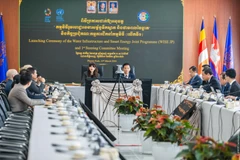
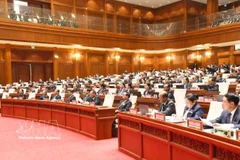
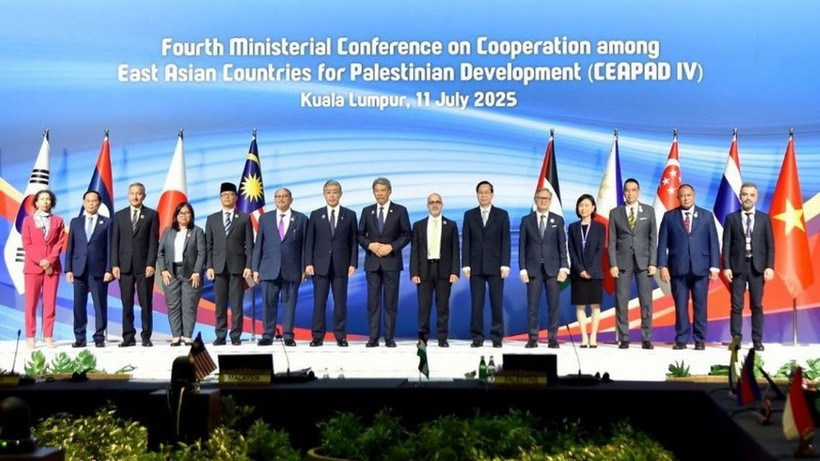
Delegates at the conference (Photo: VNA)

Kuala Lumpur (VNA) – Deputy Prime Minister and Minister of Foreign Affairs Bui Thanh Son has reaffirmed Vietnam’s consistent stance on supporting a fair, comprehensive and long-term solution to the Palestine issue, including the establishment of an independent and sovereign State of Palestine, with East Jerusalem as its capital, based on pre-1967 borders and in accordance with relevant United Nations resolutions.

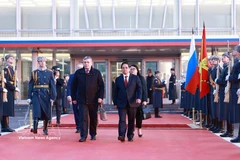
Addressing the fourth Conference on Cooperation among East Asian Countries for Palestinian Development (CEAPAD IV) in Kuala Lumpur, Malaysia, on July 11, Son also expressed Vietnam’s readiness to work closely with partners, including East Asian countries, to pool resources, share development expertise, and support capacity-building efforts for the State and people of Palestine.

On the occasion, he announced an additional humanitarian aid package worth 350,000 USD for the Palestinian people, which will be channeled through relevant international organisations, aimed at easing hardships faced by the Palestinian people and supporting their reconstruction process.

At the conference, delegates expressed their profound concern over the humanitarian situation in the Gaza Strip, calling for an immediate ceasefire and an end to violence, ensuring the safety of civilians, and facilitating humanitarian assistance efforts.

They stressed the need to foster international efforts and enhance CEAPAD partnerships to support urgent humanitarian needs as well as Palestine’s recovery, reconstruction, and development.

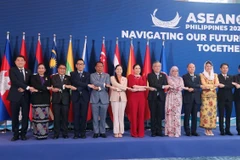
The conference, co-chaired by the foreign ministers of Malaysia and Japan, adopted the Kuala Lumpur CEAPAD IV Action Plan, a framework designed to reinforce and coordinate support efforts based on Palestine’s actual needs and practical requirements./.

VNA

See more

Houses are damaged after the earthquake in General Santos city, Philippines on June 8. (Photo: Xinhua/VNA)

Death toll from Philippines earthquake rises, tsunami reaches Indonesia, Japan

In the hard-hit port city of General Santos, disaster management officials confirmed seven deaths after several buildings collapsed and key infrastructure was damaged. The Philippine Institute of Volcanology and Seismology warned residents to exercise caution before returning to damaged buildings due to the risk of aftershocks.

Several shops were damaged following the earthquake in General Santos City, the Philippines, on June 8, 2026. (Photo: Xinhua/VNA)

At least 12 killed, hundreds injured in Philippines earthquake

The port city of General Santos suffered the heaviest damage, with disaster management officials confirming seven fatalities and about 130 injuries after several small buildings collapsed and multiple structures, including a key bridge, sustained severe cracks. The remaining five deaths were recorded in South Cotabato, Davao Occidental and Balut Island.

Laos intensifies business environment reforms

The latest Provincial Facilitation for Investment and Trade Index report indicates that since 2018, the public sector has clearly defined timelines for document approval, reducing the time required to establish a business to just 17 days, including 10 days for the issuance of a business registration certificate, five days for seal engraving, and two days for social insurance registration.

Datuk Seri Anwar Ibrahim attends the National TVET Day 2026 celebration at Dataran Putrajaya today. (Photo: Bernama)

Malaysia strengthens vocational training in technology and energy sectors

Malaysia is ramping up technical and vocational education and training (TVET) as a cornerstone of its economic transformation and talent development strategy, preparing its workforce for emerging fields such as artificial intelligence (AI), cryptocurrency technology and the global energy transition.

Indonesia eyes trade breakthrough with EAEU via FTA

Indonesia eyes trade breakthrough with EAEU via FTA

Indonesia seeks to develop relations with all countries and sees itself as a bridge between different regions of the world. Against a backdrop of growing geopolitical and global economic uncertainty, strengthening international cooperation and building reliable supply chains have become more important than ever.

Thai Prime Minister Anutin Charnvirakul (R) at Nation TV’s 26th anniversary event on June 4, 2026. (Photo: nationthailand.com)

Thailand prioritises OECD accession

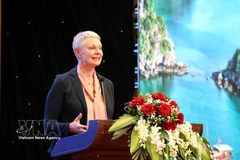
Thai Prime Minister Anutin Charnvirakul the country’s bid to join the Organisation for Economic Co-operation and Development, or OECD, is central to the government’s economic agenda.

ASEAN aims to become global digital economy hub

ASEAN aims to become global digital economy hub

Studies indicate that the ASEAN Digital Economy Framework Agreement (DEFA) could help raise ASEAN’s digital economy value to 2 trillion USD by 2030 while transforming the region into a connected, comprehensive and sustainable digital economy hub on the global stage.

Malaysian Deputy Prime Minister and Minister of Energy Transition and Water Transformation Seri Fadillah Yusof speaks at the Energy Transition Conference 2026 (ETCon26) in Kuala Lumpur on June 3. (Photo: VNA)

Malaysia accelerates energy transition

Malaysian Deputy Prime Minister and Minister of Energy Transition and Water Transformation Seri Fadillah Yusof noted that for both Malaysia and ASEAN, the transition is not only an environmental imperative but also an economic necessity and a strategic priority.

A pregnant woman receives a routine pregnancy check-up at a hospital. (Photo: VNA)

ILO report highlights gaps in maternity benefits across ASEAN

The report calls for extending maternity protection to all women, including workers in the informal economy; strengthening financing mechanisms to ensure sustainability and adequacy of benefits; and aligning maternity protection policies with broader social protection, health and care policies.