Economic thinking, cultural ecosystems: New drivers for national development

Resolution 80 views culture as an “asset” capable of generating returns and contributing to national economic development, with a target for cultural industries to account for 7% of GDP by 2030 and for culture to become a key export sector.

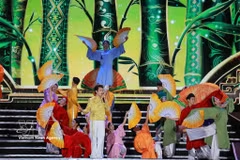
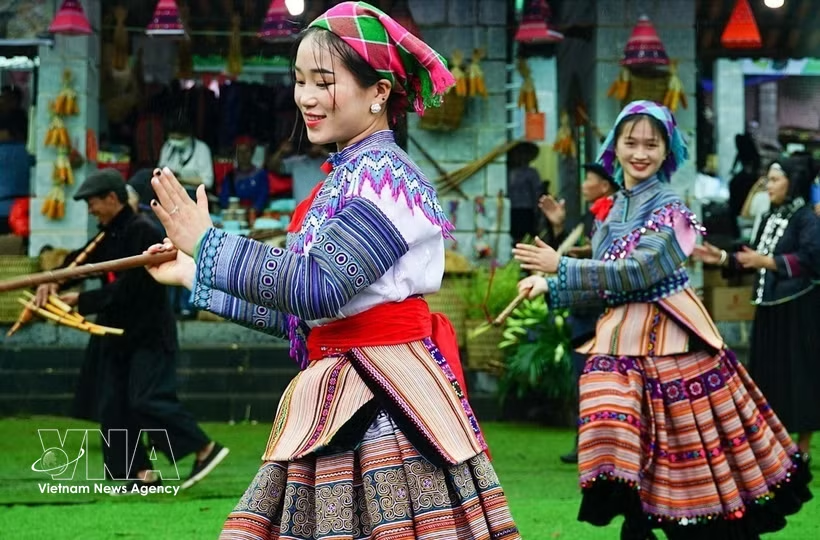
A dance performance by members of the Mong ethnic group at the “Great National Unity Festival” of ethnic communities at the Vietnam National Village for Ethnic Culture and Tourism. (Photo: VNA)

Hanoi (VNA) – In a new era where competition among nations extends beyond economics and technology to encompass values, identity and soft power, Vietnam is placing culture at the heart of its development strategy.

​Resolution No. 80-NQ/TW of the Politburo on the development of Vietnamese culture recognises it not only as a spiritual foundation but also as an intrinsic resource directly driving economic growth and enhancing national standing, while opening up a new development space in which culture is central to the broader ecosystem.

Economic thinking in cultural development

​Assoc. Prof. Dr. Nguyen Thanh Nam from the Hanoi University of Culture says the resolution takes a clear economic approach to cultural development as Vietnam moves into a new stage. It focuses on setting goals for culture’s role in the economy, growing cultural industries, connecting culture with tourism and heritage-based economic growth, evaluating culture’s overall economic value, mobilising resources and financial policies, and promoting a digital economy tied to culture.

​Resolution 80 views culture as an “asset” capable of generating returns and contributing to national economic development, with a target for cultural industries to account for 7% of GDP by 2030 and for culture to become a key export sector.

​The resolution also underscores the importance of public investment in culture, stipulating that at least 2% of total annual state budget expenditure be allocated to this sector, with gradual increases based on practical needs. It further highlights preferential economic policies, including land incentives and corporate income tax exemptions or reductions for start-ups in the cultural sector.

​Nam noted that Resolution 80 marks a significant turning point in concretising the cultural economy model and embedding economic thinking into cultural development in Vietnam. Compared with Resolution No. 33-NQ/TW (2014), which primarily focused on building people and cultural environments, Resolution 80 introduces a more practical and market-oriented approach. Whereas earlier policies largely regarded culture as a “spiritual foundation” and public good, the new framework emphasises that culture must generate GDP, profits and export value.

​Cultural industries, first mentioned in Resolution 33, are now identified as a breakthrough development strategy in the knowledge-based economy. Notably, Resolution 80 promotes a strong “public investment – private governance” model, in which the State sets direction and establishes mechanisms, mobilising financial resources and creativity from the private sector and multinational corporations.

​He also stressed that meeting the resolution’s objectives will require a new generation of cultural human resources – managers, professionals, creators and designers – who possess both a deep understanding of cultural identity and strong technological and economic management skills.
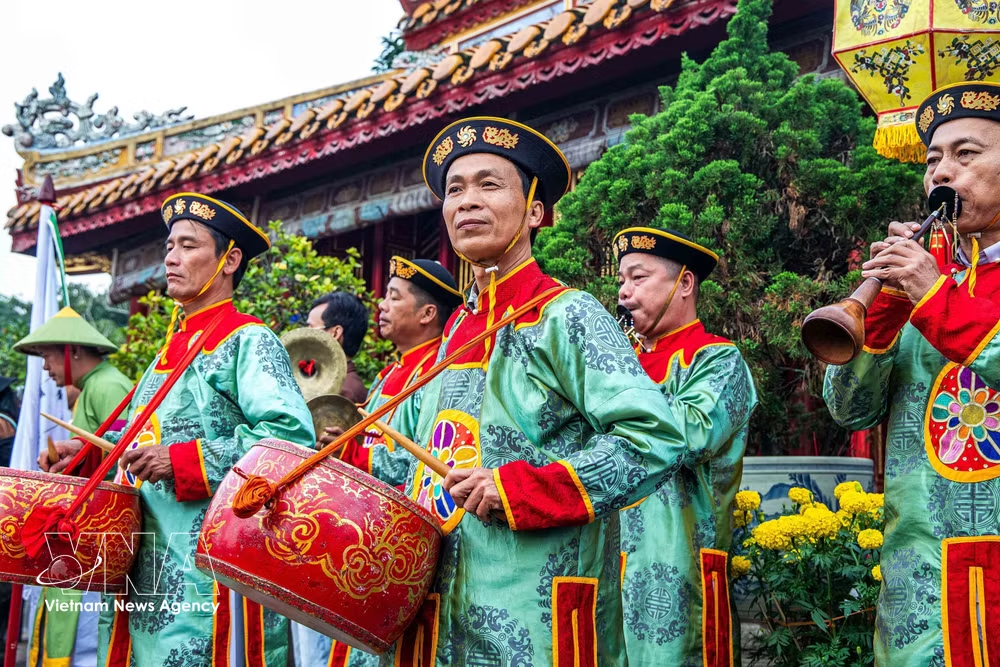
vnanet-bieu-dien-nha-nhac-anh-ttxvn.jpg
A performance of Nha Nhac (Vietnamese court music) (Photo: VNA)

Cultural ecosystem approach

​According to Pham Thanh Tinh, Chairman of the Southeast Asian Research Association of Vietnam, the introduction of the concept of a “cultural ecosystem” in Resolution 80 represents a pivotal shift in strategic thinking.

​Previously, culture was often treated as a relatively independent field associated with preservation, education and artistic activities. The new resolution, however, restores culture to its broader role, not merely as a spiritual foundation but as a dynamic system capable of interaction, diffusion, and value creation across the entire national development structure.

​The key breakthrough lies in moving from a “single-sector” mindset to an interdisciplinary and ecosystem-based approach. Culture is no longer positioned alongside the economy, science or education, but rather acts as a connective force shaping and driving these sectors. This shift is particularly relevant in today’s context, where development challenges are increasingly complex and require integrated solutions.

​As heritage goes digital and traditional values find their way into tourism, education, and creative industries, culture starts creating real, measurable value for the economy.

​From an external perspective, in an increasingly interconnected region, cultural diplomacy linked with innovation is expected to become a key pillar enabling Vietnam to engage more deeply in multilateral cooperation networks.

​To put Resolution 80 into action, the association will focus on three main areas: creating interdisciplinary knowledge ecosystems that connect culture with the creative economy, education, technology, and public policy; building regional networks and strengthening collaboration with research institutes, universities, and international organisations; and promoting culture as a key driver of innovation, from creative economy models and cultural industries to tech applications in preserving and showcasing heritage.

​With Resolution 80, Vietnam now has a clear strategic orientation to transform culture into a driver of sustainable development, supporting the country’s continued progress and strengthening its position regionally and globally./.
VNA

See more

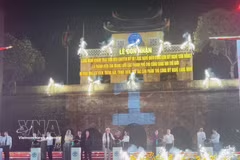
Delegates perform the opening ceremony ritual at the event held at the Thang Long imperial citadel on the evening of May 8. (Photo: VNA)

Hanoi gains two more craft villages in World Crafts Cities network

The recognition of Chuyen My and Son Dong craft villages as members of the World Crafts Cities network represents international acknowledgement of the cultural value, artisanal techniques, creativity and sustainable vitality of Vietnam’s traditional craft villages, he said.

SEA Games silver medallist Do Huy Hoang (right) will face Filipino fighter John Dave Almanza in the MMA Pro 56kg category. (Photo: Lion Championship)

LION Championship 31 to feature international fighters

The Vietnam Mixed Martial Arts Federation (VMMAF) has announced that LION Championship 31 (LC 31) will take place at 8 pm on May 9 in Hanoi, featuring nine exciting bouts, including several involving foreign fighters.

Vietnam GameVerse 2026 brings together more than 300 representatives from regulatory agencies, game developers, publishers, and leading industry experts from Vietnam and abroad. (Photo: VNA)

Vietnam GameVerse 2026 aims to elevate local gaming industry globally

Carrying the theme “Do local, go global”, this year’s event promotes a development approach rooted in Vietnamese creativity and innovation as the foundation for expanding local gaming products into international markets. Organisers expect the event to draw around 60,000 participants.

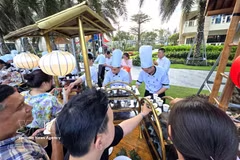
Visitors at a food stall in Da Nang (Photo: VNA)

Da Nang Food Tour Festival 2026 scheduled for May 20-24

This year’s festival will feature more than 100 booths and 70 street food stalls. A highlight will be the “Flavours of Da Nang” street parade on May 20 afternoon along Pham Van Dong beach, recreating central Vietnam’s street-food atmosphere. The opening ceremony is scheduled on May 21 morning at Bien Dong Park, blending an art show with culinary showcases.

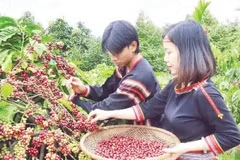
In March 2025, the Ministry of Culture, Sports and Tourism recognises “the knowledge of coffee cultivation and processing in Dak Lak” as a national intangible cultural heritage. (Photo: nhandan.vn)

Dak Lak forum spotlights Vietnam’s coffee heritage ambitions

Nearly 40 research papers and presentations from Vietnamese and international scholars and experts were featured at the event, covering topics ranging from economics, culture, and heritage to processing technology, global value chains, and sustainability

Vietnam’s craft villages get major makeover

Vietnam’s craft villages get major makeover

Amid Vietnam’s push to redefine progress beyond pure GDP growth, the Politburo’s Resolution 80-NQ/TW delivers a sharp message that culture is no longer a sidekick, but must lead and shape national development.

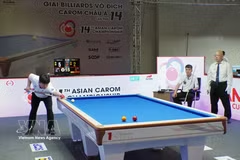
Men’s three-cushion carom defending champion Cho Myung Woo of the Republic of Korea (left) competes against Yoneyama Satoru of Japan in Group A at the 14th Asian Carom Championship. (Photo: VNA)

14th Asian Carom Championship kicks off in Ho Chi Minh City

Organised by the Ho Chi Minh City Billiards & Snooker Federation, the tournament features four events: men’s three-cushion carom, women’s three-cushion carom, men’s one-cushion carom, and the men’s U22 three-cushion category.

The opening ceremony of the VNG IRONMAN Vietnam 2026 and the VNG IRONMAN 70.3 Da Nang 2026. (Photo: VNA)

Da Nang launches Southeast Asia’s largest IRONMAN week

Speaking at the ceremony, Deputy Director of the municipal Department of Culture, Sports and Tourism Tao Viet Hai described the event as a major milestone in Da Nang’s sports and tourism development. For the first time, the city will host the full-distance IRONMAN Vietnam while also staging the 10th edition of IRONMAN 70.3 Da Nang.

Players at the Vietnam (in white) – Yemen match on May 7. (Photo: VFF)

Vietnam edge Yemen in AFC U17 Asian Cup opener

At the 2026 AFC U-17 Asian Cup, Vietnam are drawn in Group C alongside the Republic of Korea (RoK), the UAE and Yemen. Under the fixture schedule, Vietnam will face Yemen on May 7, the RoK on May 10 and the UAE on May 14.

A performance at the Thang Long - Hanoi Festival 2025 (Photo: VNA)

Thang Long - Hanoi Festival 2026 to return in September

Co-hosted by the municipal People’s Committee, the Department of Culture and Sports, and domestic and foreign agencies, the whole spectacle is meant to honour the city’s millennia-old heritage while reafffirming its strategy of establishing culture as a development engine.

An installation by Le Huu Hieu at the 61st Venice Art Biennale in Italy (Photo courtesy of Venice Art Biennale)

Vietnam lacquer artists debut at Venice Biennale

Vietnam's appearance at the Venice Art Biennale 2026 is not only a symbolic milestone for the country's fine arts scene but also a new chapter in the integration of Vietnamese art into the global landscape.

A performance at the art programme to welcome the New Year 2026. (Photo: VNA)

Spreading Vietnamese cultural identity in digital space

In the context of deep international integration, cultural identity serves as both a “shield” against assimilation and a defining marker of a nation’s image. Protecting and promoting uniquely Vietnamese cultural values has therefore become a pressing task, particularly in an increasingly complex digital environment.

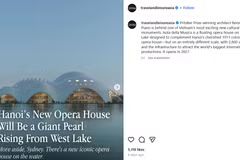
Hanoi’s New Opera House takes center stage for the global travel elite, drawing comparisons to the world’s most legendary architectural icons. (Photo: travelandleisureasia)

Asia’s leading luxury travel magazine hails Hanoi's new opera house: "Move aside, Sydney"

The magazine opened its feature with a bold declaration: "Move aside, Sydney. There’s a new iconic opera house on the water." The fact that Hanoi’s architectural masterpiece is being showcased by a platform that shapes the trends of the global travel elite is a clear testament to the project's worldwide appeal. International experts have already begun to place the Hanoi Opera House on the same scale as the most legendary icons on the planet.