Hung Kings Temple Festival, associated tourism week kick off

The annual festival serves as a major national cultural event, offering an opportunity for people across Vietnam and overseas Vietnamese communities to pay tribute to their ancestors, express gratitude, and strengthen the great national solidarity.

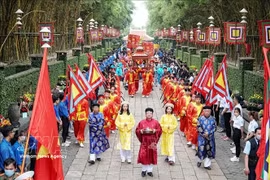
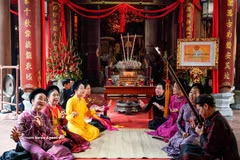
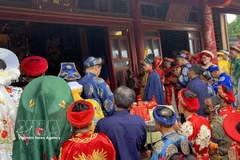
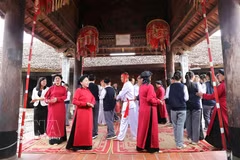
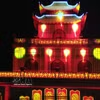
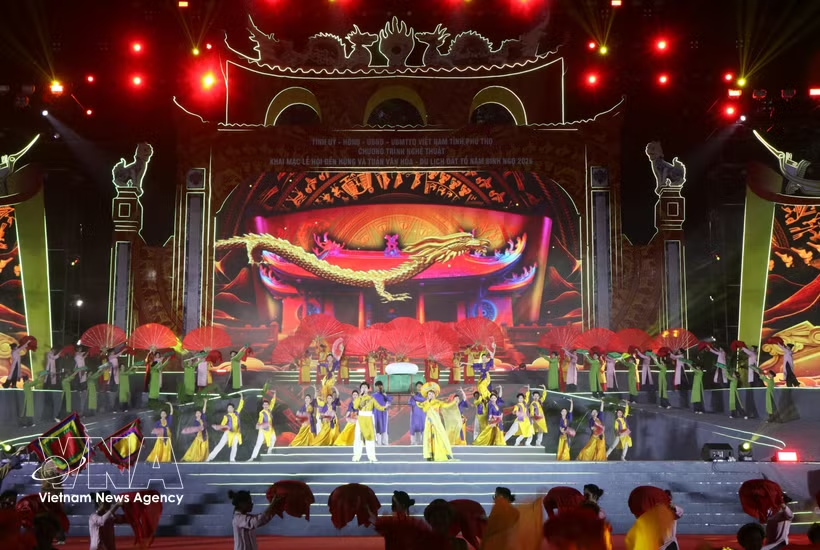
A performance at the opening ceremony of the Hung Kings Temple Festival and the 2026 Ancestral Land Culture and Tourism Week on late April 17 (Photo: VNA)

Phu Tho (VNA) – A ceremony to open the Hung Kings Temple Festival and the 2026 Ancestral Land Culture and Tourism Week was held on late April 17 in the northern province of Phu Tho, home to the Hung Kings Temple historic site – a place of worship dedicated to the legendary ancestors of the nation.

Featuring a large number of artists, artisans, professional performers, and local participants, the opening ceremony helped to showcase the cultural values of the ancestral land while popularising the image of Phu Tho among both domestic and international visitors.

Speaking at the event, Nguyen Huy Ngoc, Vice Chairman of the provincial People’s Committee, described the annual festival as a major national cultural event, offering an opportunity for people across Vietnam and overseas Vietnamese communities to pay tribute to their ancestors, express gratitude, and strengthen the great national solidarity.

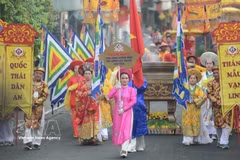
He noted that this year’s edition features notable innovations in both scale and content. A wide range of cultural, artistic, sporting, and tourism activities are being held, with participation from localities across the province, creating diverse experiences for residents and visitors alike. Notably, the revival of the traditional street folk culture festival has contributed to honouring long-standing cultural values.

The provincial official stated that through these activities, Phu Tho continues to affirm its status as the sacred ancestral land of the Vietnamese people, enhance its appeal as a tourist destination, and contribute to local socio-economic development.
vnanet-nguyen-huy-ngoc.jpg
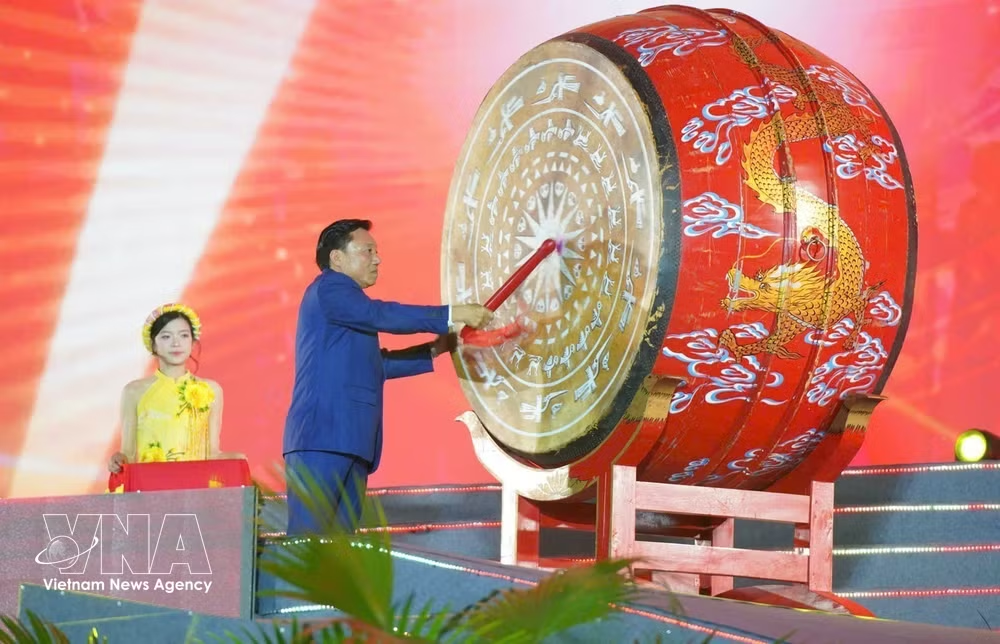
Nguyen Huy Ngoc, Vice Chairman of the Phu Tho People’s Committee, beats the drum to mark the opening of the Hung Kings Temple Festival and the 2026 Ancestral Land Culture and Tourism Week at the ceremony on April 17. (Photo: VNA)

Legend has it that Lac Long Quan (real name Sung Lam, a son of Kinh Duong Vuong and Than Long Nu) married Au Co (the fairy daughter of De Lai). Au Co then went on to give birth to a pouch filled with one hundred eggs, which hatched into a hundred sons. However, soon thereafter, Lac Long Quan and Au Co separated. Lac Long Quan went to the coast with 50 of the children while Au Co went to the highlands with the rest.

Their eldest son was made king, who named the country Van Lang and set up the capital in Phong Chau (modern-day Viet Tri ward in Phu Tho), beginning the 18 reigns of the Hung Kings. The kings chose Nghia Linh Mountain, the highest in the region, to perform rituals devoted to rice and sun deities to pray for bumper crops.

To honour their great contributions, a complex of temples dedicated to them was built on Nghia Linh Mountain, and the 10th day of the third lunar month serves as the national commemorative anniversary for the kings.

The worship of the Hung Kings, closely related to the ancestral worship traditions of most Vietnamese families, was recognised as part of the Intangible Cultural Heritage of Humanity by UNESCO in 2012./.
VNA

See more

A traditional art performance at Bach Ma temple in Hanoi (Photo: VNA)

Traditional arts hold untapped economic power

Traditional arts embody deep aesthetic values, worldviews, and national identity, shaping the country’s distinctive “aesthetic identity” and foundational cultural tastes

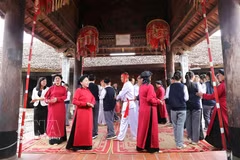
A ritual at Hue Nam Temple Festival (Photo: VNA)

Hue Nam Temple Festival: From imperial relic to distinctive cultural celebration in Hue

Historically known as Ngoc Tran Son Tu, the temple was renamed Hue Nam during the reign of King Dong Khanh in the late 19th century, symbolising royal gratitude to the Mother Goddess. It is also the only temple in Hue that harmoniously combines royal ceremonial elements with folk religious practices, creating a distinctive blend of court ritual and popular belief.

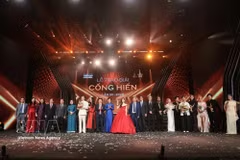
Participants in the 20th Cong hien (Devotion) Awards presentation ceremony in Hanoi on April 15 (Photo: VNA)

Devotion Awards mark two decades of honouring excellence in music, sports

Nguyen Thien Thuat, Editor-in-Chief of the The Thao & Van Hoa newspaper and Head of the organising board of the awards, said, noting that their achievements reflect the spirit of the Politburo’s Resolution No. 80, which emphasises preserving national cultural values while selectively absorbing the essence of world culture.

Artisans and students take part in cultural activities and exchanges in the Xoan singing performance space at Hung Lo ancient communal house in Phu Tho province (Photo: VNA)

Ancestral legends revived through contemporary performance

Beyond cultural value, well-organised festival programmes linked with tourism and media can contribute to the development of cultural industries and enhance Vietnam’s cultural soft power, positioning heritage-based events as distinctive national cultural brands in the international arena.

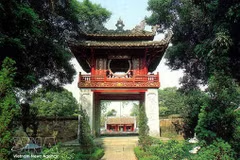
Khue Van Cac (Khue Van Pavilion) stands as a defining cultural symbol of Hanoi, closely associated with Vietnam’s long-standing tradition of valuing education and honouring knowledge. (Photo: VNA)

Greater efforts needed for heritage to shape Hanoi’s identity

As suggested by UNESCO experts, heritage should be approached as an integrated system encompassing space, people and everyday life. This perspective can inform urban planning, cultural tourism development and the creation of clear economic drivers.

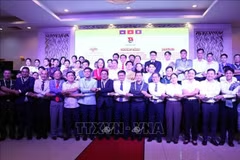
Participants at the gathering (Photo: VNA)

Lao, Cambodian students welcome traditional New Year in Ho Chi Minh City

In his speech, Vice Chairman of the municipal People’s Committee Nguyen Manh Cuong said the municipal Party organisation, authorities and people always value the close ties and solidarity among Vietnam, Laos and Cambodia. He described the three nations’ longstanding ties, forged through shared hardships, as an invaluable spiritual asset and a bedrock for sustainable development.

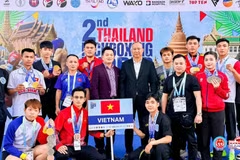
Vietnamese kickboxers win 32 gold medals at the Kickboxing World Cup 2026. (Photo: Vietnam Kickboxing Federation)

Vietnam finish third at Kickboxing World Cup 2026

According to Vu Duc Thinh, President of the Vietnam Kickboxing Federation, the strong results reflected careful preparation by local training centres and the determination of Vietnamese fighters. The team’s participation, funded largely through socialised and local resources, also demonstrated growing support for the development of kickboxing in Vietnam.

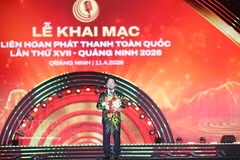
Politburo member, Secretary of the Party Central Committee and Head of the Party Central Committee’s Commission for Information, Education and Mass Mobilisation Trinh Van Quyet speaks at the event (Photo: VNA)

National Radio Festival opens in Quang Ninh

The opening night was combined with an artistic programme titled “sounds of the new era,” drawing around 50,000 spectators. The programme was structured in three chapters: Origins of Sound, Heritage Sound, and Sound of the New Era.