Expert highlights significance of Party chief’s vision for Vietnam’s higher education

Party General Secretary To Lam's keynote address at the 120th anniversary of the former Indochina University, the predecessor of Vietnam National University, Hanoi (VNU), outlined strategic directions, key tasks, and solutions for Vietnam's leading universities. It is also widely viewed as a strategic message for the country's higher education system in its next stage of development.

vnanet-70846435a92d2873713cjpgavif.jpg
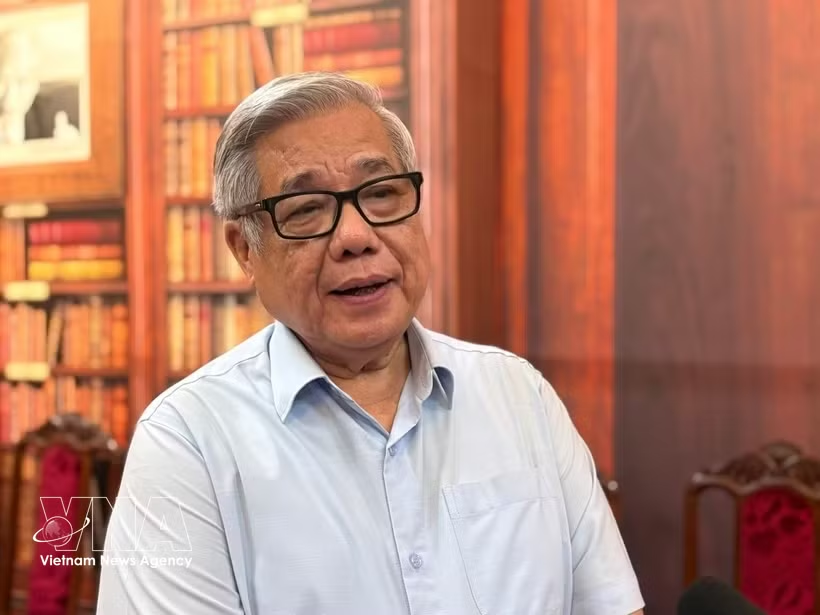
Professor Vu Minh Giang. (Photo: Pham Mai/VietnamPlus)

Hanoi (VNA) - Speaking to the press about the significance of the Party leader's directives, Professor Vu Minh Giang, Chairman of the VNU Council for Science and Training, Vice President of the Vietnam Association of Historical Sciences, and member of the National Cultural Heritage Council, described them as both a roadmap for the university's future and a demanding but honourable mission.

Both a vision and a mission

- General Secretary To Lam attended and addressed the 120th anniversary ceremony of the VNU-Hanoi this morning. What is your assessment of his speech?

Professor Vu Minh Giang: General Secretary To Lam's presence at the celebration was a great honour for the university and reflected the Party and State's deep commitment to one of Vietnam's leading higher education institutions.

VNU-Hanoi inherits the legacy of the former Indochina University, founded 120 years ago. Although established during the colonial period, it introduced a modern European-style academic tradition that brought new vitality to Vietnamese scholarship. Many of its graduates later became leading figures in the country's revolutionary cause and national development. These include former Party General Secretary Truong Chinh, General Vo Nguyen Giap, renowned physicians Ho Dac Di and Ton That Tung, and artists Tran Van Can and Nguyen Phan Chanh. Generations of intellectuals educated there made lasting contributions to the nation.

More importantly, it laid the foundation for an internationally recognised university. On November 15, 1945, despite the enormous challenges, President Ho Chi Minh attended the opening ceremony of the Vietnam National University, the successor to the Indochina University. That event sent a powerful message about valuing talent and education. General Secretary To Lam has now reaffirmed the significance of that legacy, describing it as an invaluable national asset.

His seven directives provide not only a roadmap for the university but also responsibilities for ministries, government agencies, and Party bodies to create the conditions needed for its development.

The first is to uphold the university's national mission. "National university" is not simply a title but a responsibility to undertake tasks of national importance, which requires support from ministries, sectors, and local authorities.

The second is to build an elite university. Vietnam has hundreds of universities, but an elite institution should become a symbol of innovation and intellectual leadership for the country's higher education system.

The General Secretary also called on the university to strengthen its international standing and serve as Vietnam's representative in academic exchange and academic diplomacy. That is a significant responsibility.

He also emphasised that the university should become a hub linking the Government, businesses, society, and international partners through its academic excellence.

Another important task is political and ideological education for lecturers and students. This should be approached in a dynamic and contemporary way, focusing on national traditions and the university community working to support Vietnam's development.

What impressed me most was his call for the university to pioneer new ideas. Innovation is the foundation of development, and Vietnam National University, Hanoi, must lead in renewing thinking, knowledge, and governance models to contribute to national development.

The university is deeply grateful for the General Secretary's guidance, while recognising that these directives also require ministries and sectors to work together in fulfilling this mission.

People who dare to think and act

- One of the General Secretary's directives is for Vietnam National University, Hanoi to become a "think tank" that provides scientific evidence for the State's strategic policymaking and supports businesses in technology, human resources, and new business models. What are your views?

Professor Vu Minh Giang: This is part of the broader vision of making the university a centre for connecting knowledge.

A "think tank" brings together experts with deep knowledge and expertise to provide recommendations and policy advice for businesses and, above all, for the Government.
vnanet-nganh-stem-2jpgavif.jpg
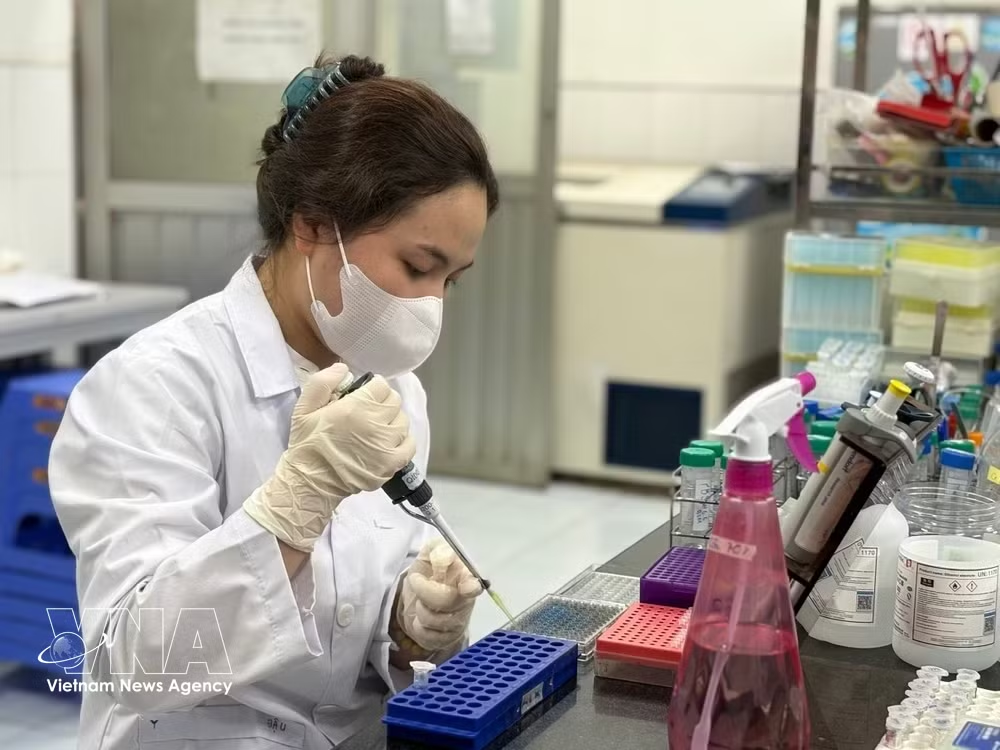
Students at the University of Science under Vietnam National University, Hanoi, conduct research in a laboratory. (Photo: Pham Mai/VietnamPlus)

The General Secretary expects the university to establish one or more think tanks that can facilitate discussion, develop policy recommendations, and provide strategic advice. The university is already moving in this direction by building units that advise businesses, local authorities, and the Government. That is precisely the role of a knowledge hub.

- What breakthrough strategies will the university need to implement these directives in the years ahead?

Professor Vu Minh Giang: The university has already formulated its development strategy, but these new directives provide momentum to reach a higher level.

In my view, three factors are essential.

First, there must be a clear direction. The General Secretary has set out the strategic orientation, while the necessary resolutions and legal reforms have largely been identified.

Second, resources are being prepared.

Finally, and most importantly, success depends on people. Leaders who dare to think, act and take responsibility, and professionals with the expertise, capability and creativity to turn ambitious ideas into reality.

One point I have heard the General Secretary stress repeatedly is that every aspiration for national development must be realised through the intelligence of the Vietnamese people. We must turn our own strengths into competitive advantages. Simply following models developed elsewhere will not produce genuine breakthroughs.

- Thank you, Professor.

See more

Nguyen Thanh Liem, Chairman of the Association of Vietnamese People in Chungnam province and Vice Chairman of the Association of Vietnamese Communities in the Republic of Korea (Photo: VNA)

Resolution expected to create new breakthrough in harnessing OV resources

The resolution marks a significant shift in strategic mindset, for the first time defining the more than 6.5 million Vietnamese living abroad as a “strategic resource” for national construction, development and defence. For many overseas Vietnamese, this represents a transition from simply being supported and mobilised to actively “accompanying and co-creating” development mechanisms.

Former Deputy Minister of Labour, Invalids and Social Affairs Nguyen Ba Hoan (Photo: Published by VNA)

Hanoi court to open trial of ex-deputy minister, 27 others in bribery case

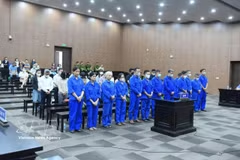
The Supreme People’s Procuracy indictment said that from 2021 through May 2025, Hoan, then deputy minister in charge of the Department of Overseas Labour Management, allowed former Director General Tong Hai Nam to direct officials to create difficulties for companies during appraisal of license applications to send Vietnamese workers abroad.

Deputy Prime Minister Pham Thi Thanh Tra speaks at the conference. (Photo: VNA)

Older persons are driver of national development: Deputy Prime Minister

Chairing a conference of the National Committee on Aging in Hanoi on August 17, Deputy Prime Minister Pham Thi Thanh Tra, who is also its Chairwoman, said the Party and State pay special attention to elderly affairs. At the same time, awareness across the entire political system and society has become increasingly clear, comprehensive and positive.

A unified land database, transparent valuation mechanisms and anti-speculation policies could lay the foundation for a more professional property market. (Photo: VNA)

Data-driven land valuation to curb speculation: Experts

From a property-market perspective, Do Thi Thu Giang, National Director of Valuation and Advisory at Savills Vietnam, said the orientations under Resolution No. 21-NQ/TW could make the market more transparent and efficient, with property values increasingly tied to actual development and use potential.

Hanoi police officers issue Level-2 electronic identification accounts. (Photo: VNA)

Digital ID holders get fee waivers, discounts

The Ministry of Finance has issued circular No. 117/2026/TT-BTC, effective from August 15, 2026 to February 28, 2027, offering incentives to citizens who meet the prescribed conditions.

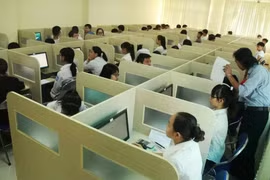
Candidates familiarise themselves with the computers before sitting the Vietnamese language proficiency assessment in Osaka on August 15, 2026. (Photo: VNA)

Vietnamese language celebrated as first computer-based proficiency test held overseas

For Vietnamese communities overseas, Vietnamese is not merely a means of communication but also an important part of cultural identity and a bond connecting people with their homeland. For foreigners who have developed an affection for Vietnam, learning the language opens another door to a deeper understanding of the country's culture, history and people.

A police officer introduces a foreign visitor to the “Smart police station” kiosk, making it easier for international visitors to access police support services. (Photo: VNA)

Pilot "Smart police station" kiosk launched in Hanoi

During the pilot phase, the "Smart police station" provides five core functions: crime/incident reporting; SOS emergency calls; crime alert; finding the nearest police stations and administrative offices; and legal Q&A.

A public servant at the Public Administrative Service Centre of Vinh Yen ward, Phu Tho province, guides residents through the marriage registration process on the online public service portal. (Photo: VNA)

Digital literacy campaign lays foundation for digital citizens in Phu Tho province

After nearly a year, the “Digital Literacy for All” campaign in Phu Tho is demonstrating its effectiveness through tangible results. Residents who were once hesitant about technology are becoming increasingly familiar with VNeID, online public services, cashless payments, and digital platforms for learning, production, and business.

Firefighters and rescue personnel deploy specialised equipment to rescue two truck drivers trapped in their cabins. (Photo: VNA)

Road accident fund to provide support from September

Under Decree No. 279/2025/ND-CP and Circular No. 126/2026/TT-BCA, injured victims with bodily injury rates of over 31% to below 81% may receive up to 10 million VND (381 USD) per case, while families of deceased victims may receive up to 20 million VND.

Ha Thanh, Chairwoman of the Ho Chi Minh City Union of Friendship Organisations and head of the advisory council for international integration, people-to-people diplomacy and overseas Vietnamese affairs under the Vietnam Fatherland Front Committee of the city (Photo: VNA)

New resolution seeks to unlock OV resources for national development

Ha Thanh, Chairwoman of the Ho Chi Minh City Union of Friendship Organisations and head of the advisory council for international integration, people-to-people diplomacy and overseas Vietnamese affairs under the Vietnam Fatherland Front Committee of the city, said Resolution No. 23 builds on the fundamental viewpoints of the Politburo's Resolution No. 36-NQ/TW issued in 2004, reaffirming that overseas Vietnamese are an inseparable part of the nation and a bridge connecting Vietnam with the world.

The Vietnamese Embassy in London's Education Section and representatives from the Department of Higher Education (Ministry of Education and Training) visit and hold a working session at Queen Mary University of London. (Photo published by VNA)

Vietnam-UK education cooperation: From market to partnership

In the 2024/25 academic year, about 3,725 Vietnamese students studied in the UK, while 13,285 enrolled in UK programmes delivered in Vietnam. Both flows are growing, but the balance is increasingly shifting towards UK education being delivered to learners in Vietnam. If managed strategically, this could enable Vietnam to expand access to international education at home while improving the quality of its workforce.