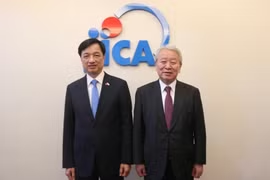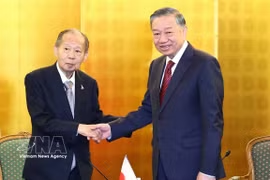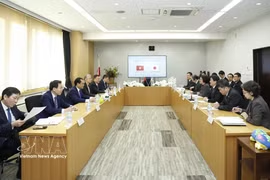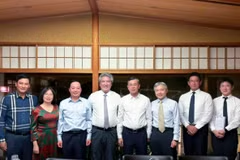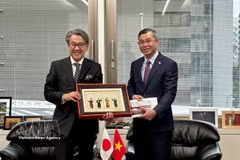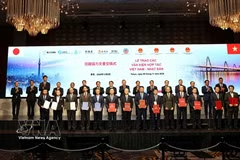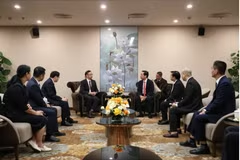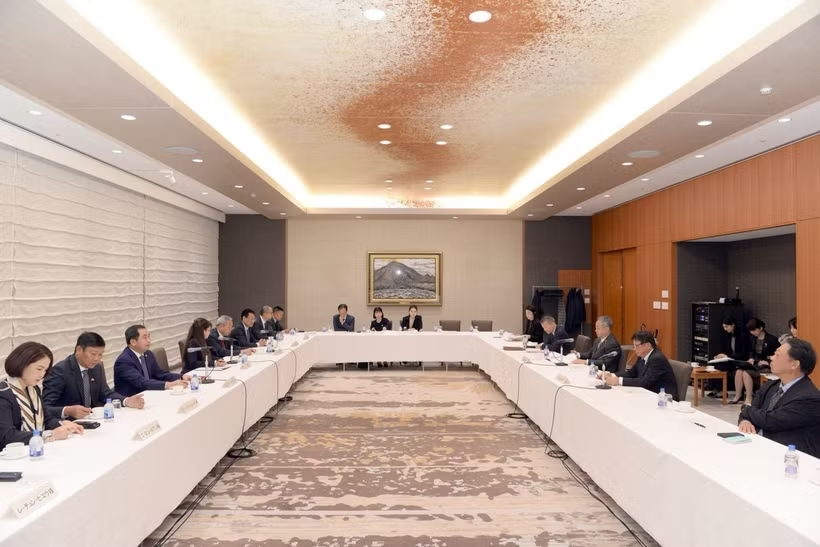
Tokyo (VNA) – A delegation of Hanoi, led by Politburo Member and Secretary of the Hanoi Party Committee Tran Duc Thang, had a working session with representatives from the Japan Business Federation (Keidanren), the Japan-Vietnam Economic Committee and the leadership of Sumitomo and Sojitz corporations in Tokyo on November 10.
Welcoming the delegation were Representative Director President and Chief Executive Officer of Sumitomo Corporation Ueno Shingo, who is also Co-Chair of the Japan-Vietnam Economic Committee, and Sojitz Chairman and CEO Fujimoto Masayoshi, another co-chair of the committee, along with representatives of Keidanren and Japanese businesses.
Representatives of the Japanese corporations spoke highly of Hanoi's development potential, advantages and investment environment, describing the capital as an attractive destination with considerable room for further growth.
Both Sumitomo and Sojitz are implementing investment and business projects in Hanoi, contributing to the city's socio-economic development and strengthening economic ties between the two countries.
The Japanese business leaders pledged to continue serving as a bridge for deeper economic, trade and investment cooperation between Vietnam and Japan. They also called for further efforts to develop specific mechanisms and policies to facilitate business connections, investment expansion and sustainable development.
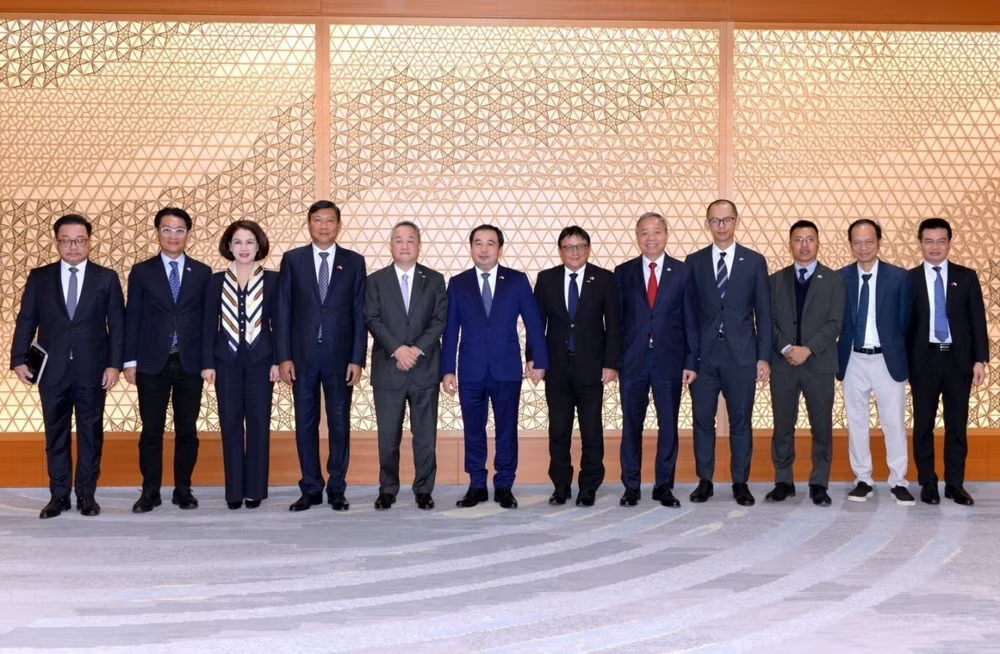
For his part, Thang thanked the Japanese partners for their warm reception and acknowledged the contributions of Keidanren, the Japan-Vietnam Economic Committee, Sumitomo, Sojitz and the wider Japanese business community to Hanoi's development.
Building on the Comprehensive Strategic Partnership between Vietnam and Japan, Hanoi wishes to promote long-term, substantive and mutually beneficial investment cooperation, he said.
Japan is one of Hanoi's most important partners and its largest foreign investor, he noted, highlighting the contributions of Japanese companies such as Canon, Panasonic, Sumitomo Electric, Yamaha, Aeon and Nidec.
According to Thang, Hanoi's investment environment is posed for a breakthrough, with the 2026 Capital Law and the capital's 100-year vision master plan expected to create major institutional and spatial development opportunities. The city is stepping up administrative reform and investment in key infrastructure while improving the business environment, particularly for enterprises operating in high-tech sectors.
He proposed that Hanoi and its Japanese partners focus on investment attraction, co-investment and joint development in priority areas, including high technology and innovation, the digital economy and digital infrastructure, clean energy and environmental protection, and smart logistics.
He called on Sumitomo to mobilise resources, complete necessary procedures and accelerate the North Hanoi Smart City project, while exploring further cooperation in high-tech industrial parks and clean energy.
Congratulating Sojitz on its 40 years of operations in Vietnam, Thang encouraged the corporation to explore projects in smart logistics and supply chains. He also welcomed its proposals for cooperation in developing green industrial park infrastructure, using clean energy and promoting digital transformation.
He invited both corporations to explore additional investment opportunities in areas where Japan has strengths, including digital transformation and healthcare.
Also on November 10, a Hanoi delegation led by Vice Chairman of the municipal People's Committee Do Anh Tuan held a working session with the Japan Bank for International Cooperation (JBIC) to promote financial cooperation and mobilise resources for the capital's strategic infrastructure and green development projects.
The delegation was received by Kawakami Nao, Senior Managing Executive Officer and Head of JBIC's Global Infrastructure and Environment Finance Group, and other senior officials.
Kawakami welcomed the delegation and said Hanoi's development plans require substantial financial resources beyond Japanese official development assistance (ODA). JBIC wishes to play a more active role in supporting private-sector businesses investing in the capital, he said.
Tuan praised JBIC's longstanding contributions to Vietnam and Hanoi, describing it as one of Japan's leading development financial institutions.
He noted that the Comprehensive Strategic Partnership between Vietnam and Japan is at its best period of development. During Japanese Prime Minister Takaichi Sanae's visit to Vietnam in May, economic security was identified as a new pillar of bilateral cooperation.
In this regard, JBIC plays an important role through projects under the Asia Zero Emission Community (AZEC), the POWERR Asia initiative and green credit facilities, he said.
He proposed that JBIC use its extensive network to introduce capable Japanese companies in semiconductors, electronic components, precision engineering, automation, R&D, digital infrastructure and environmental technologies to explore investment opportunities in Hanoi. He also called for cooperation in organising investment promotion activities focused on specific sectors.
Hanoi reaffirmed its commitment to accelerating administrative reform and digital transformation, making planning information more transparent and improving the investment climate to facilitate long-term cooperation with Japanese businesses and financial institutions./.