Phu Bai Airport plan targets 4 million passengers annually by 2030

Under the proposed plan, the airport, located in Phu Bai and Huong Thuy wards of Hue city, will serve as an international facility within Vietnam’s national civil airport network, with facilities shared for civil and military purposes.

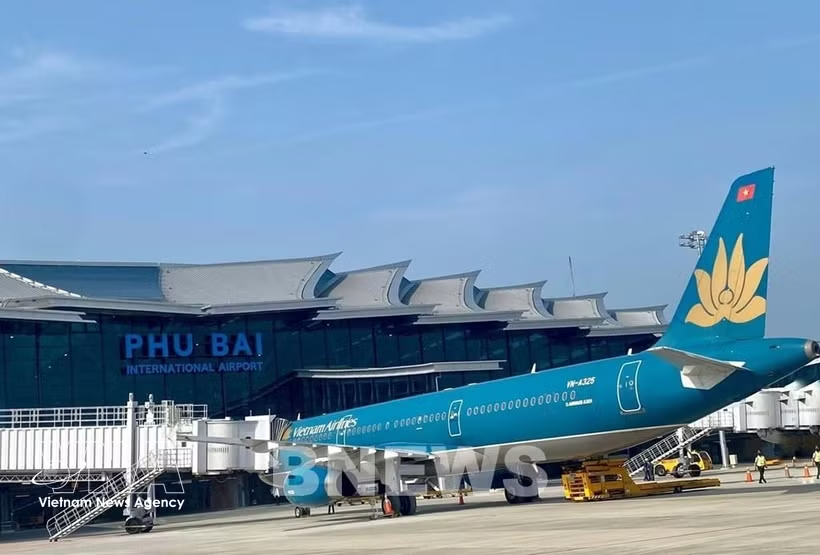
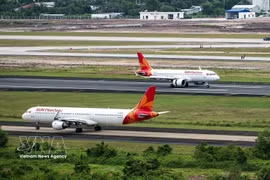
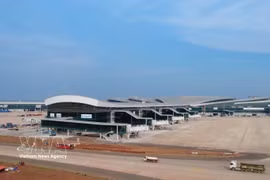
For the 2021–2030 period, Phu Bai International Airport is planned to meet ICAO Code 4E standards, with an annual capacity of 4 million passengers and 5,000 tonnes of cargo. (Photo: VNA)

Hanoi (VNA) – The Civil Aviation Authority of Vietnam (CAAV) has submitted a master plan for Phu Bai International Airport for 2021–2030, with a vision to 2050, to the Ministry of Construction for appraisal and approval.

Under the proposed plan, the airport, located in Phu Bai and Huong Thuy wards of Hue city, will serve as an international facility within Vietnam’s national civil airport network, with facilities shared for civil and military purposes.

For the 2021–2030 period, the airport is planned to meet ICAO Code 4E standards, with an annual capacity of 4 million passengers and 5,000 tonnes of cargo. It will have 11 aircraft parking stands and accommodate aircraft up to Code E, including the A350, B787, B777 and A320/A321, as well as equivalent models.

By 2050, Phu Bai is expected to maintain its Code 4E classification, with annual capacity expanded to 12 million passengers and 24,000 tonnes of cargo. The number of aircraft parking stands will increase to 27, while the airport will continue to accommodate aircraft up to Code E.

The airport's planned land use will cover 514.28 ha in both the 2021–2030 period and the vision to 2050.

Under the previous master plan for the airport through 2020, with orientations towards 2030, approved by the Prime Minister in 2009, Phu Bai was designated as a Code 4E international airport and a Level-II military airfield, with annual capacity set at 5 million passengers by 2020 and 9 million by 2030.

Meanwhile, the adjusted national airport system master plan for 2021–2030, with a vision to 2050, approved by the Ministry of Construction in 2026, sets the airport's capacity at 4 million passengers annually by 2030 and 12 million by 2050, while maintaining its Code 4E classification.

In addition, the 2023 master plans for then Thua Thien-Hue province and the north-central region, approved by the Prime Minister, outline the development of the area into a major centre for culture, tourism, specialised healthcare, science – technology, and education – training. They also target the expansion and upgrading of Phu Bai International Airport, its cargo terminal and international flight network, in connection with Chan May–Lang Co seaport.

The Hue municipal People's Committee has also adjusted the city's master plan to include the development of a free trade zone linked to Chan May seaport and Phu Bai International Airport. It also prioritises the renovation and extension of the first runway, completion of the taxiway system and investment in a second runway before 2030, in line with the approved airport master plan.

The preparation of the Phu Bai master plan for 2021–2030, with a vision to 2050, is therefore necessary to concretise the national airport system master plan and ensure consistency with regional and local development strategies. It will also provide a basis for investment in airport infrastructure to meet growing passenger and cargo transport demand, promote socio-economic development and ensure national defence and security in the central region.

During the planning process, the CAAV sought feedback from ministries, sectors, local authorities and relevant organisations, reviewed and incorporated their comments, and completed the planning dossier for submission to the Ministry of Construction for appraisal and approval./.
VNA

See more

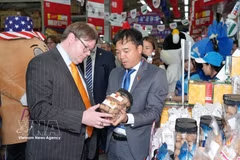
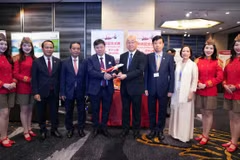
Representatives of the US Department of Agriculture and MM Mega Market Vietnam examine US products on sale at the supermarket. (Photo: VNA)

Vietnam’s retail market attracts growing interest from US suppliers

On November 9, MM Mega Market Vietnam, in collaboration with the US Department of Agriculture (USDA) and the US Consulate General in Ho Chi Minh City, launched the “Taste of USA 2026” programme, which will run from November 12 to 25 at 12 MM Mega Market centres nationwide.

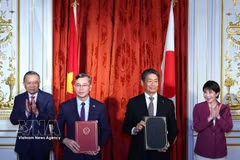
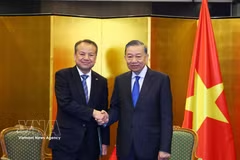
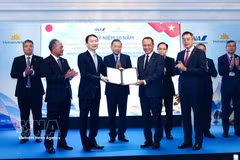
General Secretary and President To Lam and Japanese Prime Minister Takaichi Sanae witness the exchange of cooperation documents in Tokyo on November 9, 2026. (Photo: VNA)

Vietnam, Japan exchange three loan and grant aid documents

The exchange of the three documents on loans and grant aid reaffirms Japan's position as one of Vietnam's leading economic partners and reflects the strong commitment of both governments to translating high-level agreements into concrete cooperation projects, contributing to further strengthening the Vietnam-Japan Comprehensive Strategic Partnership.

North central region targets marine hub status with 10.5% growth goal

North central region targets marine hub status with 10.5% growth goal

The region’s GRDP rose 8.37% in 2025 and contributed 6.47% to national growth. Drivers are increasingly complementary. Ha Tinh’s industry and construction sector grew 24.25% in the first half; Nghe An’s industrial production index rose 23.02% and exports hit 3.1 billion USD, up 58.4%.

The conference on Vietnam-Cambodia trade connectivity will be held in AN Giang province on November 13, 2026. (Suource: Bnews)

Vietnam, Cambodia to boost trade connectivity

The Vietnam–Cambodia trade connectivity conference is part of a scheme to boost cross-border trade and exports to Cambodia in 2026, aiming to help raise bilateral trade to 20 billion USD by 2030.

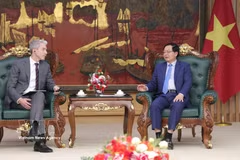
Deputy Prime Minister Ho Quoc Dung (right) receives Per Narvinger, President and CEO of Swedish telecommunications equipment maker Ericsson, in Hanoi on November 9. (Photo: VNA)

Vietnam, Sweden step up cooperation in telecom infrastructure, cybersecurity

Vietnam is accelerating institutional reforms, improving its investment and business environment, developing infrastructure and enhancing human resources quality. The Government stands ready to cooperate with leading global corporations investing in sectors of strategic importance to the country's development.

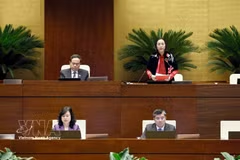
Vice President of the National Assembly Nguyen Thi Thanh speaks at the NA agenda on November 9. (Photo: VNA)

NA approves 2027 central budget allocation plan

The National Assembly (NA) on November 9 adopted a resolution on the allocation of the 2027 central budget, with all 469 deputies present voting in favour. Under the resolution, total central budget revenue in 2027 is estimated at more than 1.7 quadrillion VND (66.62 billion USD), while total expenditure is projected at over 2.3 quadrillion VND.

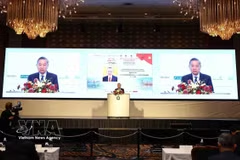
General Secretary of the Communist Party of Vietnam Central Committee and President To Lam attends the Vietnam-Japan Public-Private Forum on Economic, Science and Technology Cooperation in Tokyo on November 9, as part of his official visit to Japan. (Photo: VNA)

Vietnam-Japan relations evolve amid changing economic landscape: Nikkei Asia

Vietnam and Japan are seeking to improve the quality and added value of cooperation. During Party General Secretary and President Lam’s visit, they are expected to promote collaboration in artificial intelligence (AI), small modular reactor (SMR) technology, nuclear power and human resource training, Nikkei Asia reported.

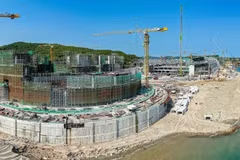
The APEC Convention Centre and related facilities are taking shape on Phu Quoc special zone, An Giang province. (Photo published by VNA)

Phu Quoc special zone envisioned as new growth engine

For 2026–2030, the Phu Quoc special economic zone will focus on high-value-added services, marine ecotourism and the digital economy. Total investment across society is expected to surpass 195 trillion VND.

Production line at Hana Micron Vina Co., Ltd in Bac Ninh city (Photo: VNA)

Processing and manufacturing continue to drive industrial growth

The sector’s industrial production index (IIP) rose 13% year on year, contributing 10.2 percentage points to overall industrial growth. Mining increased 7.1%, adding 1.1 percentage points, while electricity generation and distribution grew 10.6%, contributing one percentage point. Water supply, waste and wastewater management and treatment expanded 9.2%.