Hanoi launches 2.2 billion USD belt road No. 4 project to boost regional connectivity

Work has started on a key section of the Belt Road No. 4 – Hanoi Capital Region expressway, one of the largest infrastructure projects in northern Vietnam, with a total investment of more than 56 trillion VND (around 2.2 billion USD).

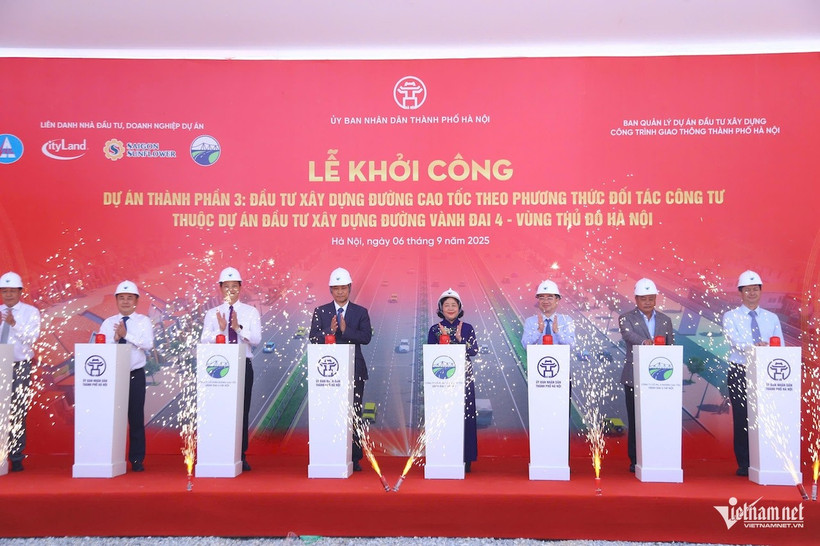
Delegates press buttons to start the project. (Photo: Vietnamnet.vn)

Hanoi (VNA) – Work has started on a key section of the Belt Road No. 4 – Hanoi Capital Region expressway, one of the largest infrastructure projects in northern Vietnam, with a total investment of more than 56 trillion VND (around 2.2 billion USD).

At a ceremony held on September 6 in Noi Bai commune, the Hanoi People’s Committee, the city’s Transport Project Management Board, and the Hanoi Belt Road 4 Expressway JSC jointly broke ground for Component 3 of the project. This section will be built under a public-private partnership (PPP) model.

The expressway will stretch more than 113 km, including 103.8 km of the main route and 9.7 km of connecting roads toward the Noi Bai–Ha Long expressway. It is expected to be completed in 30 months.

The project includes 13 elevated sections totaling 81 km, three major bridges across the Red River – Hong Ha, Me So, and Hoai Thuong – as well as eight interchanges and one fully completed junction. In its first phase, the road will have four lanes and a width of 17 metres.

Deputy Chairman of the National Assembly Vu Hong Thanh said the project is a national priority and a “game changer” for transport in northern Vietnam.

The Belt Road No. 4 will link Hanoi directly with Hung Yen, Bac Ninh, and other neighbouring provinces, while connecting with existing radial expressways to form a modern, synchronised transport network for the Red River Delta, he emphasised.

Approved by the National Assembly in June 2022 and greenlit by the Government shortly after, the project is seen as a new driver of growth. Once operational, it will not only ease congestion on existing roads, particularly the overloaded Belt Road No. 3, but also open up space for new urban, industrial, and logistics zones along the corridor.

Chairman of the Hanoi People’s Committee Tran Sy Thanh stressed the urgency of building Belt Road No. 4, calling it essential for boosting connectivity, ensuring national defence and security, and creating an economic development corridor.

The project will help ease population pressure in the inner city, attract investment, and foster balanced development across the region, he noted.

The Belt Road No. 4 project spans Hanoi, Hung Yen, and Bac Ninh provinces. So far, 98.5% of the required 1,382 hectares of land have been cleared, with full clearance targeted by the end of 2025.

Construction of parallel roads, bridges, and drainage works is already underway, with overall progress reaching 52.6% of contract value. Hanoi leads with 70% completion, followed by Hung Yen at 45% and Bac Ninh at 34%. The parallel roads are expected to be largely completed in 2025 and fully finished by the first quarter of 2026.

This is the first time Vietnam has applied the PPP model by dividing the project into smaller sub-projects, combining public investment with private capital. The groundbreaking comes as the country accelerates infrastructure development in line with the goals set out by the 13th National Party Congress.

City leaders have called on contractors to mobilise maximum resources, equipment, and manpower to ensure safe, high-quality, and timely construction. Priority will be given to major bridges and interchanges, which are critical for connecting the entire route.

With Belt Road No. 4 and the planned Belt Road No. 5 which is expected to link five northern provinces by 2030, Hanoi and its surrounding region are on track to develop a modern, interconnected transport system that will cut travel times, reduce logistics costs, and drive sustainable urban growth./.
VNA

See more

The dialogue and business networking forum between CPTPP senior officials and business leaders is held in Ho Chi Minh City on July 22, as part of the 2026 CPTPP Senior Officials' Meeting (SOM3) hosted by Vietnam. (Photo: VNA)

Public-private dialogue unlocks CPTPP potential

The CPTPP has evolved beyond tariff reductions into a broad framework covering goods, services, investment and digital trade. Its success, however, ultimately depends on businesses' ability to turn commitments into new investment, stronger supply chains and innovative business models.

Tourists on Nha Trang beach in Khanh Hoa province (Photo: VNA)

Promoting integrated governance to advance sea-based economy

Khanh Hoa has positioned itself as the renewable energy industrial and service hub for the south-central and southern regions. Its economic development strategy identifies four key growth drivers, all built on the foundation of the marine economy.

An overview of the seminar entitled "Opportunities and challenges for market development in Turkish market" (Photo: Ministry of Industry and Trade)

Türkiye offers export potential for Vietnamese food producers: seminar

Türkiye’s target of lifting total exports of goods and services to more than 400 billion USD in 2026 could create additional opportunities for Vietnamese agricultural products, food and beverages, said Ta Manh Cuong, director of the Trade and Investment Promotion Support Centre.

SSC Vice Chairman Bui Hoang Hai speaks at the opening of the programme on July 21. (Photo: VNA)

Vietnam boosts crypto market oversight capabilities

Diederik Van Wersch, Chainalysis' ASEAN Regional Director, noted that Vietnam has a high level of crypto asset adoption, offering significant opportunities for innovation while creating greater demands for oversight and risk management.

Vietnam Railways has introduced a range of tourism, heritage and dedicated train services, attracting growing numbers of passengers. (Photo: VNA)

Railways reinvent themselves with tourism, heritage trains

One of the most notable successes is the premium Hoa Phuong Do (Flamboyant Flower) train operating between Hanoi and Hai Phong city. Since entering service in May 2025, the train has completed nearly 3,000 trips and carried around 1.33 million passengers.

Representatives of relevant parties witness the arrival of the shipment. (Photo: VNA)

First Czech pork shipment officially enters Vietnamese market

A Czech diplomat described the arrival of the first container as the successful outcome of a long and complex market-opening process involving years of negotiations, regulatory approvals and close cooperation between Czech and Vietnamese authorities.

A view of financial buildings in downtown Ho Chi Minh City along the Saigon River. (Photo: VNA)

HSBC: Vietnam’s growth, macroeconomic stability to face tougher test in H2

In a recently released report, Vu Binh Minh, CFA, Associate Director, FX Trading, Markets and Securities Services at HSBC Vietnam, said Vietnam’s economy has built a relatively favourable position in the first six months of the year with GDP expanding 8.18% – the highest first-half growth rate in recent years – as key growth drivers have operated in tandem.

Ha Tay Shoes has secured numerous export orders from the US and European markets. (Photo: VNA)

CPTPP strengthens free trade, expands global economic connectivity

Since taking effect, the CPTPP has significantly expanded Vietnam's access to major markets across North America, the EU, and the Asia-Pacific, contributing to strong export growth in key sectors such as textiles and garments, footwear, and agricultural, forestry and fishery products. The agreement has also encouraged greater investment into Vietnam by promoting regional production networks and clearer rules of origin.

Tan Mingming, Deputy Director of the Foreign Affairs Office of the Dezhou Municipal People’s Government. (Photo: VNA)

Chinese firms put Vietnam on expansion radar

Tan Mingming, Deputy Director of the Foreign Affairs Office of the Dezhou Municipal People’s Government, told Vietnam News Agency reporters that the city has spent years deliberately tightening its links with the Association of Southeast Asian Nations (ASEAN), with Vietnam seen as a key partner.

A perspective of the Viettel Military Industry and Telecoms Group's high-tech semiconductor chip manufacturing plant at Hoa Lac Hi-Tech Park. (Photo: Viettel)

Hanoi builds momentum as Vietnam's semiconductor hub

As Hanoi continues to strengthen its semiconductor ecosystem, the city is creating a new growth driver for both the capital and the country, enhancing Vietnam's technological capabilities and paving the way for deeper integration into the global semiconductor value chain.

Clams are processed for export at the factory of Thanh Hoa Seafood Import-Export JSC in Thanh Hoa province. (Photo: VNA)

Vietnam steps up export to achieve 550-billion-USD target

Against a backdrop of persistent uncertainty in global commerce, the Government is implementing a broad range of measures to strengthen export growth during the remainder of the year. These include expanding overseas markets through economic diplomacy, maximising the benefits of free trade agreements (FTAs), streamlining administrative procedures, reducing logistics costs, improving access to credit and helping businesses overcome trade barriers. Authorities are also encouraging deeper processing, official cross-border exports and greater market diversification to improve the competitiveness of Vietnamese products.