Hanoi launches construction of five metro lines spanning over 300 km

The projects form a key part of Hanoi's strategy to develop a mass rapid transit network, gradually realise its urban railway master plan and support urban expansion in multiple directions.

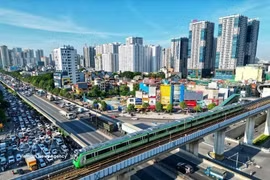
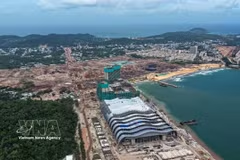
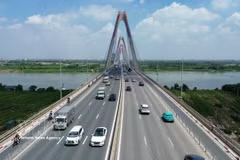
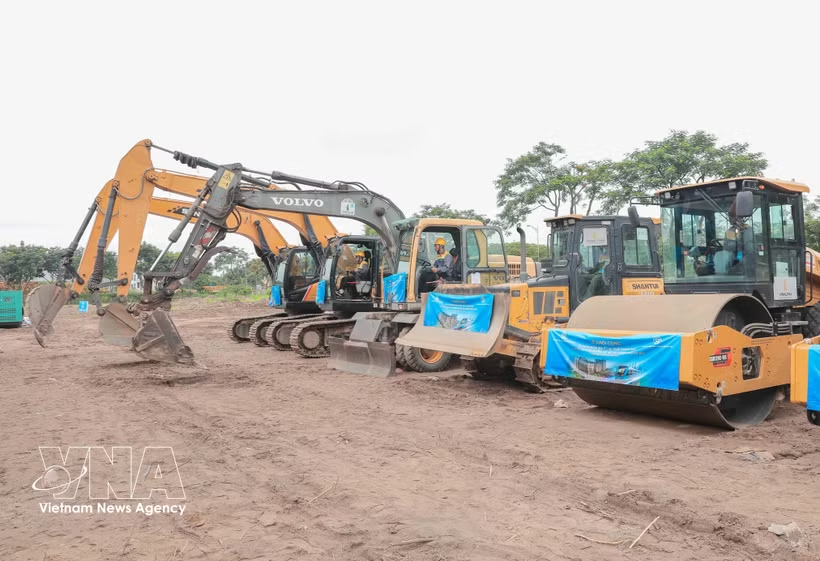
The five new urban railway projects, for which the Vinhomes–VinSpeed consortium serves as the EPC (engineering, procurement and construction) contractor, are scheduled for completion by 2030. (Photo: VNA)

Hanoi (VNA) - Hanoi is embarking on its largest-ever urban railway investment programme with the simultaneous launch of five metro lines stretching more than 300 km, aimed at strengthening connectivity between Noi Bai International Airport, Hoa Lac Hi-Tech Park, emerging urban areas and the city centre, while shaping the capital's development landscape for decades to come.

Construction on metro lines No. 1, 2, 8, 10 and 14 officially began on June 22. The projects form a key part of Hanoi's strategy to develop a mass rapid transit network, gradually realise its urban railway master plan and support urban expansion in multiple directions. The Vinhomes–VinSpeed consortium has been appointed as the EPC contractor (engineering, procurement and construction) for all five projects. The city aims to substantially complete the lines by 2030.

Among the projects, Line 1 is the largest in terms of investment scale. The 81-km route has an estimated investment of 389.53 trillion VND (14.8 billion USD). Line 1 links the Hung Vuong Stadium area, Ngoc Hoi, Hanoi Station, Gia Lam and Noi Bai International Airport. It will serve as an important north–south corridor, connecting the urban rail network with the national railway, high-speed rail and the airport.

The 56.5km-long Line 2 also connects the capital to Noi Bai airport, going through the historic city centre via Nam Thang Long, Hoan Kiem Lake, Tran Hung Dao, Thuong Dinh and southern urban areas.

Line 8 is roughly 91km in length, linking the Hoa Lac High‑Tech Park with logistics zones, industrial parks and eastern growth centres of the capital.

A closed circular route, Line 10 is approximately 43km long and connects Co Loa, Vo Chi Cong, Ring Road 3, Ring Road 2.5 and Times City before returning to Co Loa, helping to reduce traffic pressure in the inner city.

Line 14 is around 32km long, connecting the Thang Long Bridge and Ciputra area through central Hanoi to Ocean Park and the city’s eastern districts, supporting new urban development and strengthening regional links.

Under the capital’s master plan for 2021–2030, Hanoi authorities intend to develop 18 urban rail lines with a total length of approximately 979km. The city aims to complete around 500km of urban rail by 2035, with the remainder to be invested in the 2035–2045 period.

The simultaneous launch of five metro projects marks a major milestone in the development of Hanoi's public transport system and lays the groundwork for the long-term expansion of its urban railway network./.
​

VNA

See more

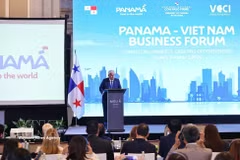
Panamanian President José Raúl Mulino speaks at the Panama-Vietnam Business Forum on October 7 in Hanoi. (Photo: VNA)

Vietnam, Panama seek to expand economic cooperation

In the presence of President Mulino, VCCI and the Chamber of Commerce, Industries and Agriculture of Panama signed a memorandum of understanding (MoU) to strengthen cooperation, enhance trade and investment promotion programmes, and support bilateral investment and trade.

Ministry updates on Vietnam-US reciprocal trade agreement talks

Ministry updates on Vietnam-US reciprocal trade agreement talks

The US is one of Vietnam’s major trading partners and holds paramount importance to the country’s exports. The conclusion of the bilateral trade agreement will help establish a stable and balanced trade framework toward sustainable development and open up greater opportunities for cooperation between the two countries.

MICE visitors enjoy services at Song Be Golf Resort in Ho Chi Minh City. (Photo: VNA)

Ho Chi Minh City shifts MICE tourism from venues to experiences

Ho Chi Minh City boasts significant advantages for MICE tourism, with the central area offering strengths in finance, trade and services; Binh Duong in industry, exhibitions and business connectivity; and Ba Ria-Vung Tau and Con Dao in marine tourism, resorts, ecology and distinctive experiences.

National Brand products are on display at the Vietnam National Brand International Forum. (Photo: VNA)

Vietnam's national brand value jumps 45% to over 462 bln USD

Deputy Minister of Industry and Trade Luong Hoang Thai outlined Vietnam's National Brand Programme 's achievements, the role of business community and plans for brand development in a press interview ahead of the 10th Vietnam National Brand Product recognition ceremony on October 16.

Khanh Hoa province possesses significant advantages for renewable energy projects and new energy sectors. (Photo: VNA)

New value chains from two industrial – renewable energy centres

To implement the revised Power Development Plan VIII, the Ministry of Industry and Trade has proposed establishing two inter-regional renewable energy industrial and service centres in the northern and southern regions to develop the renewable energy sector and a complete value chain.

WB Senior Environmental Specialist and Task Team Leader Stephen Ling speaks at the working session (Photo; VNA)

Ca Mau, WB cooperate in sustainable fisheries development

Scheduled to run from 2026 to 2029, the project aims to develop the local fisheries sector and deepen global integration, while adapting to climate change and protecting the environment through infrastructure upgrades, technological innovation, and better management and production capacity.

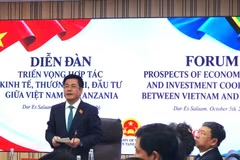
Vice President of the Vietnamese National Assembly Nguyen Hong Dien speaks at the forum. (Photo: Vietnam Trade Promotion Agency)

Tanzanian businesses seek greater cooperation, investment opportunities with Vietnam

Attending the forum during his working visit to Tanzania, Vice President of the National Assembly Nguyen Hong Dien said the two economies were highly complementary. Tanzania has strengths in natural resources, agriculture, energy, its domestic market and its strategic position in East Africa, while Vietnam has advantages in manufacturing and processing, high-tech agriculture, electronics, telecommunications and international trade.

The automatic ticketing system that uses electronic identification, authentication, biometric recognition and cashless payment for passengers on the Cat Linh-Ha Dong railway line in Hanoi. (Photo: VNA)

Cashless payments open gateway to financial inclusion

Cashless payments continued to grow rapidly in the first eight months of 2026. The number and value of cashless transactions rose 34.56% and 13.26% year-on-year, respectively, while online transactions increased 46.57% in number and 21.77% in value.