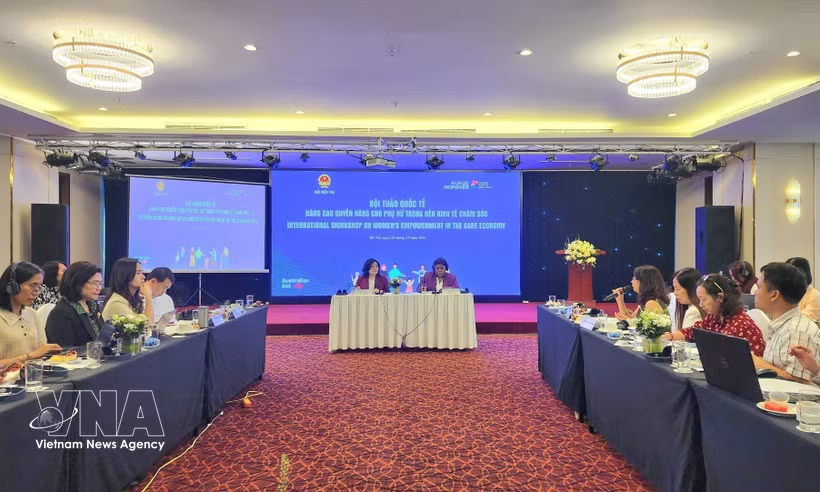
Hanoi (VNA) – The Ministry of Home Affairs, together with UN Women and the Australian Embassy, held an international workshop on empowering women in the care economy on October 8.
The event brought together agencies, organisations, experts and development partners to share experiences, identify key policy issues and propose priorities for Vietnam. The discussions also fed into preparations for the 2027 APEC High-Level Policy Dialogue on Women and the Economy.
Deputy Minister of Home Affairs Nguyen Thi Ha said the issue isn't new but now demands a more comprehensive, systematic approach given rapid changes in Vietnam and across the Asia-Pacific. The care economy touches not only social welfare and gender equality but also the labour market, productivity, workforce quality, competitiveness and the economy's ability to adapt to long-term demographic shifts.
According to her, Vietnam has built a relatively comprehensive legal and policy framework to underpin the sector, including the Labour Code, the Law on Gender Equality, the Law on Social Insurance, the Law on Population and the National Strategy on Gender Equality for 2021-2030. Together, they set goals and measures to narrow gender gaps and give women and men equal opportunities to benefit across a range of areas.
Cutting and redistributing unpaid care work is a key priority. The strategy targets reducing women's time on housework and family care to 1.7 times men's by 2025 and 1.4 times by 2030. The ratio has fallen to 1.68, meeting the 2025 goal. Unpaid work still holds back women's employment and economic advancement, however, and weighs on labour productivity and long-term workforce quality.
The pressure is building as Vietnam's population ages, with the country projected to enter an aged population phase in 2034. Smaller households, falling fertility and rising labour migration are lifting demand for care, while traditional models still lean heavily on families and women.
Ha said the Vietnamese Party and State have adopted policies to build a modern social welfare system, expand social services and healthcare, and adapt to population aging, digital transformation, green transition and shifts in employment structure. That provides a base for a national care economy strategy spanning health care, rehabilitation, social work, and family-and community-based care.
A comprehensive, inclusive care economy will open more avenues for women to contribute to economic growth, she said.
Caroline Nyamayemombe, UN Women Country Representative in Vietnam, said care should be treated as an essential part of economic infrastructure rather than primarily a social concern.
Investing in accessible, affordable, quality care services can create stable jobs, advance gender equality and build a stronger and more sustainable economy, she said.
Population aging, changing family structures, migration and rising demand for elder care across the Asia-Pacific make it necessary to close the gender gap in unpaid care work while improving women's skills, economic empowerment and access to the labour market.
Building care systems also requires coordination among public policy, private sector investment and the practical experience of civil society groups, workers, women, academics and communities.
APEC 2027 gives Vietnam a chance to push a regional agenda on women's economic empowerment by tying the care economy to the green and digital economies and demographic change, she said.
UN Women is ready to work with the ministry and partners on evidence, policies, investment and practical initiatives to advance women's economic empowerment and develop the care economy, she said.
Participants discussed the need to accelerate the care economy amid population aging, experience and policies across the Asia-Pacific, and priorities for APEC and regional cooperation in the sector. An effective care system requires shared responsibility and investment from governments, businesses, communities and families, through care services, family-friendly workplaces, social protection, the growth of care enterprises and innovation, they said./.
See more
Nguyen Van Dai labeled as terrorist over role in Viet Tan
The Ministry of Public Security has identified Nguyen Van Dai, who now lives in Germany, as a person engaged in terrorist activities, in accordance with Vietnamese and international laws.
Education in digital era: Cooperation vital to mastering technology, developing people
The two-day event aims to advance major policies on breakthroughs in science, technology, innovation and national digital transformation, education and training, as well as international integration in the new situation.
Sea turtle nests on Lam Dong's Hon Cau island for sixth time this year
Since the beginning of 2026, sea turtles have nested six times at three beaches on Hon Cau island, namely Nhat, Mui Tau and Ba Hon. Three nests were left undisturbed at safe locations, while another three were relocated to the incubation area for protection, involving a total of 246 eggs.
Vietnamese-origin community seeks stronger support to contribute to Cambodia’s development
The Vietnamese-origin community in Cambodia has made important contributions to the traditional friendship between the two countries and is striving to further contribute to the host’s development.
Vietnam tourism gains appeal from safety, diverse experiences
According to international reports referenced by the WEF, Vietnam has a high level of safety awareness, a low crime rate and a terrorism impact score of zero. These factors helped place the country’s Safety and Security indicator among the world’s highest in the TTDI 2026 rankings.
Administrative reform shifts focus to practical results
Agencies largely kept the receipt, processing and return of administrative results running continuously, openly and transparently, with citizens and firms at the centre of public service delivery. They also kept upgrading, linking and using the databases serving administrative processing, carried out tasks under the 100-day Action Plan for the Politburo's Resolution 57-NQ/TW, and rolled out new initiatives and models to lift service quality.
Tackling IUU ‘yellow card’: Tay Ninh tightens fishing fleet management
The southern province is tightening fleet management, addressing regulatory gaps and supporting fishermen in completing procedures and shifting livelihoods.
Inside Phu Quoc’s APEC landmarks: Features ‘never seen before’
Nicolas Medrano, Design Principle and SOM’s Asia-Pacific Practice Leader, said from the outset, the project was designed to fit Phu Quoc's terrain, coastline, elevation and geography. It includes extensive outdoor public spaces that connect people directly with nature, providing a foundation built to adapt, withstand challenges and develop sustainably over the next century.
Phu Quoc int’l airport planning adjusted to serve APEC 2027
Under the adjusted plan, several sections of internal service roads will be added or revised to meet security, safety and operational requirements for the event. A parking area for ground service vehicles and equipment will also be added east of the VIP/general aviation terminal.
Hanoi adds electric buses on two more routes
The move is part of Transerco's green transition roadmap, which aims to raise the share of green vehicles in its fleet to more than 51% by the end of 2026.
Dong Thap steps up fishing vessel control, seafood traceability
Dong Thap province aims to completely address cases involving unregistered, uninspected or unlicensed fishing vessels and prevent vessels from leaving port unless they fully meet all requirements by October 15.
Vice President urges stronger promotion of lifelong learning
Vice President Vo Thi Anh Xuan hailed the association’s contributions and praised its officials and delegates, particularly those who have helped spread a passion for learning in their communities.
People-to-people diplomacy contributes to Ho Chi Minh City’s development
Ho Chi Minh City currently has 117 licensed foreign NGOs operating in areas including healthcare, education, social protection and community development. As of September 2026, the municipal People’s Committee had approved 30 applications to receive and implement project and non-project aid packages, with total committed funding of about 302 billion VND (11.6 million USD).
Over 100 delegates to attend Quy Nhon Dialogue on Climate and Transition
Supported by the French Development Agency (AFD) and held under the patronage of the Ministry of Science and Technology and the provincial People’s Committee, the dialogue serves as a pilot “Zero Version” to test the model ahead of annual editions from 2027.
Nearly 2.6 million people join online Constitution and law contest
Nearly 2.6 million people took part in an online contest on the Constitution and laws organised by the Ministry of Justice over 45 days, highlighting the broad reach of digital legal education.
Dak Lak fishermen enhance preparedness for rough-sea fishing, IUU fishing combat
Many vessel owners have upgraded their boats, invested in modern equipment and increased engine capacity to improve productivity while meeting anti-IUU fishing requirements.
Vietnamese students in Australia promote innovation, knowledge links
For the 2026–2028 tenure, the SVAU will continue placing students at the centre of its activities, strengthen its organisation and network, and promote digital transformation and innovation.
Military aircraft transports 15,401 samples of martyrs' remains to Hanoi for DNA testing
The transportation of the 15,401 samples marked the 11th such shipment and the first to be carried by a military transport aircraft, representing a journey of gratitude and tribute to the nation's fallen heroes, said Lt. Gen. Ho Van Thai.
Stronger responsibility needed from online film distributors amid rise of short, AI-generated films
The growing popularity of short and AI-generated films on digital platforms is creating new opportunities for filmmakers while posing challenges for content quality and the management of online film distribution.
Hanoi puts 28 more electric buses into operation
The new VinFast Green Bus vehicles, manufactured in 2026, have a capacity of 60 passengers. They are equipped with low floors for easier boarding, facilities for people with disabilities, air conditioning and other modern amenities to improve passengers’ comfort and travel experience.