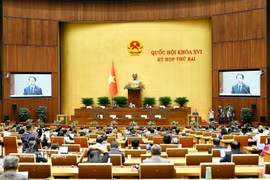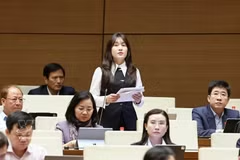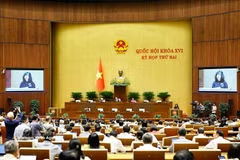
Hanoi (VNA) – Lawmakers November 9 discussed a draft law amending and supplementing several articles of the Law on Occupational Safety and Hygiene.
Deputy Nguyen Vu Trung from Ho Chi Minh City proposed revising Articles 12 and 74 to protect whistleblowers and those who directly identify occupational safety and hygiene risks or incidents. He noted that Clause 1a of Article 12 prohibits obstructing the reporting and provision of information on occupational accidents and diseases, as well as the handling of such cases. While this provision was a step in the right direction, he said the law should also prohibit retaliatory treatment of those who report incidents.
Regarding provisions clarifying employers' responsibilities and the role of trade unions under Articles 7 and 10, Trung said Point e, Clause 2 of Article 7, which adds obligations to declare, investigate, compile statistics on and report incidents, should ensure that these duties are linked to responsibility for addressing the causes of accidents, providing truthful information and preventing the costs of safety measures from being shifted onto workers.
He also called for additional mechanisms for occupational health management under Articles 21, 37, 82 and 85, including further revisions to the provisions on workers' health examinations. While stressing the importance of regular check-ups, he said general health examinations could not replace monitoring specific risks arising from exposure to noise, chemicals, dust, microorganisms and other harmful factors.
On this basis, he proposed setting out a roadmap for connecting data from health examinations, occupational disease screenings and workplace environmental monitoring, ensuring that such data would be used solely for healthcare and prevention purposes and handled in accordance with confidentiality requirements.
Expressing strong support for the proposed amendments to the law, deputy Pham Anh Tuan from Ninh Binh called for additional provisions regulating remote and flexible working arrangements to meet the needs of the digital economy.
He proposed adding provisions on occupational safety and health standards specific to remote work, and suggested considering the addition to the list of occupational diseases of musculoskeletal disorders caused by prolonged improper working postures, as well as mental health disorders and psychological burnout arising from remote working environments.
Tuan stressed that these measures represented proactive steps to prepare for the digital future, ensure that legislation remained sustainable and inclusive, and provide substantive protection for workers in the new era.
Stressing that achieving double-digit growth required protecting the very people who generated that growth, deputy Tran Manh Huy from Da Nang said that connecting occupational safety data should go beyond collecting, storing and managing information. More importantly, it should help identify accident risks early and prevent them from materialising.
Huy therefore proposed adding provisions on using data to issue warnings, prevent occupational accidents and monitor the handling of safety risks. He also called for encouraging the use of automated monitoring equipment and artificial intelligence at high-risk workplaces, with implementation roadmaps suited to different business sizes and without creating unnecessary additional costs or administrative procedures.
Regarding Clause 4 of Article 37, Huy said occupational disease management should not stop at recording how many workers had contracted diseases. More importantly, it should focus on early detection of risks to workers' health.
He called for clarifying the health sector's responsibility for analysing and identifying abnormal signs, coordinating with labour management agencies to conduct inspections and issue warnings, and arranging examinations and early screening when necessary. Health information must also be kept confidential to prevent leaks, discrimination or the loss of employment opportunities simply because a worker has been identified as facing an occupational health risk./.
See more
Vietnamese leaders send condolences over shooting in Poland
General Secretary of the Communist Party of Vietnam Central Committee and President To Lam and Prime Minister Le Minh Hung on November 9 sent messages of condolences to Polish President Karol Nawrocki and Prime Minister Donald Tusk over a recent mass shooting in the city of Krakow.
☕ Afternoon briefing on November 9
The Vietnam-Japan Public-Private Forum on Economic, Science and Technology Cooperation, the 2027 state budget plan approved, and the 9th Vietnam–Australia defence policy dialogue are among news highlights on November 9.
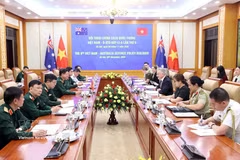
Vietnam, Australia hold 9th defence policy dialogue
The two sides agreed to effectively implement the common perceptions reached by the two countries' senior leaders and defence ministries, as reflected in the joint statement on deepening the Vietnam–Australia Comprehensive Strategic Partnership and the updated joint vision statement on further defence cooperation between the Australian Department of Defence and the Vietnamese Ministry of National Defence.
President Ho Chi Minh’s 1946 diplomacy combines steadfastness, flexibility: Japanese expert
In 1946, as President of the Democratic Republic of Vietnam, Ho Chi Minh pursued efforts to ease tensions through both official and informal channels. In addition to official diplomatic negotiations with French government leaders, he met leaders of political parties and forces across the political spectrum, held press conferences, gave interviews, and engaged with the French public.
Top Vietnamese leader attends Vietnam-Japan Public-Private Forum on Economic, Science and Technology Cooperation
Focusing the theme of co-creating technologies, co-building future value chains, the forum provided a platform for the two countries to explore new cooperation opportunities.
National Assembly passes 2027 state budget plan
Under the resolution, central budget revenue is targeted at nearly 1.776 quadrillion VND, while local budget revenue at nearly 1.559 quadrillion VND next year.
📝OP-ED: Optimising cultural strength, reinforcing great national unity from grassroots
Harnessing cultural strength and reinforcing the great national unity bloc begin with concrete action at the grassroots level. In this process, Party committees provide leadership, local authorities create favourable conditions, the Vietnam Fatherland Front (VFF) and its member organisations play a central role in mobilising and bringing people together, while citizens are the creators, practitioners and beneficiaries of cultural values.
Proactive diplomacy turns commitments into tangible benefits
Beyond safeguarding independence and self-reliance, diplomacy must proactively anticipate developments, prevent conflicts, expand cooperation and mobilise external resources to create a peaceful environment for sustainable development and enhance Vietnam’s international standing.
Lawmakers consider measures to expand social insurance coverage
During the day, legislators discussed draft laws amending and supplementing provisions of the Law on Social Insurance, the Labour Code, the Law on Archives, the Law on Gender Equality, the Law on Red Cross Activities and the Law on Employment.
☀️ Morning digest on November 9
Activities of Party General Secretary and President To Lam's official visit to Japan, the 10th National Buddhist Congress, and the sixth political consultation at the deputy foreign minister level between Vietnam and Spain are among news highlights over last weekend.
General Secretary and President To Lam meets Vietnamese experts, intellectuals in Japan
The top leader expressed his pleasure at meeting outstanding Vietnamese professionals, saying that the occasion provides an opportunity to review achievements and discuss ways to better connect knowledge, experience and resources between Vietnam and the Vietnamese expert community in Japan.
CPV values traditional friendship with Mexican Labour Party
Deputy head of the CPV Central Committee’s Commission for Publicity Tran Thanh Lam proposed deeper theoretical exchanges and sharing of experience in Party building and national development; stronger cooperation in education, science, culture, external information, press, publishing and traditional medicine.
Top Vietnamese leader’s Japan visit to open up new space for bilateral cooperation
The visit is expected to further deepen ties through Party, State, parliamentary and people-to-people channels, while creating breakthroughs in economic, financial, scientific and technological cooperation, innovation, education and training, digital and green transformation, and supply chain diversification, thereby contributing to a peaceful and stable environment for development in both countries.
NA President attends inauguration of projects at Tan Trao special national historical site
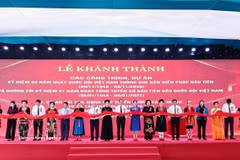
The 9.2-kilometre Tan Trao–Trung Yen revolutionary road was built with a total investment of 300 billion VND (12.7 million USD) from the central budget. Construction began in December 2025 and was completed in less than 11 months despite extremely challenging conditions.
Vietnam, Finland move to strengthen political trust, expand cooperation
Politburo Member and Head of the Party Central Committee’s Commission for Publicity Trinh Van suggested that Finland further promote its role as a bridge between Vietnam and the European Union (EU), while Vietnam could serve as a bridge between Finland and the Association of Southeast Asian Nations (ASEAN). He called for effective utilisation of the EU-Vietnam Free Trade Agreement (EVFTA) and urged Finland to encourage the remaining EU member states to ratify the EU-Vietnam Investment Protection Agreement (EVIPA) at an early date.
Top Vietnamese leader begins official visit to Japan
The visit is expected to further translate the potential and achievements of bilateral cooperation into concrete outcomes, strengthen the longstanding bonds between the two countries and ensure that the friendship nurtured across generations continues to deliver lasting benefits to both peoples.
Top leader and spouse depart for official visit to Japan
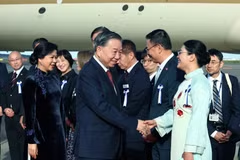
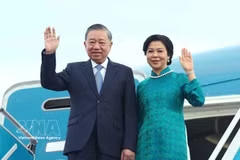
General Secretary of the Communist Party of Vietnam Central Committee and President To Lam, his spouse Ngo Phuong Ly and a high-ranking Vietnamese delegation left Hanoi on November 8 for a four-day official visit to Japan at the invitation of the Japanese State.
Top leader calls for a modern, safe, efficient coal industry, upholding spirit of “discipline and unity”
Upholding the tradition of “Discipline and Unity”, General Secretary of the Communist Party of Vietnam Central Committee and President To Lam called for building a modern workforce, improving workers’ skills, promoting technological innovation and ensuring better living conditions.
Vietnam wishes to deepen Comprehensive Strategic Partnership with Japan: Top leader
Vietnam has always regarded Japan as one of its most important and long-term comprehensive strategic partners. It highly value Japan’s help for Vietnam to achieve its two centenary strategic goals, said top leader To Lam.
Top leader’s visit to deepen Vietnam-Japan strategic cooperation: expert
The upcoming visit to Japan by General Secretary of the Communist Party of Vietnam Central Committee and President To Lam is expected to give fresh impetus to the Vietnam-Japan Comprehensive Strategic Partnership, reflecting the strategic priorities of both countries, according to a Japanese expert.