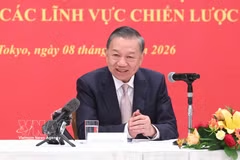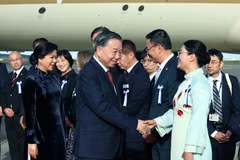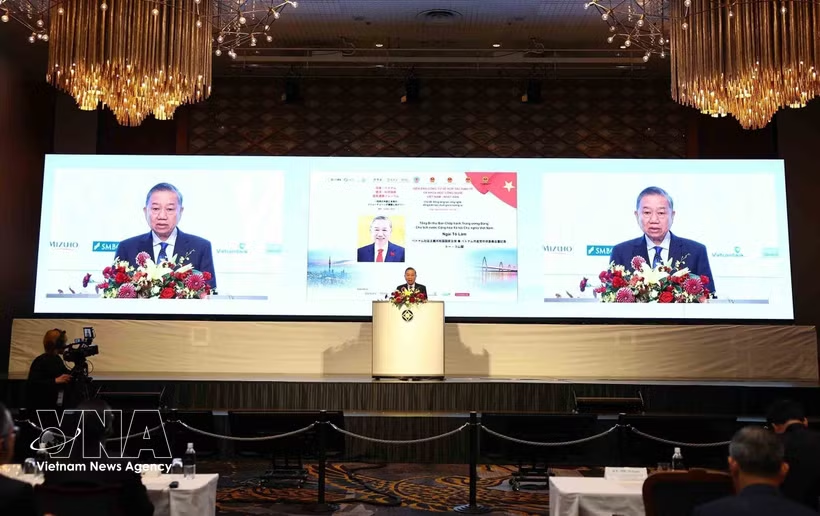
Tokyo (VNA) – General Secretary of the Communist Party of Vietnam Central Committee and President To Lam attended the Vietnam-Japan Public-Private Forum on Economic, Science and Technology Cooperation in Tokyo on November 9, as part of his official visit to Japan.
Focusing the theme of co-creating technologies, co-building future value chains, the forum provided a platform for the two countries to explore new cooperation opportunities.
In his welcome remarks, Vietnamese Minister of Finance Ngo Van Tuan stressed that the event took place as the Vietnam-Japan Comprehensive Strategic Partnership is opening up new prospects for cooperation. Rapid changes in technology, digital transformation, green transition and supply chains require both sides not only to expand investment and trade but also to improve quality, technological content and added value.
Vietnam is continuing to improve its investment and business environment while promoting new growth drivers, he said.
The minister called on businesses from both countries to step up research, development and technology application, strengthen links between enterprises, research institutes and universities, and turn research outcomes into commercially viable products.
He also urged closer participation in emerging value chains, helping Vietnamese businesses improve technological capacity, quality standards and corporate governance, and engage more deeply in design, manufacturing and supply activities.
Cooperation should focus on appropriate public-private partnership models, linking investment with workforce training, technological innovation and market development, with priority given to programmes featuring clear partners, objectives and implementation plans.
Tuan affirmed that the Ministry of Finance will work with relevant ministries, agencies and Japanese partners to further improve the investment and business environment, enhance resource mobilisation and allocation, and address business concerns in accordance with its authority and the law.
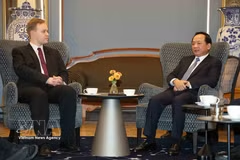
For his part, Chairman and CEO of the Japan External Trade Organisation (JETRO) Ishiguro Norihiko welcomed General Secretary and President Lam and the Vietnamese delegation on their official visit, highlighting Vietnam’s efforts to attract foreign investment and accelerate industrial development, with a shift from quantity to quality and greater emphasis on science and technology, innovation and human resources training.
He noted that this orientation is creating growing business opportunities for Japanese companies in Vietnam and expressed JETRO’s desire to explore new potential and expand business cooperation in the country.
At the forum, representatives of Vietnamese and Japanese businesses shared their views and presented practical cooperation initiatives, demonstrating their determination to unlock new development opportunities for bilateral relations.
Addressing the forum, General Secretary and President Lam said that after more than half a century of cooperation, Vietnam and Japan have built a solid foundation of extensive, substantive and trusted cooperation. Their Comprehensive Strategic Partnership has been developing positively, with economic cooperation serving as an important pillar, while science – technology and innovation are emerging as a new driver of development.
Japan is one of Vietnam’s leading economic partners and the largest provider of official development assistance (ODA). Bilateral cooperation is expanding strongly into strategic technology sectors. The implementation of joint semiconductor research projects by the two countries in 2026 is a practical example of the shift from technical cooperation towards joint research and technology development.
Vietnam and Japan are not only trusted partners today but also have all the conditions needed to become co-creation partners who shape the future together, he said.
The top Vietnamese leader noted that the world is undergoing profound changes. Vietnam is entering a new stage of development, with a firm determination to become a developed, high-income country by 2045. It has identified science – technology, innovation, digital transformation and the development of high-quality human resources as key drivers for improving productivity, growth quality and national competitiveness.
Japan boasts strengths in technology, finance, governance, quality standards and global market networks. Vietnam, meanwhile, has a dynamic workforce, a market with significant potential, a strategic position in regional production networks and strong development aspirations. Combining these complementary strengths will generate new growth drivers for both economies, he emphasised.
While Vietnam and Japan have worked together over past decades to build infrastructure and develop manufacturing industries, in the decades ahead, they need to jointly create new technologies, develop new industries and build new value chains.
To realise this vision, General Secretary and President Lam called on both sides to jointly research, develop and master technologies, making co-creation a new driving force in bilateral relations.
He urged the two countries to strengthen links in research, product development and technology commercialisation, prioritising areas with strong potential and shared interests, including artificial intelligence, semiconductors, biotechnology, clean energy and smart industries.
He encouraged the establishment of joint research centres, laboratories and technology development programmes, with research closely aligned with production needs and market demand. The two countries should make a decisive shift from technology adoption and application to joint research and innovation, and from manufacturing products based on existing designs to jointly participating in product design and development.
The General Secretary and President stressed the need for the two sides to elevate economic connectivity and build new value chains that are autonomous, sustainable, and highly resilient.
He suggested Japanese businesses continue expanding high-quality investment in Vietnam and strengthen cooperation with Vietnamese enterprises in research, design, supporting industry development, smart manufacturing, and governance capacity improvement.
Vietnamese businesses, for their part, should proactively innovate and enhance their technological capabilities, product quality and governance standards so that they can not only participate in but gradually take on higher value-added stages of production, he said.
He said the two sides should work together to develop high-quality human resources and a knowledge ecosystem, placing people at the centre of long-term cooperation. They should strengthen links among the State, educational institutions and businesses; promote training programmes for engineers, technology experts and young scientists; and expand joint research, expert exchanges and collaboration among leading training institutions.
Investing in knowledge and younger generations is the most far-reaching investment in the long-term future of Vietnam–Japan relations, the top leader stressed.
The two sides should make public–private cooperation an important means of translating strategic vision into concrete results, he said, stressing the need for them to explore the establishment of a Vietnam–Japan technology co-creation network, select priority programmes and projects that are feasible and deliver substantive value, and support technology commercialisation and the development of innovative enterprises.
Vietnam remains steadfast in building an independent and self-reliant economy while pursuing deep international integration, the leader said, affirming that it will continue improving its institutional farmeworks, developing infrastructure, enhancing human resource quality and ensuring a stable, transparent, favourable and highly predictable investment and business environment.
The country is committed to protecting the lawful and legitimate rights and interests of investors and creating favourable conditions for Japanese businesses, scientists and partners to cooperate, invest, innovate and pursue long-term development in the country, he stated.
General Secretary and President Lam expressed his hope that Japanese businesses view Vietnam not merely as an investment and production destination or consumer market, but also as a partner in joint research, technological innovation, product development and expansion into regional and global markets. Vietnamese businesses, meanwhile, should demonstrate greater initiative, self-reliance, resilience and innovation, becoming increasingly capable and influential partners in international cooperation networks.
The success of Vietnam-Japan cooperation in the coming period should be measured by the technologies developed, products created, businesses growing together and generations of highly skilled workers trained, he said.
The top Vietnamese leader expressed his confidence that, guided by the spirit of co-creating technology, shaping future value chains, Vietnam and Japan will continue to stand together, leverage their respective strengths, seize opportunities, overcome challenges and share the fruits of development.
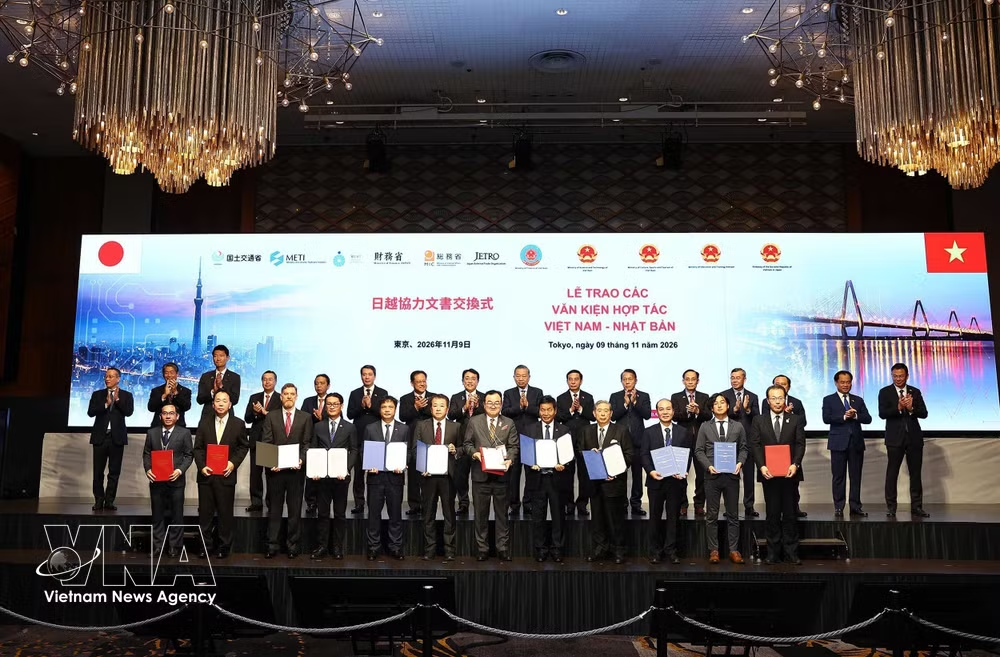
At the forum, General Secretary and President Lam and the Vietnamese high-ranking delegation witnessed the exchange of cooperation documents between Vietnamese and Japanese businesses, ministries and agencies.
The agreements covered information technology, artificial intelligence (AI) and semiconductors; energy, renewable energy and green transition; education and training, and scientific research; healthcare; finance and banking, aviation and investment; as well as agriculture, smart transport and logistics.
The Vietnamese leader and the delegation also witnessed the announcement of the Vietnam-Japan Tourism Cooperation Year 2027–2028./.