Malaysia boosts investment in innovation

Malaysia’s gross expenditure on R&D (GERD) reached 1.01% of gross domestic product in 2022, a notable increase, with more than 51% contributed by the industry sector. The country is targeting GERD to reach 2.5% by 2030, in line with the national goal of transforming into a high-technology nation.

Kuala Lumpur (VNA) - Malaysia is expanding its investment in research and development (R&D) as part of its push to become a high-technology nation by 2030, said Malaysian Deputy Science, Technology and Innovation Minister Datuk Mohammad Yusof Apdal.

The official was quoted by local media as saying that Malaysia’s gross expenditure on R&D (GERD) reached 1.01% of gross domestic product in 2022, a notable increase, with more than 51% contributed by the industry sector.

The country is targeting GERD to reach 2.5% by 2030, in line with the national goal of transforming into a high-technology nation, Mohammad Yusof said in his speech at the soft launch of the ASEAN Technology Cooperation and Development Summit 2025.

He said the mission of the Science, Technology and Innovation Ministry (Mosti) is anchored in a vision to transform Malaysia from a technology user into a technology developer with global market capabilities by 2030. Mohammad Yusuf said the government is accelerating real-world innovation with the National Technology and Innovation Sandbox (NTIS), providing a platform for pre-commercial technologies to be tested and adapted at scale.

Since its inception, the NTIS has supported numerous innovative solutions, focusing on applications ranging from precision drones to AI diagnostics and renewable energy systems.

Additionally, Malaysia is investing in talent as an estimated 600,000 Malaysians will need to be reskilled over the next three to five years due to artificial intelligence and automation.

The ASEAN Technology Cooperation and Development Summit 2025, to be held on November 25 and 26 in Kuala Lumpur, will focus on five pillars – future mobility and smart transportation, future healthcare and digital medicine, future consumer and digital commerce, future building and safety emergency response, and future employment and entrepreneurship.

The two-day event is set to convene over 100 companies, more than 50 global investors, and 2,000 innovators and ecosystem leaders from ASEAN, China, Canada, Australia, the Middle East, Europe and Japan. It will feature a technology exhibition with over 100 booths highlighting innovations across key sectors. The summit is expected to attract more than 50,000 livestream viewers./.

VNA

See more

Thailand diversifies oil sources to ensure energy security

Thailand diversifies oil sources to ensure energy security

Although the diversification of oil import sources has helped reduce the risk of domestic oil shortage, it has not immediately reduced energy costs because import prices depend on market mechanisms, transportation costs, foreign exchange rates and the terms of oil contracts.

ST Telemedia Global Data Centres (Thailand), an affiliate of Singapore Telecom, is developing three data cehtres in Thailand including this facility on Rama IX Road in Bangkok. (Photo: bangkokpost)

Thailand tightens regulations on data centres

The new rules focus on controlling investment scale, electricity and water consumption, environmental impacts, and preventing investors from reserving resource quotas beyond their actual needs.

A road is under construction in Dong Nai city, Vietnam. (Photo: VNA)

ADB: Southeast Asia needs 7.1 trillion USD in infrastructure investment by 2040

ADB estimates that the region will need an average of 476 billion USD in infrastructure investment annually during 2026–2040, equivalent to 8.7% of GDP. However, at current investment levels, government budget resources would cover only around 45% of this demand, leaving an annual financing gap of 264 billion USD.

Kyodo News publishes an article titled “Sculptures by Japanese, Vietnamese artists on display in Yokohama,” (Screenshot photo)

Japanese media widely cover top Vietnamese leader ’s visit

Japanese media have continued extensive coverage of General Secretary of the Communist Party of Vietnam (CPV) Central Committee and President To Lam’s activities in Japan, highlighting his meetings with representatives of leading financial institutions at the Tokyo Stock Exchange, witnessing of cooperation agreement signing and participation in cultural exchanges.

Thailand pushes for establishment of ASEAN emergency public health centre

Thailand pushes for establishment of ASEAN emergency public health centre

The draft agreement stipulates that ACPHEED will comprise three specialised centres based in three ASEAN member states. Vietnam will oversee the centre for prevention and preparedness; Indonesia will host the centre for detection and risk assessment; and Thailand will be responsible for the centre for response and risk communication.

Indonesia designates 31 mln ha of waters as conservation areas

Indonesia designates 31 mln ha of waters as conservation areas

Head of the Convention and Marine Resource Balance working team at the ministry’s Directorate of Ecosystem Conservation Ahmad Sofiullah said this week that it is a strategic effort to ensure the sustainability of Indonesia’s marine ecosystems.

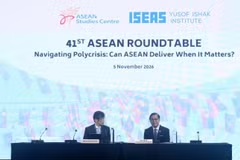
Thai Deputy Prime Minister and Minister of Foreign Affairs Sihasak Phuangketkeow (R) takes part in the Q&A session at the 41st ASEAN Roundtable. (Photo: VNA)

Thailand calls on ASEAN to proactively address polycrisis

Thai Deputy Prime Minister and Minister of Foreign Affairs Sihasak Phuangketkeow noted that no single member state could tackle challenges ranging from major-power competition and economic fragmentation to climate change and energy and food security on its own. Regional cooperation is therefore a strategic imperative, enabling ASEAN not only to overcome crises but also to sustain its development momentum.

Palm oil and palm oil-based products are among Indonesia’s promising export commodities. (Photo: VNA)

Indonesia to launch commodity export monitoring platform next year

DSI will draw on data from customs authorities, trade activities and the financial system, alongside contracts and documents uploaded by exporting companies. The platform will monitor the volume, quality, prices and destination markets of various commodities, as well as transactions between related parties.