Malaysia calls on ASEAN to build more integrated, resilient economy

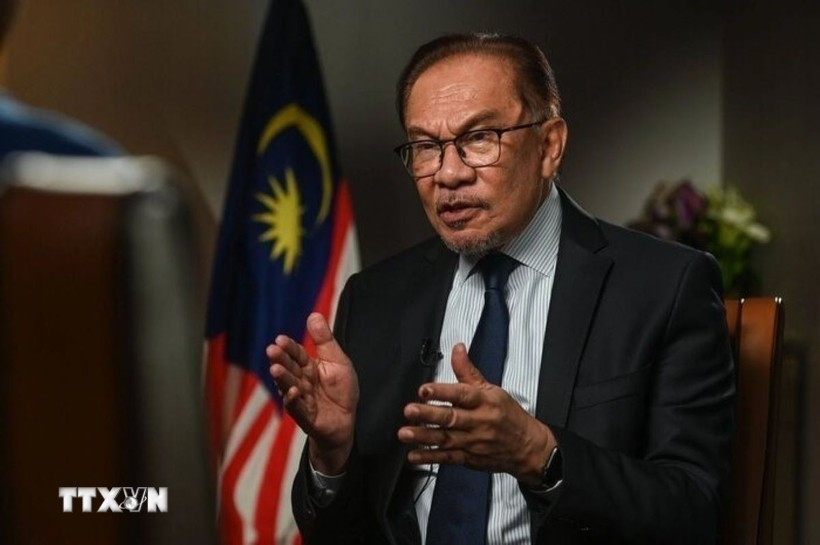
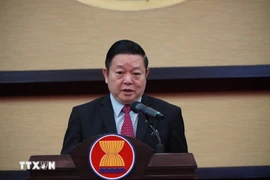
Malaysian Prime Minister Datuk Seri Anwar Ibrahim on July 29 called on the Association of Southeast Asian Nations (ASEAN) to focus the bloc’s energies inward, towards building a more integrated and resilient ASEAN economy.

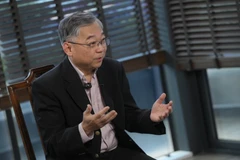
Malaysian Prime Minister Datuk Seri Anwar Ibrahim (Photo: Xinhua/VNA)

Jakarta (VNA) – Malaysian Prime Minister Datuk Seri Anwar Ibrahim on July 29 called on the Association of Southeast Asian Nations (ASEAN) to focus the bloc’s energies inward, towards building a more integrated and resilient ASEAN economy.

In his policy address in ASEAN at ASEAN Secreteriat in Jakarta on July 29, Anwar said that the region is home to a vast and vibrant market of 660 million people. The potential is undeniable, but to realise it fully, ASEAN must narrow the existing development gaps and forge stronger, more equitable economic linkages across member states.

He said at the 47th ASEAN Summit in Kuala Lumpur, ASEAN will once again demonstrate its collective commitment towards improving the unimpeded flow of goods within the region. Through renewed efforts to reduce tariff and non-tariff barriers, the group is taking meaningful steps towards creating a more seamless and dynamic ASEAN economic community that works for all, not just for some.

The Malaysian leader said that the Regional Comprehensive Economic Partnership (RCEP) is central to this vision. As the world’s largest trade agreement, it reinforces ASEAN’s role as the linchpin of regional economic architecture.

He said the success of the ASEAN-GCC-China Summit is a clear signal that ASEAN is ready to build new bridges and unlock new partnerships. It also reaffirms our shared determination to shape a future based on mutual respect, shared growth, and strategic cooperation.

In addition, PM Anwar emphasised that digital economy will be a key driver of ASEAN’s next phase of growth. That is why ASEAN are advancing efforts to conclude the ASEAN Digital Economy Framework Agreement, while modernising our existing trade agreements with strategic partners including China, India, and the Republic of Korea. These efforts reflect ASEAN’s readiness to embrace change and position ourselves at the forefront of digital transformation.

According to Anwar, ASEAN must be an agent of change – one that has the capacity to shape the global rules and norms to remain open, inclusive, and firmly rooted in the principle of justice. ASEAN’s commitment to regionalism and multilateralism remains the anchor of the region’s collective stability and progress./.
VNA

See more

The 8th Cooperative Plan Meeting between the Ministry of Commerce of Thailand and the Ministry of Industry and Commerce of Lao PDR, December 17, Bangkok, Thailand (Photo: nationalthailan.com)

Thailand, Laos aim to boost bilateral trade

Laos is Thailand’s 7th largest trading partner in ASEAN and 18th globally. From January to October 2025, two-way trade grew by 18.65% to 8.18 billion USD, with Thai exports increasing by 16.90% to 4.81 billion USD and imports rising by 21.23% to 3.60 billion USD.

File photo of Visa and Mastercard credit cards. (Photo: AP)

Unpaid credit card balances in Singapore hit record high in 10 years

Experts attributed the worrying trend to factors like people not spending within their means, consumer culture emphasising prestige items, and easier access to credit like “buy now, pay later” services. Analysts said this can be a hint of growing financial pressures faced by Singaporeans amid rising prices.

Malaysian Deputy Prime Minister Datuk Seri Fadillah Yusof (Photo: Bernama)

Malaysia accelerates clean energy transition

Delivering a speech at the Clean Energy Transition Asia (CETA) Summit 2025 in Kuala Lumpur, Fadillah, who is also the energy transition and water transformation minister, said that the Southeast Asian region now drives more than half of the global energy demand.

Indonesian localities extend state of emergency amid natural disasters

Indonesian localities extend state of emergency amid natural disasters

As disaster-related losses continue to rise, authorities in the affected provinces have decided to extend the state of emergency to ensure resources and legal mechanisms for response efforts. West Sumatra extended it to December 22, North Sumatra to December 24, and Aceh to December 25.

Malaysian Deputy Prime Minister Datuk Seri Fadillah Yusof delivers his opening keynote address at the Global AI, Digital and Green Economy Summit 2025 in Kuala Lumpur, December 15, 2025. (Photo: Bernama)

Malaysia eyes AI-driven energy future

Malaysia’s direction is to focus on building a modern grid, a digital economy powered by trustworthy AI, and climate finance systems that deliver real-world decarbonisation.

Air passengers at the departure terminal of the Phnom Penh International Airport. (Photo: khmertimeskh.com)

Air travel between Cambodia, Thailand remains operational

In a statement released on his Facebook post, Hun Sen explained that his earlier message, advising the Royal Government to consider suspending cross-border travel, referred specifically to land routes, as tensions are escalating along the entire land border, with some spillover into maritime areas.

Thailand, Myanmar boost anti-drug cooperation

Thailand, Myanmar boost anti-drug cooperation

Myanmar authorities have handed over three drug-related fugitives wanted by Thailand and one Thai national who was residing illegally in Myanmar to Thai authorities, according to the Myanmar Police Force.

An aerial drone photo shows a bridge damaged by floods in Bener Meriah regency, Aceh, Indonesia, (Photo: Xinhua)

Indonesia: Over 200 people remain missing after floods, landslides

The floods and landslides that struck three provinces on Indonesia's Sumatra Island have caused damage to about 1,200 public facilities, as well as 219 health facilities, 581 educational establishments, 434 places for worship, 290 office buildings and 145 bridges.