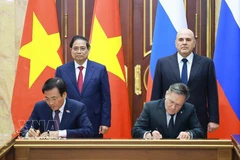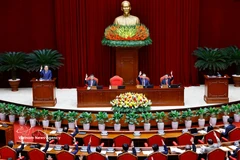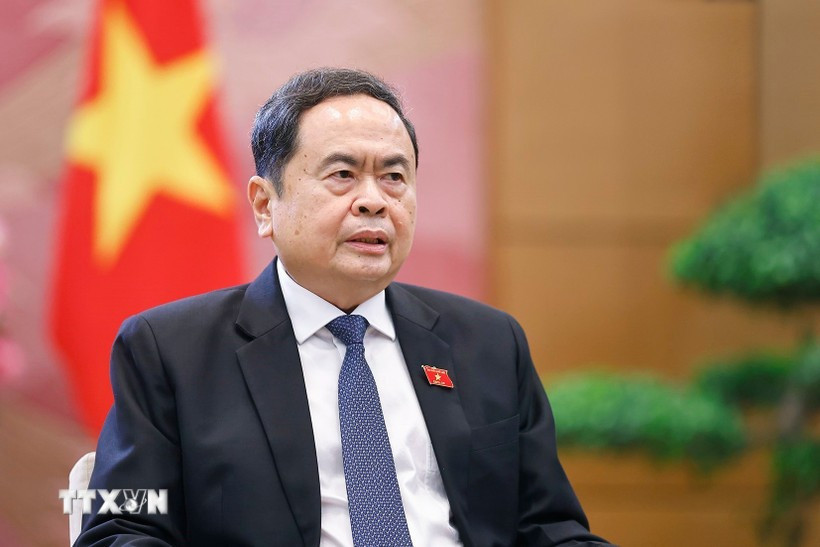
Hanoi (VNA) – Through its activities, especially in law building, external relations and supreme supervision over external affairs, the National Assembly (NA) has make great contributions to the country’s overall foreign relations over the past eight decades, NA Chairman Tran Thanh Man told the press on the occasion of the 80th anniversary of Vietnam’s diplomatic sector (August 28, 1945–2025).
Over the past 80 years, under the leadership of the Communist Party of Vietnam, the NA has steadily consolidated its position as the highest representative body of the people and the supreme body of state power of the Socialist Republic of Vietnam, significantly contributing to the effective implementation of the country's foreign policy.
Parliamentary diplomacy has emerged as a crucial component in the country’s overall foreign policy framework, complementing the Party's external relations and the State's diplomacy. This coordination has created the synergy for Vietnam's modern diplomacy and promoted the country's stature in the international arena, stated the NA leader.
From its earliest years, parliamentary diplomacy played an integral role in safeguarding and building the revolutionary government. Between 1945 and 1975, parliamentary diplomacy took shape, and activities of the NA's external relations then laid the political – legal and international relations foundations for professional and comprehensive development of diplomacy in the following periods. During the 1975–1986 period, although the country faced economic embargoes and isolation by the West, the 6th legislature (1976–1981), the first following the national reunification, marked an institutional and apparatus turning point. Notably, the NA's approval of Vietnam’s accession to the Inter-Parliamentary Union (IPU) in April 1979 symbolised a crucial step of the parliament's integration into the world, he highlighted.
Since the outset of the Doi Moi (Renewal) period, parliamentary diplomacy has continued to be promoted and expanded, helping promote the role and standing of the Vietnamese NA on the global stage. The NA has established parliamentary relations with over 140 countries and actively participated in most global and regional parliamentary organisations, including the IPU, the ASEAN Inter-Parliamentary Assembly (AIPA), the Asia-Pacific Parliamentary Forum (APPF), and the Francophone Parliamentary Assembly (APF).
Its multilateral engagement has been marked by the successful hosting of major international events such as IPU-132 (2015), APPF-26 (2018), AIPA-41 (2020), and the 9th IPU Global Conference of Young Parliamentarians (2023). In January 2025, Vietnam successfully hosted the APF Executive Committee Meeting and the Francophone Parliamentary Forum focusing on sustainable agriculture, food security, and climate change adaptation.
Given the role of the NA as both the highest representative body of the people and the supreme body of state power, parliamentary diplomacy is imbued with distinctive state and people characteristics. This dual character enables it to serve as a bridge, amplifying the synergies of the Party's external relations, the State's diplomacy, and people-to-people diplomacy. In this capacity, it has helped diversify and deepen Vietnam’s ties with partners, creating opportunities for fostering cooperation across a wide range of areas, from economic development to cultural and educational exchanges. Through these efforts, parliamentary diplomacy has conveyed a message about a dynamic, friendly, responsible, and proactive Vietnam in the international arena, the top legislator went on.
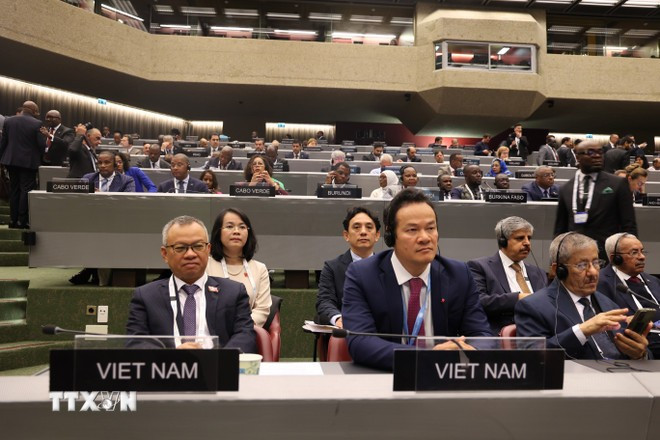
According to the NA Chairman, the Vietnamese NA’s involvement in multilateral parliamentary forums has been practical, aligned with Directive No. 25-CT/TW, issued by the Party Central Committee's Secretariat, on boosting and elevating multilateral diplomacy through to 2030. By actively and responsibly participating in dialogues, building consensus, and proposing initiatives, the Vietnamese NA has reinforced both its own role and that of the nation in the international community.
In addition, this is also an important channel for Vietnam to promote and safeguard its national interests. Through multilateral parliamentary activities, the country could garnered and made use of international consensus on and support for strategic issues directly conencted with national interestst such as peace, security, sustainable development, climate action, food security, and water resource security. At the same time, Vietnam has used these opportunities not only to showcase its development achievements and experience, but also to popularise its image as a peaceful, stable, dynamic, and responsible nation.
Vietnam has not merely participated in these forums but has frequently taken on roles of the organiser. Its successful hosting and organisation of regional and global inter-parliamentary events have demonstrated its capacity, mettle, and integration proactiveness, helping the country play a more active role in shaping international principles and norms and in resolving common issues of the region and the world. The country’s initiatives on climate change and water security have been well received, reflecting its responsible contributions and enhancing the international community's trust in the country's role and sense of responsibility.
In addition, the top legislator said, the NA has a key role to play in law making and supreme supervision over external relations.
He elaborated that the legislature has passed, amended, and perfected legislation to ensure legal consistency and provide a strong basis for the implementation of the Party and State's foreign policy.
The NA has also ratified numerous international agreements of strategic importance, from new-generation free trade agreements and international human rights conventions to regional and global cooperation frameworks. These actions affirm Vietnam’s commitment to seriously realising international commitments while ensuring that the ratified treaties match national interests. The ratification of major new-generation FTAs such as the Comprehensive and Progressive Agreement for Trans-Pacific Partnership (CPTPP) and the EU-Vietnam Free Trade Agreement (EVFTA) has provided a robust legal framework for international integration, foreign investment attraction, and export market expansion, strongly supporting the Government’s economic diplomacy.

At the same time, the National Assembly also serves as a bridge to bring international commitments into the domestic legal framework, creating a consistent system of laws for Vietnam to effectively implement international agreements in support of sustainable development. As a result, the country’s legal regulations are increasingly aligned with international standards, meeting the requirements of commitments under the World Trade Organisation (WTO), United Nations conventions, and other bilateral and multilateral agreements, NA Chairman Man said.
In addition, the legislature’s supreme oversight of external affairs has been carried out with growing effectiveness, through monitoring the relevant agencies in implementing international treaties, pursuing foreign policy, and ensuring that the fulfillment of international commitments is closely linked with the country’s development needs, he stated, affirming that questioning sessions, thematic supervision, and government reports on foreign affairs at NA sessions have helped enhance transparency, efficiency, and accountability in this area.
Through legislation, ratification of international treaties, and supreme oversight, the legislative body not only accompanies but also promotes the implementation of the country’s foreign policy, thereby safeguarding national interests and enhancing its position and reputation in the international community, the NA Chairman asserted.
Regarding tasks for the upcoming period, the top legislator emphasised that the requirements to achieve rapid and sustainable development, firmly safeguard independence and sovereignty, and maintain a peaceful and stable environment for development place new, heavier, and more comprehensive tasks on the NA’s foreign affairs.
In this context, the overarching goal of the NA’s external relations, together with Party diplomacy, state diplomacy, and people-to-people diplomacy, is to preserve a peaceful, stable, and favourable environment for national construction and defence; implement strategic tasks for socio-economic development; and firmly and persistently safeguard independence, sovereignty, sovereign rights, territorial integrity, and core interests in accordance with international law.
He stressed the need to uphold the role of the parliamentary diplomacy channel; proactively, actively, and responsibly participate in multilateral parliamentary cooperation mechanisms; and strengthen bilateral relations with the parliaments of other countries, especially key and strategic partners.
The National Assembly will also further improve the quality of legislation, ratification, and supervision of international treaties, ensuring harmony between national and ethnic interests and international commitments. In addition, renewing methods and content, and fostering close coordination between Party diplomacy, state diplomacy, and people-to-people diplomacy, is a crucial requirement, helping the NA’s foreign affairs truly become an important pillar in Vietnam’s comprehensive and modern diplomacy, the NA Chairman noted.
Amid new demands from both domestic and international contexts, the focus of the legislative body’s foreign affairs in the new era is to continue affirming its proactive, active, and responsible role, contributing to the implementation of the Party’s and the State’s foreign policy of independence, self-reliance, multilateralisation, and diversification.
In the context of digital transformation and the rapid changes in the international environment, the NA is also required to strongly innovate its methods of external engagement to adapt to the new situation. This includes enhancing the application of information technology in organising activities, expanding forms of online dialogue and exchanges, and improving the timeliness and effectiveness of parliamentary interactions and connections. In addition, building a contingent of professional and competent parliamentary diplomats, with strong political mettle, proficiency in foreign languages and technology, and sound knowledge of international law and practices, is a key factor in improving the quality and effectiveness of its activities.
Extending his best wishes to the diplomatic sector’s officials, civil servants, public employees and staff on the occasion of its 80th founding anniversary (August 28, 1945-2025), the top legislator expressed his belief that the diplomatic service will continue to undergo strong innovation; promote its glorious tradition and its pioneering, vital, and consistent role; comprehensively, creatively, and effectively implement Party diplomacy, state diplomacy, and people-to-people diplomacy; and build a comprehensive, modern, and professional diplomatic sector./.