Party chief inspects local political system operation in Dien Bien's Si Pa Phin commune

The visit aimed to assess the new two-tier local government model, preparations for upcoming Party congresses at levels, and implementation of the Politburo’s Conclusion on school construction in border areas.

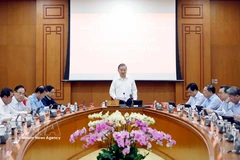
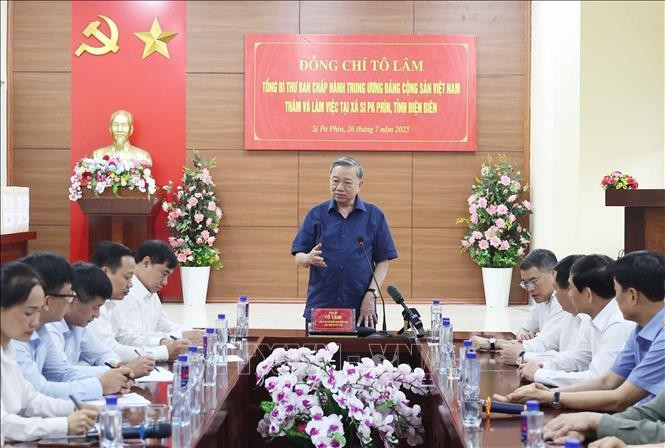
Party General Secretary To Lam at a working session with Si Pa Phin commune, Dien Bien province, July 26 (Photo: VNA).

Dien Bien (VNA) - Party General Secretary To Lam and a high-ranking delegation on July 26 visited Si Pa Phin commune in the northern province of Dien Bien to inspect the operation of the local political system.

The visit aimed to assess the new two-tier local government model, preparations for upcoming Party congresses at levels, and implementation of the Politburo’s Conclusion on school construction in border areas.

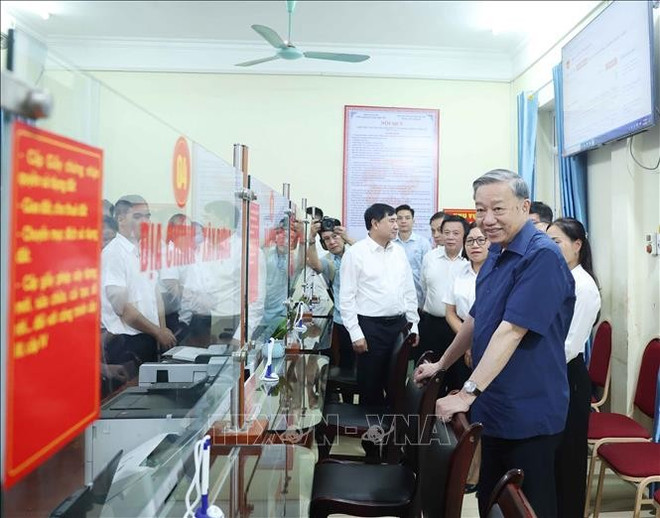
Visiting the communal public administrative service, the Party chief praised the efforts of local authorities and relevant forces, emphasising that grassroots administration not merely about carries out administrative tasks. It represents a major shift, as local authorities now act on behalf of the State to implement the Party’s guidelines and policies at the grassroots level, helping to improve people's lives and effectively bring the Party Central Committee's resolutions and conclusions into practice at the grassroots level.

Si Pa Phin is a mountainous and border commune located in the northwest of Dien Bien, nearly 85 kilometres from the provincial administrative centre.

The commune faces challenges such as uneven educational levels, outdated customs, inadequate infrastructure, and widespread poverty. It has 700 poor households (accounting for 35.02%) and 302 near-poor households (15%). The average per capita income in 2025 is estimated at just 20.19 million VND (772 USD) per year.

Despite these challenges, the commune has maintained political stability and social order. Socio-economic conditions are showing signs of improvement. National target programmes and social welfare policies have been implemented in a timely manner. The local political system has been consolidated and strengthened, with improved leadership and administrative capacity at both Party and Government levels.

Following the establishment of its Party Committee and administration, the commune launched a public service centre on July 1. Staff with strong qualifications and reform experience were appointed, supported by local police, the Ho Chi Minh Communist Youth Union, and telecom officials. The centre addresses daily administrative needs, with unresolved issues escalated to higher authorities.

An on-site inspection revealed that the commune has actively overcome early challenges, securing infrastructure and familiarising staff with administrative processes to serve residents and businesses effectively.
uuid3d9d7307ed-27b7-44c9-a61b-1461ae51f20b26code3d00126library3d126type3d126mode3d126loc3dtrue26cap3dtrue.jpg
Party General Secretary To Lam inspects the Public Administrative Service Centre of Si Pa Phin commune, Dien Bien, July 26 (Photo: VNA)

General Secretary Lam urged the Party Committee and administration of communes to strictly comply with political system operation regulations, review all assigned tasks and administrative procedures to ensure smooth and uninterrupted service, and finalise internal rules and regulations to create a legal foundation for effective operations.

He also called on the Vietnam Fatherland Front Committee and relevant agencies to continue supporting the preparation and operation of the grassroots political system, ensuring consistency, legality, and efficiency.

Regarding upcoming tasks, the Party chief stressed the need to continue implementing central and provincial solutions for socio-economic development and national defence and security.

He requested the local authorities to focus efforts on poverty reduction and improvement of the livelihoods of ethnic minority groups, with particular attention to efforts to eliminate poverty, enhance healthcare and education, and improve the spiritual life of residents to ensure that no one is left behind.

Regarding education and training, the General Secretary emphasised that the investment in building inter-level primary and secondary schools in border communes is a sound, timely policy, imbued with deep humanitarian significance and strategic vision. It reflects the Party Central Committee’s attention to local development and the spirit of solidarity between urban areas and mountainous regions.

The Politburo has instructed the Party Committee of the Ministry of Education and Training to take the lead in reviewing, amending, and supplementing existing regulations. These revisions should ensure that students in land border communes are eligible for appropriate boarding and semi-boarding policies, considering practical difficulties related to terrain and geographic distance.

The Ministry is also to work with the Ministry of Home Affairs to devise a plan for appropriate teacher allocation based on a review of current staffing and future needs, including training teachers proficient in ethnic minority languages, proposing budget allocations to sustain school operations, and adjusting allowances for teachers in accordance with new conditions. In addition, policies should be developed to encourage human resources to serve in border communes, and plans should be made for schools nationwide to establish twinning arrangements with those in border areas to promote exchange, connection, and support for disadvantaged schools.

At the Cultural House of Tan Lap hamlet in Si Pa Phin commune, General Secretary Lam presented gifts to local ethnic residents. The community is composed mainly of Thai, accounting for 80% of the population. Tan Lap currently has 136 households and 607 residents, including 32 classified as poor and 10 as near-poor.

He also presented gifts to the family of veteran Dien Bien soldier Vang A Chao (born in 1929), father of martyr Vang A Sia, who laid down his life during the 1979 northern border defence war./.
VNA

See more

Experience virtual reality technology at Nha Trang Center shopping mall (Khanh Hoa). (Photo: VNA)

Experts give ideas to build AI economy from data

Vietnam’s economic growth over past decades has largely relied on labour expansion, capital accumulation, export promotion and deep global trade integration, but as the country enters a higher development stage, this model is showing limitations.

VINASA Vice Chairwoman and Secretary General Nguyen Thi Thu Giang (right) and SEPC General Director Abhay Sinha sign the MoU on cooperation in New Delhi on March 25. (Photo: VNA)

Vietnam, India ink deal to step up IT cooperation

Under the terms of the MoU, the two sides will jointly push trade and investment in IT and services, arrange business delegations and business-to-business meetings, share market and policy information, and help companies access partnership opportunities and expand into new markets.

The Ninh Thuan 1 Nuclear Power Plant project is planned to be built in Khanh Hoa province (Photo: VNA)

Vietnam approves atomic energy development strategy, targeting civil applications

Tran Chi Thanh, Director of the Vietnam Atomic Energy Institute under the Ministry of Science and Technology, underscored that in the coming period, the institute and its affiliated units will continue promoting their strengths to promote the safe and secure application of atomic energy, contributing effectively to socio-economic development goals.

Students at FPT Ha Nam Inter-level High School practice their lessons directly by applying digital technology software (Photo: VNA)

FPT joins top 35 global AI application development service providers

The recognition reflects FPT’s end-to-end AI capabilities, spanning strategic consulting, solution design, application development, and the integration and deployment of AI systems in real-world operations. Notably, the company has developed IvyHub, an integrated agentic AI platform that enables enterprises to design, deploy and manage AI agents at scale.

The High-Frequency Systems and Microchip Laboratory at Ho Chi Minh City University of Technology, Vietnam National University, Ho Chi Minh City. (Photo: VNA)

Ho Chi Minh City sets sights on becoming semiconductor hub

A central component of the plan is expanding cooperation with global technology leaders such as AMD, NVIDIA and Qualcomm. These partnerships are expected to support technology transfer, strengthen chip design capabilities and help the city move further up global semiconductor value chains.

The modern nanotechnology research laboratory of Vietnam National University, Ho Chi Minh City. (Photo: VNA)

Resolution 57 delivers tangible outcomes from local practice

In the course of implementing this resolution, the northern province of Quang Ninh has emerged as one of the early movers in translating strategic orientations into comprehensive development models linked to innovation and digital transformation.

Delegates at the launch of the new version of Ho Chi Minh City technology exchange platform. (Photo: VNA)

Ho Chi Minh City launches upgraded technology exchange platform

The upgraded platform represents a comprehensive shift from a simple information-sharing model to a managed online technology trading system, enabling monitoring and measurement of real transaction outcomes. It is built on three pillars, namely new tradable technology products, a modern digital platform, and an improved operational model.

A Viettel 5G base station provides coverage at the April 16 Square area in Dong Hai ward, Khanh Hoa province. (Photo: VNA)

Conquering 6G networks helps Vietnamese businesses master strategic technologies

The global 6G alliance marks not only a technological milestone but also an opportunity for Vietnamese enterprises to strengthen their position on the global technology landscape. With the involvement of FPT, Viettel and VNG, Vietnam is gradually emerging as an early mover in the development and application of 6G technology.

At the Online Product Safety Summit in Hanoi on March 18. (Photo: dms.gov.vn)

Hanoi summit advances operation of ASEAN product safety portal

The Online Product Safety Summit in Hanoi on March 18 focused on practical enforcement solutions for identifying and removing non-compliant goods from online marketplaces, thereby strengthening consumer protection amid the rapid growth of e-commerce.

Illustrative image (Photo: VNA)

Resolution 57 charts directions for Vietnam’s technology ecosystem

Vietnam's sci-tech sector must evolve from a manufacturing base toward mastering technologies and ultimately developing original products independently, which requires shifting away from outsourcing and assembly models to one where domestic scientists lead in design, development and ownership of core technologies.

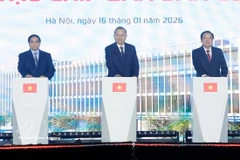
Party General Secretary To Lam (centre), Prime Minister Pham Minh Chinh (left), and Chairman of the Party Central Committee’s Commission for Internal Affairs Phan Dinh Trac mark the start of work on a high-tech semiconductor manufacturing plant in Hanoi on January 16, 2026. (Photo: VNA)

Resolution 57 refines technology priorities for new growth phase

The Ministry of Science and Technology is seeking feedback on a draft Prime Minister decision outlining four key categories: priority high technologies for investment, encouraged high-tech products, strategic technologies, and strategic tech products. The move is intended to capture emerging technology trends while strengthening the policy framework for high-tech development.

Professor Geert Angenon of Vrije Universiteit Brussel (Photo: VNA)

European experts highlight potential for AI cooperation with Vietnam

Experts believe that as demand for technological innovation grows and international partnerships expand, Vietnam has big opportunities to deepen cooperation with European partners in high-tech agriculture, healthcare, digital transformation and artificial intelligence.