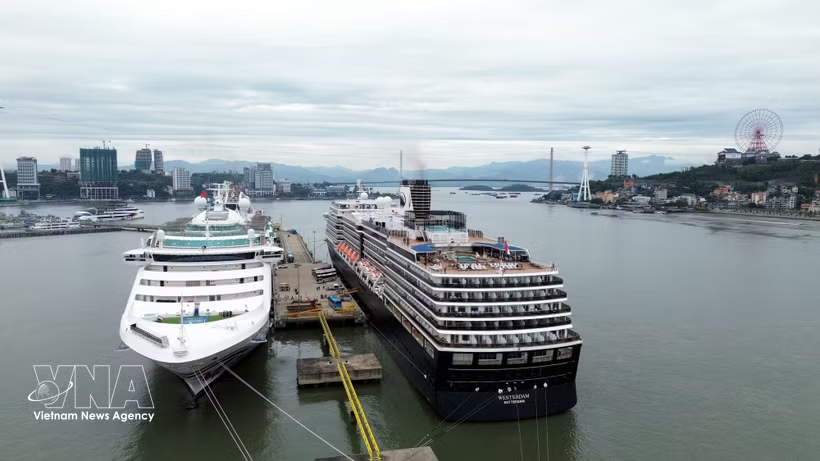
Quang Ninh (VNA) – The northern city of Quang Ninh has charted its development vision through 2030, aiming to become a national growth powerhouse creating momentum for regional development, with strong spillover potential and international competitiveness.
It will focusing on ensuring balanced economic, social and environmental development, and integrating urban, maritime, border and heritage assets into a complete ecosystem.
The city also aims to establish itself as a national centre for the marine economy, tourism, cultural industries, modern high-tech industries, the heritage economy, the night-time economy and the urban economy.
Economic strength is expected to be reflected in average GRDP growth of around 12% annually, raising GRDP per capita at current prices to approximately 20,000 USD by 2030. Behind these figures lies the expectation of a more productive economy capable of generating greater value and competing more effectively.
By 2030, services are projected to account for around 40–43% of GRDP, industry and construction 45–48%, and agriculture, forestry and fisheries 2–5%. The digital economy is targeted to contribute approximately 30% of GRDP.
Importantly, the quality of growth is being given equal weight to its scale. Social labour productivity is targeted to increase by an average of 12% annually, while total factor productivity (TFP) is expected to contribute more than 55% of growth during 2021–2030. The urbanisation rate is hoped to exceed 75%.
The new Quang Ninh will focus on developing road and high-speed rail infrastructure, airports, seaports and smart urban infrastructure, connecting major urban centres.
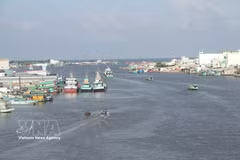
By 2030, it aims to build 124km of new high-speed railway and around 57km of expressway on the Noi Bai–Bac Ninh–Ha Long route passing through the city. Van Don International Airport is targeted to reach a capacity of 2.5 million passengers annually. Meanwhile, seaport systems at Hon Net–Con Ong, Yen Hung, Cai Lan, Hai Ha and Van Ninh–Van Gia will continue to be developed.
Alongside economic development, Quang Ninh is setting clear social targets. By 2030, the city aims for a permanent population of around 1.75 million, more than 90% of workers receiving training, including 48% holding degrees or professional certificates, and an unemployment rate below 2%. Average housing floor space is targeted at around 36 sq.m per person.
In healthcare, targets of 68 hospital beds, 20 doctors, eight university-trained pharmacists and 33 nurses per 10,000 people are intended to underpin an increasingly comprehensive healthcare system. Health insurance coverage is expected to reach 100%, while average life expectancy is targeted at more than 76 years.
Quang Ninh also aims to rank among the five leading provinces and cities nationwide in terms of the Human Development Index (HDI), providing a broader measure of development quality.
In education, more than 95% of schools are expected to meet national standards. The city also aims to maintain zero households living in poverty under the national multidimensional poverty standard.
These objectives reflect the principle that economic development must not become detached from living standards; rather, the benefits of growth should create opportunities for all residents to share in its achievements.
A developed Quang Ninh must also be a green Quang Ninh. By 2030, more than 99% of the urban population is expected to have access to clean water through centralised water supply systems; 100% of wastewater in concentrated urban areas is to be collected and treated; and all operating industrial parks and clusters are to have centralised wastewater treatment systems meeting discharge standards. Forest coverage is to remain above 50%, creating greater scope to balance development with conservation.
Nguyen Manh Cuong, Director of the municipal Department of Science and Technology, said Quang Ninh will develop an integrated database to enable authorities at all levels to make decisions based on scientific evidence and forecasting models rather than assumptions. AI and big data will be applied in real-time monitoring of traffic flows, energy use, the environment and public services.
Alongside development, maintaining stability and safety remains a clear priority, with efforts to safeguard political security and social order and safety while sharply reducing crime and social problems.
By 2030, the realisation of each of these targets is expected to contribute to a more dynamic Quang Ninh, with an expanded development space, more widely shared benefits and local people truly at the centre of the development process./.