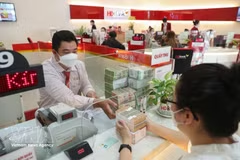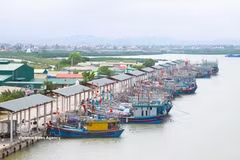
Hanoi (VNA) - Despite complex global fluctuations, the economic picture of localities across Vietnam in 2025 continued to show a trend of recovery and expansion. Key growth regions such as the Red River Delta and the Southeast maintained their role as leading economic drivers, while several smaller provinces also capitalised on infrastructure advantages and public investment to achieve relatively strong growth.
The information was released by Nguyen Thi Huong, Director General of the National Statistics Office (GSO), at a press conference announcing socio-economic performance in the fourth quarter and the whole of 2025 on January 5.
Rise of growth-driving regions
Assessing gross regional domestic product (GRDP) growth, Huong noted that the recovery remained uneven. Clear disparities persist between coastal localities and major industrial centres and provinces still dependent on agriculture or mining. This divergence poses challenges to the sustainability and quality of growth in the coming years.
The Red River Delta continued to play an outstanding role as one of the country’s most important growth engines. The region posted an estimated GRDP growth of 9.74%, accounting for more than 36% of the nation’s overall economic expansion.
The result came not only from Hanoi's stability but also from strong momentum in surrounding industrial hubs such as Hai Phong, Bac Ninh, and Quang Ninh.
Among the leading localities, Quang Ninh and Hai Phong stood out with respective growth rates of 11.89% and 11.81%. These impressive figures were driven by their ability to attract and effectively disburse foreign direct investment (FDI) alongside the expansion of large-scale industrial complexes.
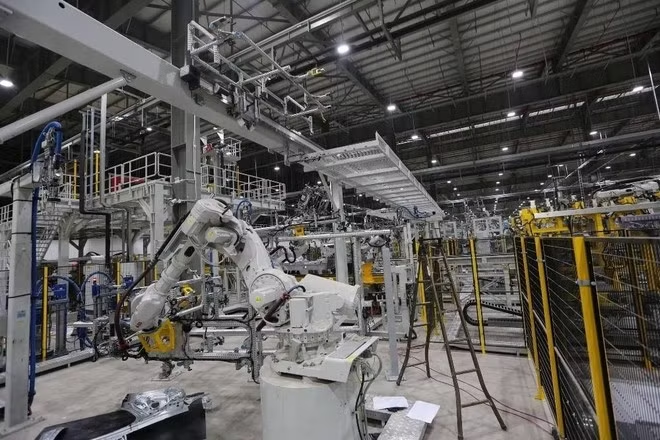
A notable development in 2025 was the administrative boundary mergence, which had a positive impact on regional economies. A typical example is Bac Ninh following its merger with Bac Giang. The synergy between a high-tech electronics hub and a locality strong in supporting industries, with abundant land resources, has created an internationally competitive processing and manufacturing centre.
With an estimated growth rate of 10.3%, Bac Ninh continues to consolidate its position, thanks to the expansion of major investors such as Samsung and Amkor, as well as new projects such as Fulian.
The Southeast remained southern Vietnam’s largest economic region, contributing more than 31% to overall growth. Ho Chi Minh City recorded a growth rate of 7.53% after restructuring efforts.
The highlight of the southern economic locomotive lay in the service sector, which accounted for nearly 66% of the city’s total growth. This reflects a shift toward higher value-added industries such as finance, logistics, and the digital economy. Meanwhile, Dong Nai posted a 9.63% growth, supported by momentum from the Long Thanh International Airport project and the recovery of key industrial sectors.
In the central region, Da Nang recorded a growth rate of 9.18%, benefiting from the recovery of tourism and progress in its strategy to develop into an international financial centre. The city’s construction sector surged by more than 25% as many large urban real estate projects resumed.
Thua Thien–Hue also joined the group of fairly strong performers, with growth of 8.5%, driven by industrial development and heritage-based economic activities.
Regional development gap
Despite these positive results, the economic picture in 2025 still revealed notable disparities in regional development. Localities posting relatively low growth rates of below 7% included Vinh Long, Thai Nguyen, and Tuyen Quang.
Their slower growth largely stems from economic structures that remain narrow, relying heavily on traditional agriculture, mining, or low-value processing industries. In addition, risks from natural disasters, global commodity price fluctuations, and slowdowns among several major FDI enterprises have had immediate impacts on GRDP performance.
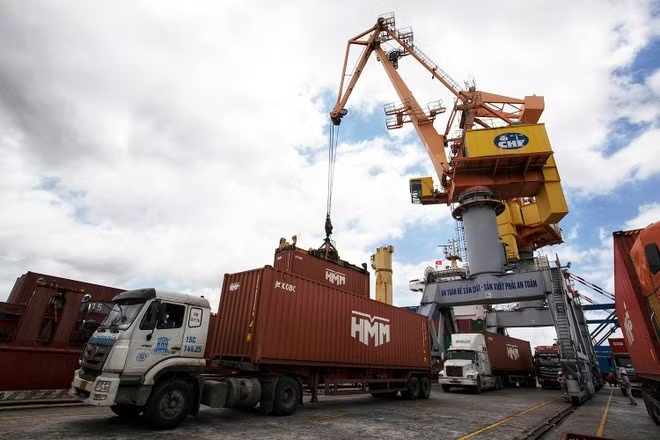
Statistics also show that many provinces continue to depend on labour-, resource-, and land-intensive growth models, with limited progress toward innovation-driven or green economic development.
Huong stressed that these disparities require urgent attention in resource allocation and regional economic coordination. Without timely policy measures, the gap between dynamic growth regions and disadvantaged areas may widen, affecting the country’s goal of inclusive development.
To address the issue, the NSO recommended accelerating the disbursement of public investment, particularly for strategic transport infrastructure projects that enhance regional connectivity. Stronger links with major growth poles would help disadvantaged provinces participate more deeply in national and global value chains.
Furthermore, localities need to proactively develop flexible growth scenarios that do not rely solely on attracting investment at all costs, but focus on economic restructuring to improve labour productivity. /.