Reputable figures in ethnic communities help strengthen national unity

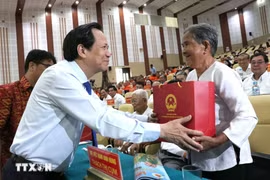
Vietnam currently has 29,626 reputable individuals within ethnic communities, who maintain close ties with local people and are selected by villages, hamlets and residential clusters.

ttxvn-nguoi-co-uy-tinjpgavif.jpg
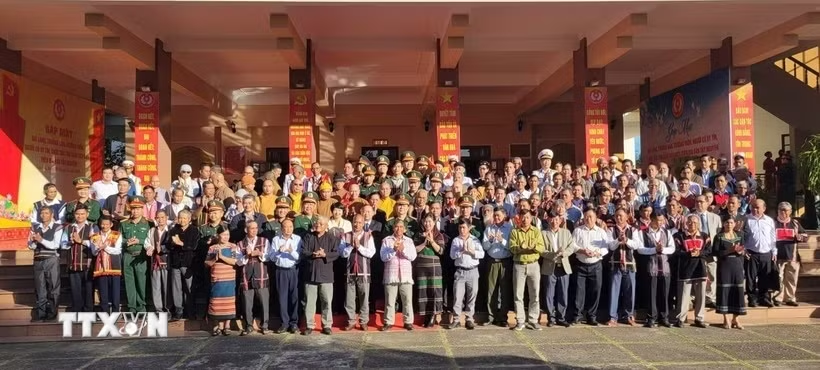
Strengthening grassroots solidarity through village elders and reputable figures in the Central Highlands. (Photo: VNA)

Hanoi (VNA) - Vietnam currently has 29,626 reputable individuals from ethnic minority communities who maintain close ties with local people and are selected by villages, hamlets, and residential clusters.

A draft submission on a decree outlining criteria for selecting and recognising reputable individuals, along with policies supporting them, has recently been released by the Ministry of Ethnic and Religious Affairs. It confirms that these 29,626 individuals are nominated in accordance with regulations by local communities, including villages, hamlets and residential groups.

During the 2021 to 2025 period, local authorities allocated nearly 500 billion VND to implement policies for these figures. They organised 1,423 conferences to disseminate information to nearly 89,900 participants, held 984 training courses attended by around 58,496 individuals, and arranged 54 study tours within districts for 1,659 participants.

In addition, 298 provincial-level exchange and study visits were conducted for 12,811 participants, while 348 visits to Hanoi and other provinces involved 12,069 individuals. Authorities also provided four types of newspapers and organised 2,841 additional information sessions, such as distributing bulletins and materials, to more than 17,500 participants. These efforts aim to enhance awareness of legal knowledge, Party guidelines, State policies, and local socio-economic development.

However, the ministry noted that the planned dissolution of district-level administrative units from July 1, 2025, has affected the implementation of policies for reputable individuals in ethnic minority communities.

For instance, Article 6 of Decision No. 12/2018/QD TTg, amended by Decision No. 28/2023/QD TTg, stipulates that district-level People’s Committee chairpersons are responsible for recognising, removing, and replacing reputable individuals. To align with the Party’s policy and current legal framework under the two-tier local government model, this authority needs to be reassigned to the commune-level People’s Committee chairpersons.
ttxvn-nguoi-co-uy-tin-3151jpga.jpg
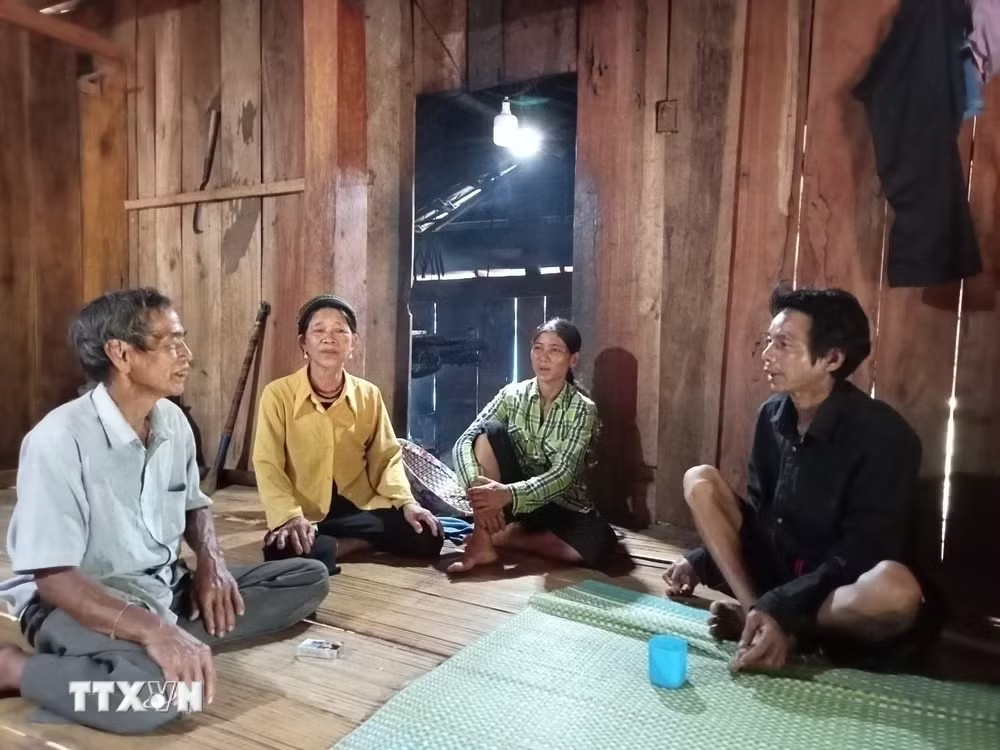
Vietnam currently has 29,626 reputable individuals within ethnic communities, who maintain close ties with local people. (Photo: VNA)

On this basis, the Ministry of Ethnic and Religious Affairs advised the Government to issue Decree No. 124/2025/ND CP dated June 11, 2025, which decentralises authority in ethnic and religious affairs. Accordingly, responsibilities for recognising and managing reputable individuals have been transferred from the district to the commune level.

While this issue has been addressed in the short term, the ministry stressed the need for further research and evaluation to develop long term, practical policies.

Similarly, the restructuring of provincial and commune level administrative units in 2025 is expected to lead to the reorganisation of villages and residential groups. The Prime Minister has tasked the Ministry of Home Affairs with developing a roadmap to streamline these units, enhance self governance, and better serve local communities.

However, such mergers may affect the number of recognised reputable individuals. The Government is therefore expected to review and revise selection criteria to ensure they remain appropriate under new conditions.

Given political, legal and practical requirements, as well as international integration demands, the ministry emphasised that issuing a decree on criteria and policies for reputable individuals is urgent. The decree is expected to institutionalise Party guidelines and State laws, meet governance requirements following administrative restructuring, and address shortcomings observed during the 2021 to 2025 period, ensuring that criteria and policies are clear, consistent and feasible./.

See more

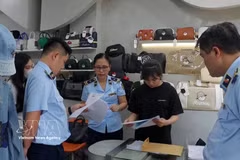
Officials from the Market Surveillance Department of Da Nang conduct inspections at business establishments in Hai Chau ward. (Photo: VNA)

No “blind spots” in crackdown on smuggling, counterfeit goods

In the Jan-April period, authorities nationwide uncovered and handled nearly 44,000 cases related to smuggling, trade fraud and counterfeit goods, while initiating 1,464 criminal cases involving 2,277 suspects, according to the National Steering Committee for Combating Smuggling, Commercial Fraud and Counterfeit Goods (National Steering Committee 389).

A delegation of 60 exemplary overseas Vietnamese from 20 countries and territories offers incense to commemorate the Hung Kings. (Photo: VNA)

Overseas Vietnamese community contributes to national unity, development

According to Chairman of the State Committee for Overseas Vietnamese Affairs Nguyen Trung Kien, many overseas Vietnamese entrepreneurs have achieved success in developed economies, gaining experience in corporate governance, advanced technologies, and international-standard operations.

A market surveillance team carries out an unannounced inspection at a fashion business in Hanoi. (Photo: VNA)

Hanoi steps up crackdown on counterfeit goods, IP infringements

The agency has set a target of increasing the number of handled cases by at least 20% compared to the same period last year between May 7 and 30. Inspection and monitoring activities will continue beyond May 30 on a regular, focused and systematic basis across the city.

Construction of Tran Hung Dao bridge, one of seven bridges spanning the Red River, launched in 2025, alongside Hong Ha, Me So, Tu Lien, Ngoc Hoi, Van Phuc and Thuong Cat bridges (Photo: VNA)

📝OP-ED: Beyond rhetoric, urban reconstruction moves ahead

Transport infrastructure development is a key task in the capital’s major development strategies, closely linked with the Hanoi Capital Master Plan with a 100-year vision and the implementation of the revised Capital Law. A series of major projects, including ring roads, urban railways, national railways and regional economic connectivity projects such as the Red River Landscape Boulevard Axis, are being implemented to enhance connectivity, promote the growth of Hanoi and the country, and lay the foundation for urban reconstruction in a modern, synchronised and sustainable direction.

 Dong Nai – aspiration to rise in new era

Dong Nai – aspiration to rise in new era

Following its merger and status elevation to Vietnam’s seventh centrally-run city starting April 30, 2026, Dong Nai is entering a pivotal phase to reposition its role and standing within a broader development landscape. More than an administrative upgrade, the move—coupled with strategic projects such as Long Thanh International Airport—is opening new space for the southern locality to make socio-economic breakthroughs, strengthen regional connectivity and reshape its development model toward services, tourism and innovation.

Passengers check in at Tan Son Nhat Airport in Ho Chi Minh City (Photo: VNA)

Vietnam to roll out pre-arrival information system nationwide

The PAI system enables international travellers to provide essential information related to their trips prior to arrival in Vietnam. Once declarations are completed, immigration authorities can analyse the data and process entry procedures in a timely manner, helping travellers avoid long queues and waiting times at immigration checkpoints.

Government approves framework to overhaul adoption law

Government approves framework to overhaul adoption law

Three broad policy directions for amending the Law on Adoption have been endorsed in Resolution 123 issued on May 6, which tasks the Ministry of Justice with drafting a revised law for Government review by June. Deputy Prime Minister Le Tien Chau will oversee the process.

The second congress of the Vietnamese Youth and Student Federation in Europe (VYSEF) on May 9 ( Photo: VNA)

Vietnamese youth in Europe strengthen ties, expand network

For 2026–2031, VYSEF aims to develop in a more professional and sustainable manner, focusing on promoting digital transformation, improving coordination of activities, strengthening connections among young intellectuals, and promoting cooperation with international partners.

Party General Secretary and State President To Lam meets with the Vietnamese community, officials and staff of the Vietnamese Embassy in Sri Lanka on May 8. (Photo: VNA)

Top leader meets Vietnamese embassy staff, community in Sri Lanka

Party General Secretary and State President To Lam praised the community’s efforts in preserving Vietnamese culture, language and traditions and called on them to uphold the national identity while integrating well into the host society and complying with local laws.