State sector to lead within a fair, competitive environment

The resolution also charts a development path for SOEs, focusing on improving both quality and scale in critical sectors. For enterprises where the State no longer needs to maintain a controlling stake, the policy direction is clear: accelerate restructuring and consolidation to create stronger entities or proceed with full equitisation.

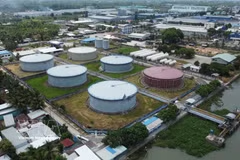
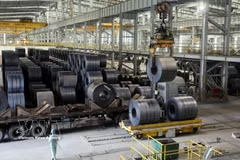
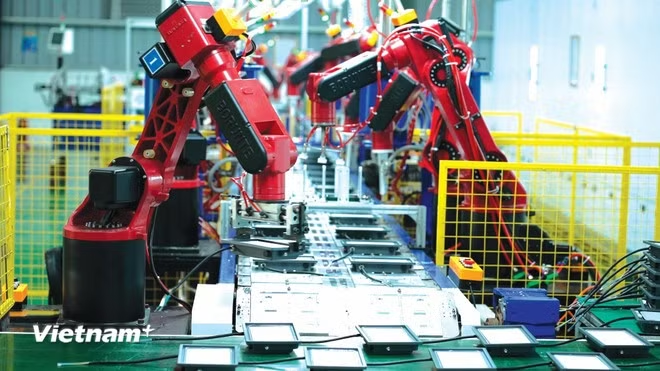
The State must maintain a stable role to safeguard economic security and enhance national competitiveness globally. (Photo: VietnamPlus)

Hanoi (VNA) – Beyond redefining the role of State-owned enterprises (SOEs), Resolution No. 79-NQ/TW issued by the Politburo sets out a broader framework for optimising public resources, emphasising that the State sector should lead through efficiency and internationally aligned governance rather than institutional advantages, while ensuring a level playing field for all economic actors.

According to Phan Duc Hieu, standing member of the National Assembly’s Economic and Financial Committee, this is the first policy document to address the management and use of State resources “in all forms.” The new perspective recognises that public resources extend beyond State capital in SOEs and are embedded across various mechanisms and channels throughout the economy.

Under this approach, the State sector is expected to consolidate its role as a key material force guiding development in strategic industries and sectors considered the “lifelines” of the economy. Maintaining a stable State presence in these areas is essential to safeguarding economic security and strengthening the country’s international competitiveness.

The resolution also charts a development path for SOEs, focusing on improving both quality and scale in critical sectors. For enterprises where the State no longer needs to maintain a controlling stake, the policy direction is clear: accelerate restructuring and consolidation to create stronger entities or proceed with full equitisation.

khu-kinh-te-van-phong.jpg
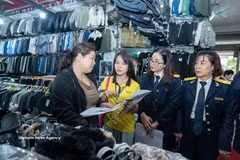
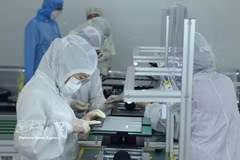
A notable target set out in the resolution is that all SOEs must adopt governance frameworks aligned with international practices. (Photo: VietnamPlus)

The relationship between the State sector’s “leading role” and the principle of equal treatment among economic sectors has long been debated. From a legal standpoint, Nguyen Hong Chung, chairman of the DVL Law firm, said Resolution 79 clarifies that the two principles are not contradictory. Instead, the State should focus on areas where the market alone cannot function effectively, such as building core infrastructure, ensuring energy security, and managing systemic risks.

In this sense, the State’s leadership is not about crowding out market players or relying on privileges, but about setting standards that enable the wider economic ecosystem to develop. To avoid overextension of resources, Chung proposed establishing five clear criteria to determine strategic sectors: national security, natural monopolies, market failure mitigation, systemic risk management, and technological leadership.

He also stressed the importance of clear “entry and exit conditions.” When effective private-sector competition emerges, the State should gradually shift from direct production to a regulatory and rule-making role, ensuring transparency and fair competition.

xv71985.jpg
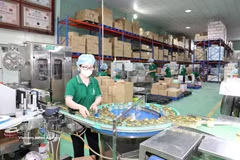
Greater transparency and adherence to market discipline by SOEs could help reduce social transaction costs and boost investor confidence. (Photo: VietnamPlus)

From a macroeconomic perspective, Minister of Finance Nguyen Van Thang, speaking at a discussion session of the 14th National Party Congress, noted that the 2026–2030 period will require the country to accelerate its development momentum. Vietnam aims to raise GDP per capita to about 8,500 USD by 2030 while sustaining annual growth above 10%, placing considerable expectations on all economic sectors.

To support these objectives, the Government issued Official Dispatch No. 06/CD-TTg at the beginning of 2026, urging State economic groups and corporations to target output or revenue growth of at least 10%. The Prime Minister emphasised that the SOE sector must act as a driving force as the 2026–2030 five-year development plan gets underway.

Alongside efforts to strengthen domestic capacity, the Government is also prioritising the full disbursement of public investment and the attraction of high-quality foreign direct investment into advanced sectors such as semiconductors and artificial intelligence. Together with the reform agenda under Resolution 79, these measures are expected to inject fresh momentum into the economy.

The resolution also calls for sweeping reforms of public service units. According to Hieu, the guiding principle is clear: The State will retain only those entities that deliver essential public services or carry out political tasks that the private sector cannot or is unwilling to undertake.

In areas where the market can operate effectively, the State will gradually step back to allow greater social participation, thereby streamlining the administrative system and improving public service quality./.
VNA

See more

SIAL Canada CEO Stéphane Thuillier (right) visits the Vietnam pavilion and speaks with a representative of the Vietnam Trade Office. (Photo: VNA)

Vietnamese exports expand foothold in Canada

The Vietnam Trade Office in Canada organised a national pavilion this year, supporting 15 companies in product displays while helping connect five others operating independent booths. The initiative is designed to enhance product promotion, facilitate partnerships and broaden market access in North America, particularly in the processed food segment.

Core site (Vinh Truong hamlet, Phuoc Dinh commune) for the construction of the Ninh Thuan 1 nuclear power plant. (Photo: VNA)

All-out push to fast-track Vietnam’s first nuclear power plants

Khanh Hoa province has also intensified oversight, introduced housing support of 5 million VND (nearly 190 USD) per month for displaced residents awaiting resettlement, and clarified responsibilities for land inventory, measurement and site selection. Notably, more than 9.8 billion VND has been disbursed to relocate 570 graves, helping accelerate clearance for the Ninh Thuan 1 Plant.

Traditional handicraft products at the Vietnamese booth attract visitors at the Paris Fair (Photo: VNA)

Vietnamese products shine at Paris Fair

Amid deepening international integration, the presence of Vietnamese enterprises at the annual Foire de Paris continues to affirm the appeal of Vietnamese goods and culture in the French market. The event also provides an opportunity for Vietnamese businesses to directly engage with French and European consumers, thereby strengthening their foothold in this promising market.

Do Gia Thang, Secretary-General of the Vietnam Business Association in Australia (VBAA) and Chairman of the Vietnam–Australia Young Entrepreneurs Club (Photo: VNA)

International Financial Centre - Vietnam's strategic move in global race: Expert

Vietnam is pursuing a “one centre – two destinations” model. Ho Chi Minh City is envisioned as a comprehensive financial hub linked with a free trade zone, while Da Nang will focus on innovation, fintech, digital assets and serve as a testing ground for new financial models. This complementary structure allows Vietnam to develop a tailored approach rather than replicate existing financial centres.

Financial buildings in central Ho Chi Minh City along the Saigon River, facing the Thu Thiem peninsula in An Khanh ward. (Photo: VNA)

Ho Chi Minh City attracts significant investment from France

Ho Chi Minh City is emerging as an attractive destination for French investors, particularly in infrastructure, sustainable urban development and green transition. French investment of more than 2.2 billion USD is contributing to economic growth and opening up broader prospects for long-term cooperation.

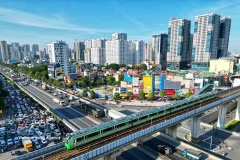
An aerial view of a crossroads in Hanoi (Photo: VNA)

Hanoi pushes SOEs to lead breakthrough growth

According to experts, Resolution 79-NQ/TW reaffirms the state economic sector’s leading role in the socialist-oriented market economy. The real shift, however, is moving SOEs from simply “holding” assets to actively “leading” development, and from traditional “management” to enabling growth across the board.

A representative of the Coast Guard speaks at the meeting. (Photo: VNA)

Ho Chi Minh City steps up decisive action to lift IUU “yellow card”

The city will fast-track eCDT implementation, study the feasibility of a fishing port in Can Gio, and propose granting accounts to border guard stations to strengthen oversight of vessel movements. Enhanced inter-provincial coordination, particularly with Lam Dong, Da Nang, Quang Tri and Ninh Binh, was also emphasised to tighten control and strictly handle violations, especially those related to VMS.

An overview of Prime Minister Le Minh Hung's working session with the Ministry of Finance on April 29 (Photo: VNA)

PM emphasises need for governance shift to drive growth

Ministries and agencies must enhance forecasting capacity, adopt more responsive policy tools, and fundamentally rethink how policies are designed and executed in a rapidly evolving environment, said PM Le Minh Hung.

Long Thanh International Airport is currently under construction and is expected to be put into operation by the end of 2026. (Photo: VNA)

Dong Nai rolls out 4.3 billion USD plan for key transport links

Dong Nai will implement three major transport projects with a total capital exceeding 110 trillion VND (4.3 billion USD), aimed at strengthening connectivity between Dong Nai, Ho Chi Minh City, and key economic regions in the Central Highlands, central, and southwestern regions.