Hanoi (VNA) – “Phu Quoc offers the high and the low, the blissful and the bonkers, the relaxing and the oddly riveting”. That was the impression left on Cathy Adams, News Features Editor, Travel at British newspaper The Times, after a journey through the rapidly changing Vietnamese island.
In an article titled “The bonkers Asian island that won’t stay off-grid for long”, Adams portrays a Phu Quoc full of contrasts that somehow sit comfortably alongside one another: some of Asia’s finest beaches beside dazzling spectacles; secluded, peaceful resorts just a short distance from an “unhinged” world of fireworks, jet skis and European-inspired architecture.
“A bit like staying on a film set”
The British journalist’s first impression of southern Phu Quoc did not begin on a deserted beach, but with a spectacle far removed from conventional notions of an island holiday.
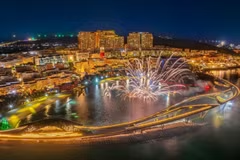
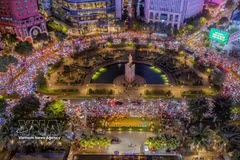
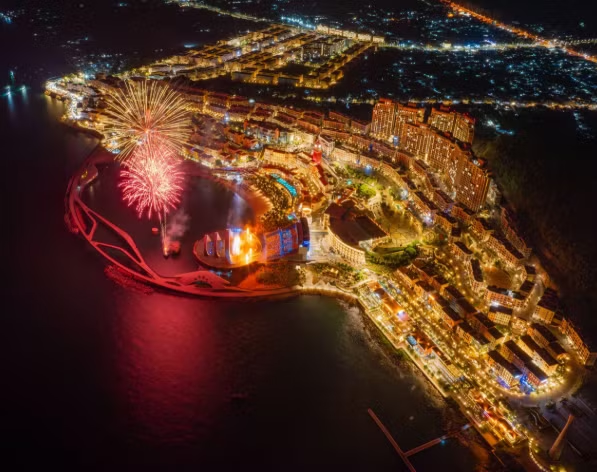
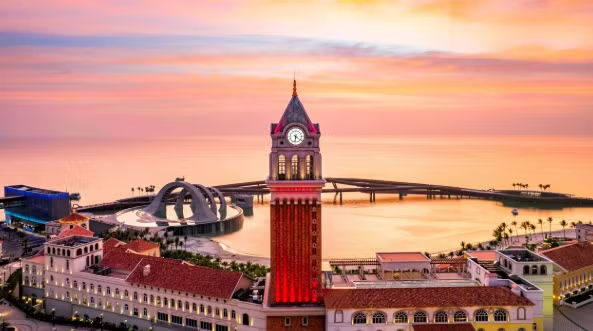
“Dusk in Sunset Town is not what you might expect,” Adams writes at the beginning of the article. Standing on Kiss Bridge – a nearly 800-metre structure extending out over the sea, with two separate sections drawing close without touching - she watches open-mouthed as the spectacle unfolds below.
Performers in futuristic costumes race across the harbour on jet skis, trailing bursts of fireworks behind them. Above the water, flyboard performers wearing giant butterfly wings skim across the sea and trace figures of eight in the air amid beams of blue light, while fireworks continue to explode over the bay.

What surprises Adams even more is that the fireworks show does not happen just once, but twice every evening.
From Kiss Bridge, the backdrop evokes St Mark’s Square in Venice, with a red-brick campanile illuminated by sparks from the fireworks. Walking through Sunset Town – which Adams describes as more akin to a “mini Sorrento” – she says she feels like a “reverse Marco Polo”, standing in the East and encountering an eccentric new version of the Old World.
In the author’s characteristically playful description, the whole thing may be “gaudy, gauche but good clean fun”. It is extravagant, bold and somewhat bonkers, yet also pure entertainment that makes it difficult not to smile – particularly for families travelling with young children.
Leave behind that world of sound and light, however, and Phu Quoc immediately shifts into a different rhythm.
It is not the atmospheric Vietnam of Hanoi, the nostalgic charm of Hoi An or the distinctive waterways of the Mekong Delta. Instead, the island has built an appeal of its own around high-end beach resorts at relatively accessible prices – places where, as Adams puts it, there may be “nothing more pressing to do than move between your sunlounger and the bar”.
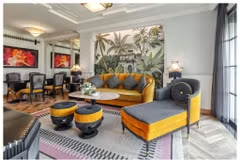
At Kem Beach, Adams is particularly struck by JW Marriott Phu Quoc Emerald Bay, a resort designed by architect Bill Bensley around the fictional story of a 19th-century French colonial university named after the naturalist Jean-Baptiste Lamarck.
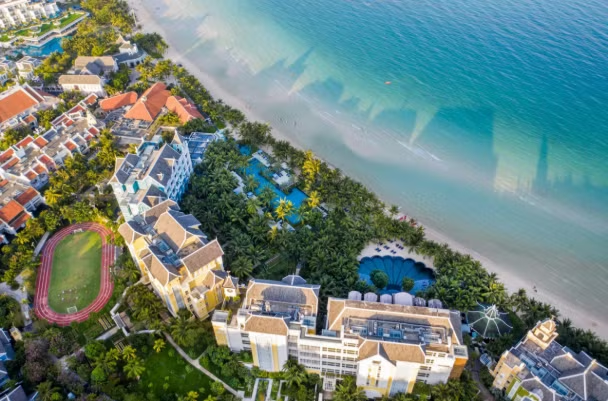
Yellow, pink and blue accommodation blocks become “departments”. The bar is the department of chemistry, while the gym represents physical education. Adams and her family stay in the “conchology” section, surrounded by pictures of shells and other whimsical details.
Guests are referred to as “students”, receive fresh coconuts from the “dean” – the general manager – and are presented with a “graduation” certificate when they check out.
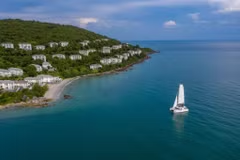
The resort’s eccentric, theatrical aesthetic leads Adams to conclude that it is “a bit like staying on a film set”. Yet beyond the elaborate concept, what ultimately wins her over is Kem Beach itself, with its teal water, gently shelving seabed and sand so fine that it slips easily through her fingers.
An island stepping onto the global stage
Behind these seemingly contrasting experiences lies a Phu Quoc developing at a pace that is increasingly difficult to ignore.
Adams points to Sun Group as one of the forces reshaping an island once known largely for pearl farming into a major tourism, resort and entertainment destination.
The destination’s growing appeal was reflected in an 80% increase in searches for Phu Quoc reported by Expedia in 2025. Across the island, newly built roads are making travel easier, while international hospitality brands including Ritz-Carlton and Rixos are planning a presence in the years ahead.
Phu Quoc International Airport is also being expanded, while air links connecting the island with major Asian hubs such as Hong Kong, Bangkok, Seoul, Taipei and Singapore continue to grow.
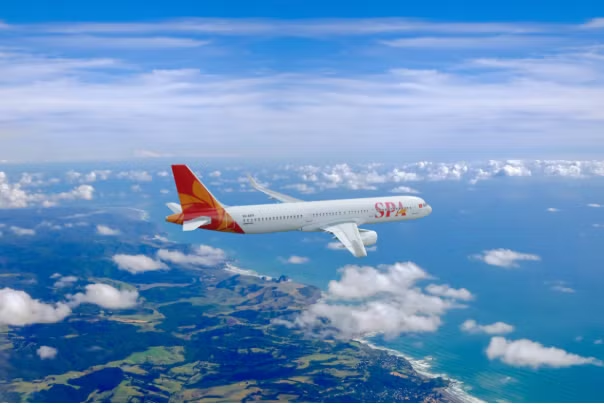
The Times also highlights the arrival of Sun PhuQuoc Airways and its plans to build a wide-body fleet aimed at launching long-haul services to Europe. In the original article, Adams notes that the airline signed an order for 40 Boeing 787 Dreamliners for long-haul European routes. These developments point to ambitions for Phu Quoc to move beyond its position as a regional resort destination and towards a place on the global tourism map.
At the end of her journey, Adams describes Phu Quoc as a place that offers “the high and the low, the blissful and the bonkers, the relaxing and the oddly riveting”.
After all the dazzling performances and unconventional architecture, the journalist finds that some of the island’s greatest pleasures lie in its simplest experiences: staying happily ensconced at a beautiful resort, swimming in reliably warm water, enjoying a cold beer, and spending an evening in Sunset Town watching the lights and fireworks erupt over the sea.
Those seemingly incompatible opposites have come to define the island’s character: tranquil enough to make visitors want to linger, yet unusual enough to keep their curiosity alive.
“I can’t wait to see what it looks like in another ten years,” Adams writes.
Perhaps that is also the most fitting conclusion for Phu Quoc today: an island that may not remain off the global tourism map for much longer, yet still leaves visitors eager to see what unexpected development comes next./.